Category: Japan

  • 10 Differences Between Elementary Schools in Japan and the Philippines

    1. Teachers in Japan do not have a permanent school assignment. They change schools. They can only teach in one school for three to four years the longest. They have to move to another school within the city or the neighboring cities. New teachers change from one to three years and veteran teachers who are about to retire can stay in the same school for up to seven years.

    In the Philippines, most teachers stay in their assigned schools until retirement, unless they want to be transferred to another school for personal reasons or for promotion.

    2. Teachers in Japan change grade level assignments. Not only that teachers have to change schools in Japan, they also have to change their grade levels assignments. For example, a teacher who teaches first grade this year will most probably be teaching second year the following year. They follow the students they are teaching. Few teachers remain in the same grade for consecutive years.

    Whereas in the Philippines, most teachers stay in the same grade level until retirement. It is not uncommon for siblings to have the same first grade teacher.

    3. Class schedule in Japan changes everyday. Class schedule in Japan is not fixed for the whole year unlike in the Philippines. The schedule is announced a week or a day before usually on Fridays. It is very easy to change the class schedule in Japan because all subjects are taught at equal amounts of time. Each subject is taught at 45 or 50 minutes. Unlike in the Philippines, academic subjects like Math and Science are taught up to one hour or longer and shorter time for non-academic subjects like Music or Home Economics.

    I was very surprised about this when I came to work in Japanese public elementary schools because in the Philippines we decide on the schedule at the beginning of the school year. Teachers gather and spend a good amount of time making the schedule that would fit every teacher’s individual schedule and every class’ individual schedule. It’s not easy to make the schedule work for every teacher and every class. Once decided, we follow this schedule from start (June) to end (March) unless there are important changes that we need to do.

    4. Japan is a country that values equality and uniformity. Equality in schools is observed through equal treatment of students in terms of opportunities and participation in activities. For example, on a Sports Day, all students participate regardless of their physical abilities. Everyone can participate in racing whether he runs fast or slow or even in wheelchair. Whereas in the Philippines, competition is common. We have all sorts of school competition (Quiz Bee, Spelling, Beauty Contest, Money Contest, Sports Meet, etc.) which is not very common in Japan. It is a battle of the fittest in the Philippines. And only the fittest and the brightest shine. Uniformity is also a very important attribute of Japanese schools and the whole society in general. This can be seen through uniform designs of school bags, school shoes, haircuts and even hair color in junior high schools and high schools. Wearing black suits over white inner is common and considered standard for students on the job training and for those looking for a job. Subtle, basic colors are the staples. It is not pleasing to stand out like a sore thumb in Japan, which is the opposite in the Philippines. Filipinos like individuality and assortment and we like to stand out. Medatsu is a Japanese word which means to stand out. In Japan, you don’t want to be a medatsu, but in the Philippines, being a medatsu is encouraged.

    5. Outdoor and indoor shoes shoes culture in Japan. The footwear worn from the house and outdoors will not be allowed to be worn inside the school buildings. Each class/student has their own shoe box. Upon entering the school building, outdoor shoes are changed to indoor shoes. Japanese are very particular about cleanliness. Indoor shoes help to avoid dirt getting inside the school building from outside.

    In my native land, this custom doesn’t exist. Although some individual teachers require their students to bring indoor shoes, and have their own classroom shoe box, this is not considered a standard for everyone to follow. It’s all up to the teacher or the principal.

    6. Japanese teachers should be able to play the piano and swim before they can pass to be a licensed teacher. In Japan, each elementary school teacher is expected to teach music, play the piano of course and to teach swimming in the school’s swimming pool.

    Most public schools in the Philippines don’t have a single piano. Even the small private schools don’t. Teachers teach music even without the ability of playing any musical instrument. It is not a requirement. But, Filipinos love to sing. And I wonder why even though we lack many musical instruments, which sometimes we can only see in pictures or drawings that teachers ask the students to draw (draw the three types of musical instrument: brass, wind and percussion and make a scrap book in music class), we can still sing out loud from the bottoms of our hearts. 🙂 Many Filipinos are famous singers locally and internationally.

    For an elementary student in the Philippines, having a swimming pool in the school is like living the dream. Filipinos love swimming. Most occasions like birthdays we like to celebrate it in the beach. But, unlike Japanese, we don’t learn basic swimming skills in school. We learn it on our own. Pretty sure by just going to the beach often or the nearby river. Beaches in the Philippines are open all throughout the year and we even have night swimming. This is a big surprise to the Japanese people since they can only go swimming in the beach in summer. Night swimming is rare. Swimming schools are open all throughout the year but swimming pools are only open in summer.

    7. School lunch in Japan is prepared at schools or school lunch centers. School lunch is one of the best features in Japanese schools. I have a different detailed blog about it here. I like Japanese school lunch. It saves me from the hassle of preparing my own packed lunch and saves me some yen since school lunch is cheaper compared to buying food outside. It’s nutritious, well-balanced and well prepared. Japanese students help in the distribution of their school lunch. Whereas in the Philippines, students can opt to bring their lunch boxes, buy at the school canteen or go home and eat if their houses are close to school.

    8. Japanese children walk to school on their own (with exemption of those living in far-flung countryside). Chaperon and giving children rides to school are greatly discouraged and most often not allowed in Japan. Students go to school by groups according to their area of residence. In the beginning of classes in April, parents and guardians will accompany grade one students on their way to school but only up to few meters away from their houses. Not all the way to school.

    It’s a different scene in the Philippines. In the beginning of class, about 90% of grade one students are taken to school by their guardians. Guardians even stay to watch the class from the classroom windows. Although this is discouraged by the school, some parents couldn’t help but watch their kids in class. In the weeks that follows, fewer guardians do this. Many children, especially lower grades, are taken to school (up to the school gate) by their guardians all throughout the year. In some private schools, there are car pool companies that take children to school for a specific amount of fee.

    The difference lies about the distance and safety. In Japan, students should go to the nearest elementary school in their area, not in any school they want to go unless they want to go to a private school. It’s usually a few minute walk from their houses. Except if you’re living in the inaka (country side) where your school can sometimes be as far as an hour walk. In the cities, there are traffic volunteers (usually the elderlies) that guide students in their way to school making sure of the safety of the road. Parents, teachers and principals also help in doing this. This is called ‘koutsu jidou’ in Japanese. Parents take turns doing this. It is very common to see the elementary school principal guiding the traffic and greeting students in front or near the school gate. In the beginning of classes, usually the whole month of April, teachers accompany students halfway on their way home where guardians are waiting to take them up to their houses. This is only done in the beginning and when students get used to it, they go to school and go home with their own groups. Whereas in the Philippines, many parents opt to send their children to central schools, the big schools in the heart of the city, which is very far away from their houses and nearly impossible to get to by foot. With the distance problem and the traffic, it is dangerous and impractical to walk to school.

    9. Recess time in Japan is not eating time. Classes in Japan usually starts at 8:30 in the morning. Four subjects are taught in the morning which usually last 45-50 minutes with 10-15 minutes interval. The nakayasumi is the mid-break and the longest break. During this time, students can go to the playground or to the library or just relax and have a break. In the Philippines, subjects are usually taught consecutively without intervals (for example, schedules are 8:00-9:00, 9:00-10:00) and during the recess time, students usually eat their baons (bring to school snacks), or go to the school canteen, or buy at the canteen tray delivered in their very own classroom. Baon can be food or money or both. This is a part of Philippine culture that most school children look forward to and recess time is jokingly everyone’s favorite subject.

    10. Bringing money to school is okay in the Philippines but not in Japan. As mentioned above, students can buy food to eat during recess time in the Philippines and students can bring money as much as their parents can afford to give them. In Japan, it is uncommon for students to bring money to school and if they do, there is a limitation, for example, elementary students can only bring ¥100, junior high schools ¥300. There is nothing to buy at the school so there is no need for money. Japanese students are also not allowed to bring their own snacks or use accessories or bring CDs etcetera.

    These are only few of the many differences between the elementary and junior high schools in Japan and the Philippines. These differences are of course very normal and not written to make one country look better or bad. These differences are part of the culture and that is what makes each country unique.


  • Valentine’s Day in Japan and the Philippines

    Valentine’s Day in Japan and the Philippines

    There is a huge difference between how the Philippines and Japan celebrate Valentine’s.

    What to give/receive

    In the Philippines, Valentine’s is more on flowers – roses as the main star. With matching teddy bears and chocolates on the side. And love letters too.

    In Japan, it’s mainly chocolate. Not very much on flowers.

    Who give

    Ladies are feeling princesses on Valentine’s Day in the Philippines because they are showered with love. Boyfriends, husbands and admirers are expected to give something to their girlfriends/wives. Teachers also receive presents from their students. And students are also encouraged to give something like a card to their parents as well.

    In Japan, it’s the opposite. Girls give to boys, and ladies to gents. There are three types of chocolate given on Valentine’s Day in Japan:

    1. Honmeichoko – for the opposite sex you like/love 2. Girichoko – from the word “giri”, meaning obligatory, like the subordinate to the boss. co-workers, not necessarily “love”, and 3. Tomochoko– from the word “tomo”, meaning friend, given between friends usually between girls. And this is getting more popular than honmeichoko.

    The Craze

    In the Philippines, you can feel that “love is in the air” in February. Shops, malls, restaurants, schools and offices get decorated with cupids and hearts.

    Come Valentine’s Day, red is the color. And many singles want to find “the one” to date or to settle down. Students celebrate by buying flowers and presents for their teachers. Sometimes, classes are canceled to give way to a Valentine Party.

    That would never happen in Japan. No disruption of classes because it’s Valentine’s. Not that I know of so far. Valentine’s Day is a somewhat ordinary day.

    Many couples go on a dinner date in the Philippines and many proposals happen too. I guess it’s similar in Japan but I just don’t see it or feel it.

    In Japan, girls (and their mothers) get really busy on Valentine’s Day (or the day before) making the best homemade chocolate.

    If you go to the supermarkets, the first thing you see on displays are arrays of chocolates and baking materials. It’s the season for chocolates. Actually, right after New Year’s, shops change to Valentine’s mood.

    Of all these differences, the girls giving chocolate to boys and expressing their affection is one thing that is hard for me to do. It’s not that it’s bad but it’s just something I did not do growing up. I was taught to just wait and never express your feelings to the opposite sex.

    But maybe it’s changing nowadays.

    What do you think?

    Would you rather be the one to give or receive?

    How do you celebrate Valentine’s in your country?

  • Why most Japanese people don’t speak English well?

    Why most Japanese people don’t speak English well?

    You might be surprised and ask yourself this question when you visit Japan for the first time.

    Having lived in Japan for many years now, I would like to share my thoughts on this matter. There are many reasons why Japanese people don’t speak English well.

    1. Japanese Sense of Nationalism

    First of all, I observed that Japanese people are very nationalistic. They love everything about their country and they are very proud to be Japanese. I am sure I am not the only English teacher here who encountered a student who resists learning English and says ‘Why do we have to speak English? We are Japanese!’ or ‘This is Japan! Speak Japanese!’

    2. Music Culture

    Learning English songs is one way to speak English fast. We learn phrases and new words through the lyrics. It helps us memorize lines and learn pronunciation naturally.

    While we in the Philippines are very familiar with English songs and foreign singers as the influence of American music is strong, Japanese have their own strong music trend and popular bands and singers. I was surprised that nobody knew Bruno Mars or his song ‘Count on Me’ among my students, young and adults as well. When I played ‘Always’ by Jon Bon Jovi, it was their first time to hear it. Or maybe my choice of music is just bad. Well, I just played the songs I like and I thought everyone knows it. Well, not in Japan.

    The influence of Korean artists, the K-pop groups is stronger than American music in Japan. I remember the phrase ‘Korean invasion ‘ that we used when we went crazy over Korean dramas in the Philippines. I was one of those who watched Jewel in the Palace, Full House, and many other Korean dramas. In Japan, it’s not Korean dramas but K-pop singers. This makes some Japanese especially the younger generation, interested in learning Korean rather than English.

    3. Shy Culture

    Learning a language is learning a culture. Most Americans and foreigners in general, are assertive and expressive people. They speak their minds and are not afraid to voice their opinions, using language as a tool. On the other hand, most Japanese are rather reserved and shy. They keep their opinions to themselves. They rather follow and listen than question. Very passive. While we were trained to orally participate in class in my elementary and high school years, I observed that it’s not very much the practice in Japan. Teachers mostly dominate the classes thru lecture method and employees seldom raise questions during meetings.

    4. Perfect English Concept

    “If you can’t speak English right, better not speak at all.” I’ve heard this line many times already. Even in my country. Many Japanese and second language learners are afraid to make grammatical mistakes when using English. Being looked down awaits to those who dare to. “It’s embarrassing.” In this case, many prefer to say nothing. Closed lips. Mum. Sshhh.

    5. English is taught mainly in Japanese

    Whether it is in elementary, junior high school, senior high school or university level, do not be surprised if one day you observe an English class, fully taught in Japanese. The books are in Japanese, discussions in Japanese, tests are in Japanese, what else is left? Greetings? That, too, is surely in Japanese. “Kirits! Rei! Onengaishimasu.” If there are institutions that use English, it’s very few and it’s not all English. Maybe 70-30, with Japanese as majority.

    6. English Teachers Don’t Speak English

    Not once, not twice but many times, I encounter a Japanese English teacher who blatantly (sometimes proudly) admit they can’t speak English. Yes. You read it right. I was so surprised the first time I heard it. Of course not all Japanese English teachers are proud non-English speakers. Most of them can actually speak (they studied it in the university ) but won’t. It goes back to the sense of nationalism and the perfect English concept. Why speak English when they are all Japanese and they are in Japan? English Department Teachers meetings are, of course, conducted in….Japanese.

    7. The Need to Speak English

    In the Philippines, there is a need to learn and speak English. Elementary and high school subjects like Mathematics, Science and English are taught in all English. In the university, all subjects except Filipino are taught in English. If you apply for a job, you have to have good English communication skills to have an edge and land a decent job. Many Filipinos go abroad to work, in which the universal language, which is English, is used.

    On the other hand, in Japan, all subjects are taught in Japanese. If they master the Japanese honorific language which is used in the business world, that is sufficient enough. Only recently that companies want employees with English speaking skills. Most Japanese are not interested in working abroad. Not even go visit English speaking countries. Some of my students in a little bit challenging junior high school told me why they don’t like English. They love Japan. They live and work in Japan. They listen to Japanese songs, watch Japanese dramas and movies. Why do they need English? Not even interested in having foreign friends/boyfriends/girlfriends. If there are those who are very interested in English, and have all the reasons to learn the language, only a few.

    These are only my opinions and observations based on my own experience in staying and living in Japan for some time now. If you have your own, don’t hesitate to share.

    To my Japanese friends and other ESL learners, who wants to speak English, I have some tips for you.

    1. Don’t just study but speak it. Just like driving, you have classes to learn the basics, but you will never know how to drive if you don’t get into the car and actually drive it. English (and any language you are learning) is the same. Speak it to learn it.

    2. Don’t be afraid to make mistakes. Even the native speakers commit mistakes. Ask yourself: Do I speak my mother language the proper way? Oftentimes no. We don’t. Language is a tool. It is used to communicate. To connect. What’s a small mistake will do but make you learn and become better. It is the mistake that we remember and learn to not make it wrong again.

    3. Accept that we are not perfect. If we don’t speak English perfectly, that means we speak another language, not just English. We are bilingual or multilingual. Take pride of that gift.

    4. Discover your interest in the foreign culture. Most often than not, the reason why we want to learn a language is our interest to learn the culture. It might be music, food, religion or tourism. Before, I had no interest in learning Spanish but when I discovered we have many similar words, that’s when I got so interested in the language. I also fell in love with Latin telenovelas and music. I love Thalia!!! As for my interest in Japanese, I love how interesting Japanese people are, their discipline, their politeness. And the beauty of Japan never ceases to amaze me.

    Speaking a foreign language or not being able to is not what’s the most important point. What matters most is our understanding and openness why some people do speak and some people don’t. No hate. No judgement. Just realities we have to face when we step into a new culture.

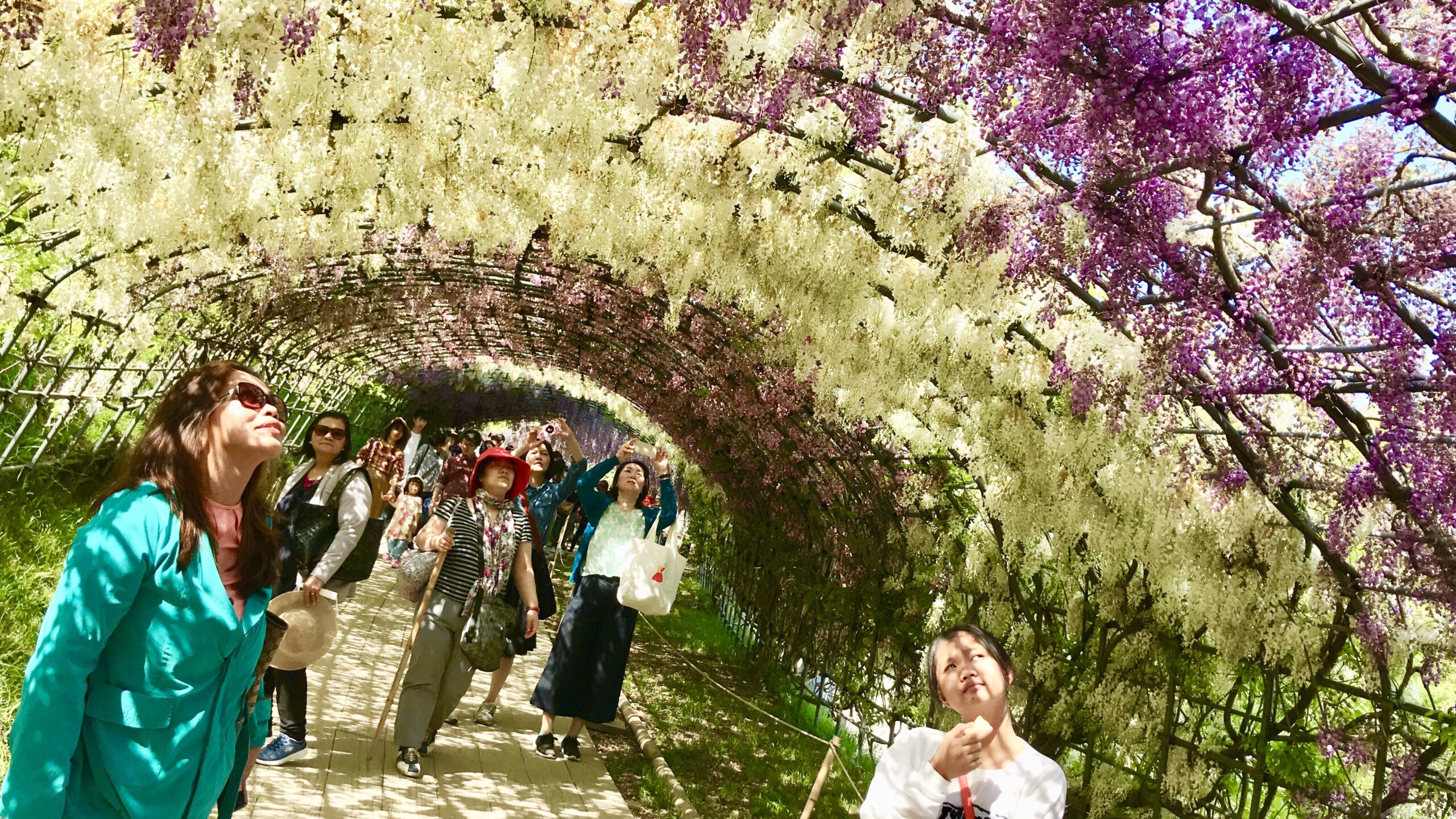
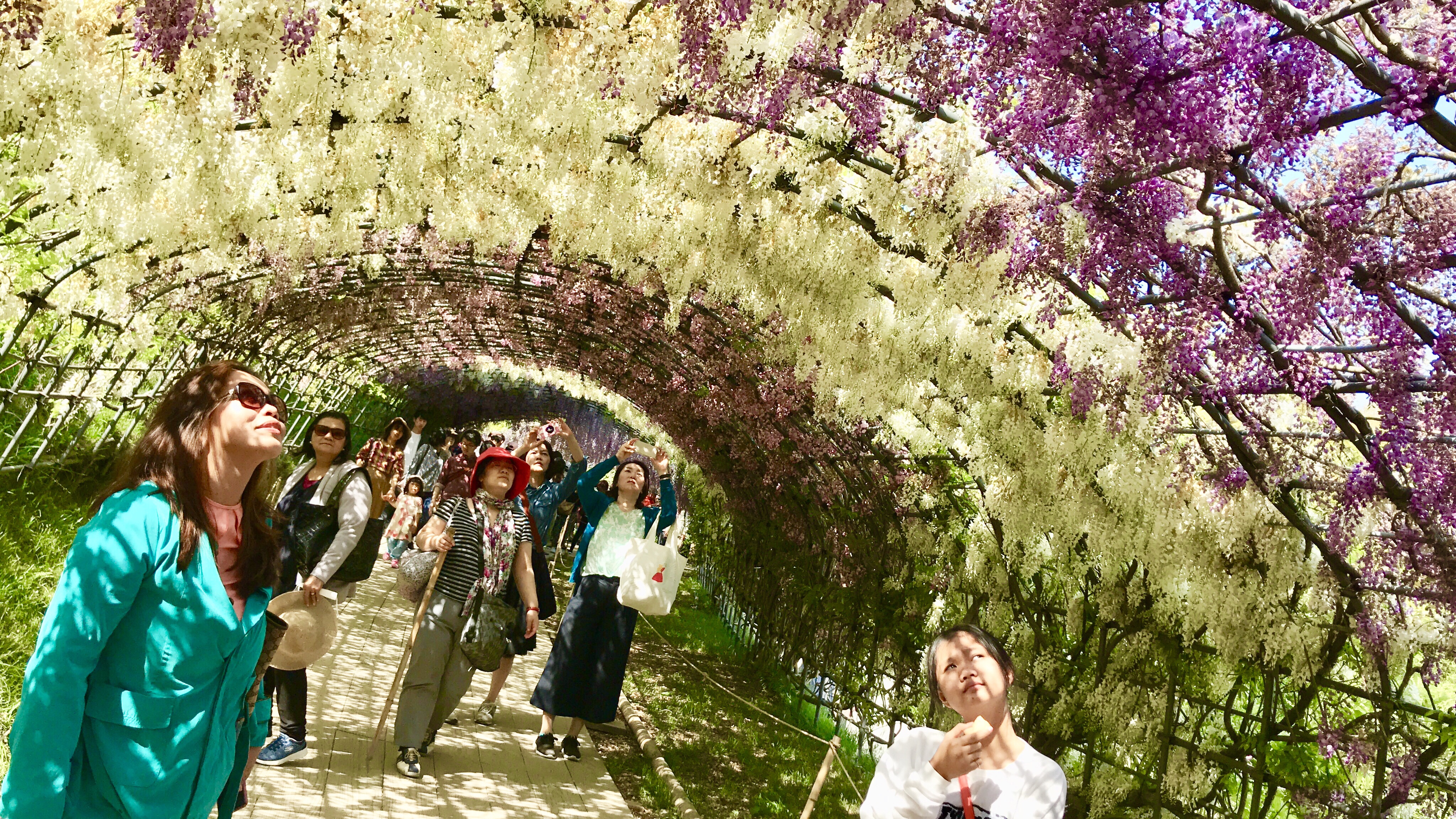
    Wisteria Gardens in Kitakyushu, Fukuoka Prefecture, Japan
  • New Year’s Celebration in Japan and the Philippines

    As a Filipina living in Japan for many years now, I can compare how New Year’s Day is celebrated in both countries. There are few similarities and many differences between Philippines and Japan celebrating New Year’s Day that I would like to share according to my observation and experience.

    Decorations and Preparations

    In the Philippines, whatever is decorated for Christmas will be carried over for the New Year’s. In fact, the greetings “Merry Christmas and a Happy New Year” is commonly displayed in houses, offices, shops, restaurants and malls.

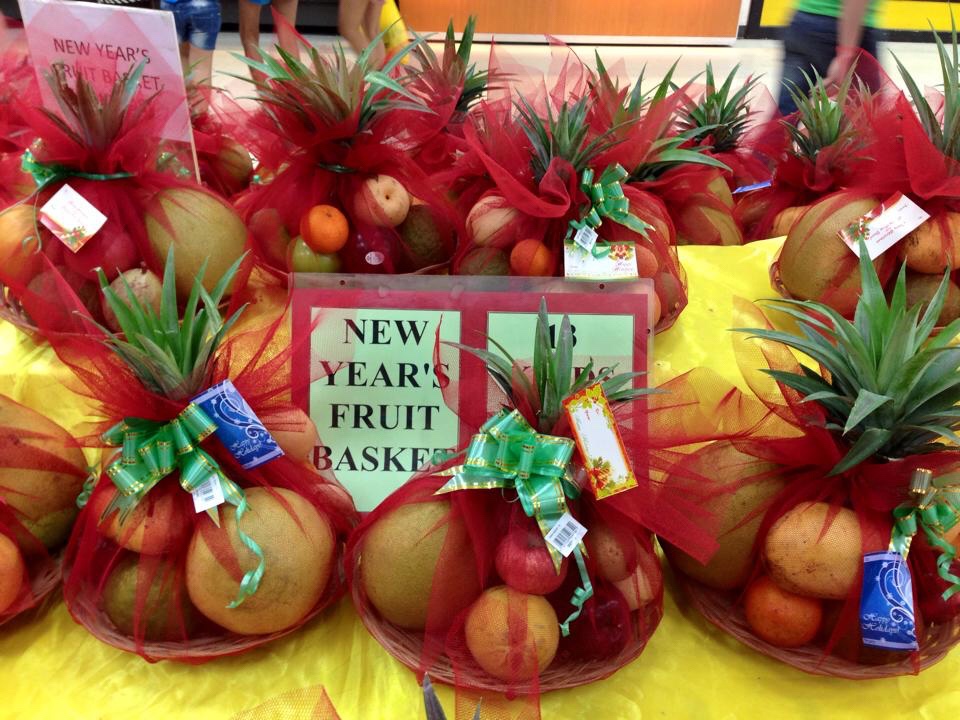
    To welcome the year, a tradition of displaying 12, which is recently changed to 13 round fruits – we call the lucky fruits on the dinner table on New Year’s Eve, is practiced in the Philippines. 12 represents each month and 13 represents an extra month which means abundance. Round signifies infinity, no beginning and no end of good luck and good fortune. Round objects are considered lucky so it is common to see people wearing polka dots. Round and sweet foods like leche flan, puto cheese, kalamay are considered lucky.

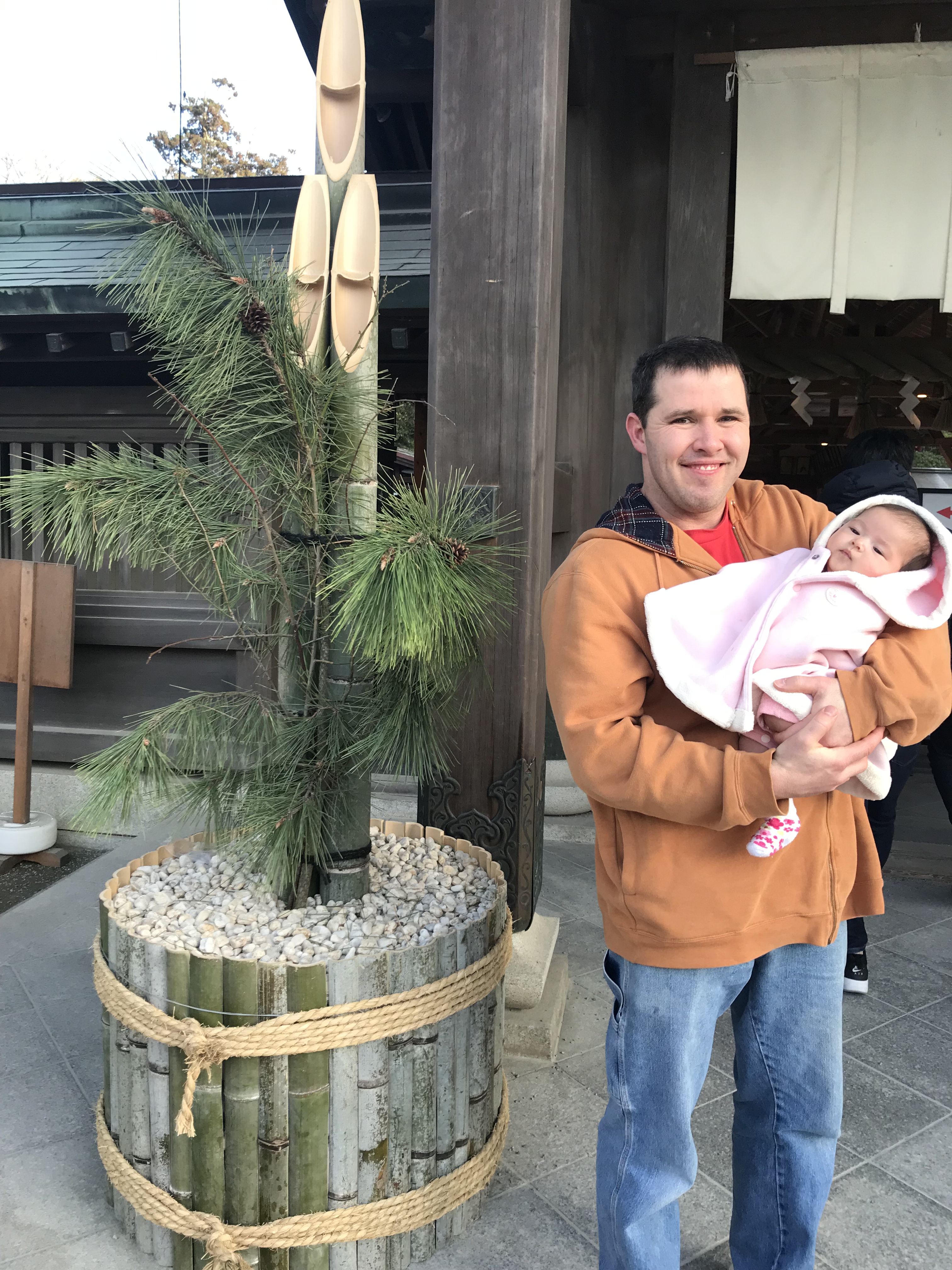
    In Japan, New Year’s is the biggest event of the year. Japanese start preparing for the New Year’s by doing a general cleaning which they call osoji. People clean their houses and offices from the main door to the windows, waxing floors , bathroom and everything in between. Shimenawa (sacred straw rope) also called shimekazari and kadomatsu (bamboo and pine decoration) are seen in main doors and gates. Shimenawa are seen in shrines all throughout the year but houses only display these in New Year’s season. There is also kagamimochi (mirror rice cake) and a display of the year’s animal symbol. These decorations are believed to welcome the ancestral spirits and gods to enter the home.

    Kadomatsu at Munakata Shrine

    Food

    In the Philippines, people rush to the market at the break of the dawn on the 31st and expect the supermarket to be flooded with shoppers to prepare for media noche. There is a long list of food prepared for media noche but the regulars are lechon (whole roasted pig), pansit (noodles), lumpia(spring rolls), fried chicken, macaroni salad and spaghetti and of course the lucky fruits. Mostly people prepare food that are either round and sweet and those believed to make the year lucky and abundant.

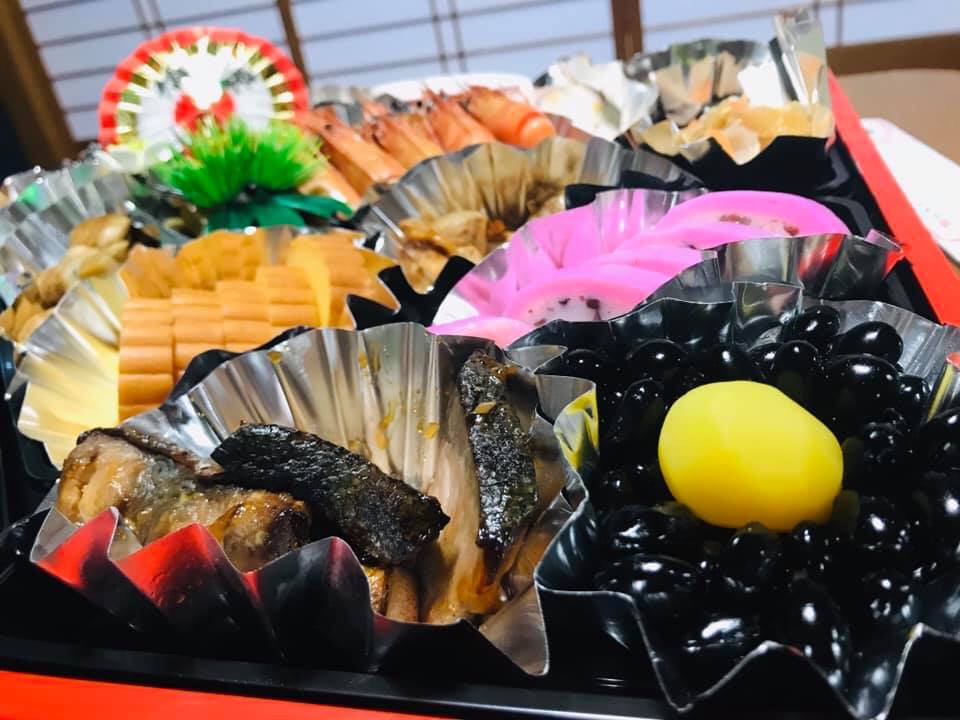
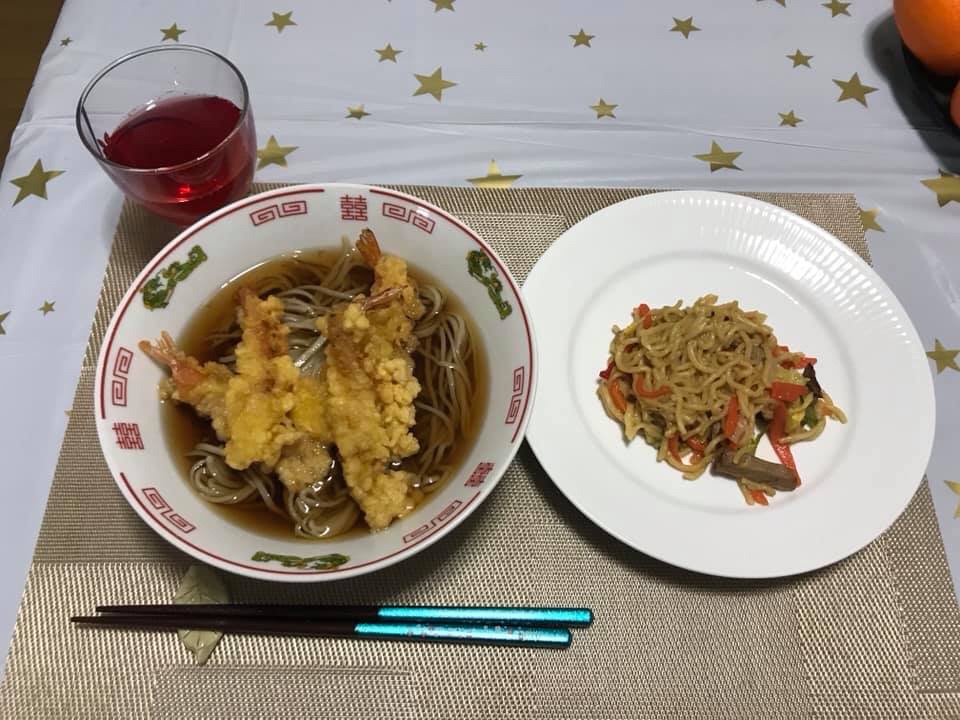
    In Japan, there is toshikoshi soba and osechi ryouri. Toshikoshi soba is eaten on New Year’s Eve as a symbol of crossing to a new year. Osechi consists of many different kinds of food in a box. Each food carries a meaning. For example, shrimp means long life as the shrimp is curved like an old person.

    Our first osechi ryouri in our house 2018-2019
    Toshikoshi soba (Japan) on the left and pansit (Philippines) on the right

    New Year’s Eve

    It’s hard to keep up with the energy of the Filipinos when it comes to welcoming the new year. The most exciting countdown begins hours before midnight ( three more hours, two more hours, one more hour) and the closer it gets, the higher the energy and the louder the noise. Party starts when darkness hit or even before that. The neighborhood turns into karaoke bar and disco bar with people drinking and dancing on the streets. The ten minutes before 12 and the first ten minutes of January first is the noisiest, loudest, craziest, happiest time of the year. Before the ten-second countdown, people scream of excitement, get ready to jump (for those who wants to get tall), turn on all the lights in the house, turn on the car or motorcycle engine, blow the horns incessantly, get something even the pot cover to make noise. Everyone counts the last ten seconds “10-9-8-7-6-5-4-3-2-1! BOOM! The fireworks, the blowing of horns, the noise of cars and motorbikes, the jumping, the dancing, the shouting “Happy New Year” is endless. You don’t say it once, nor twice, nor three times. You say it to everyone in the house and to the neighbors. People go crazy with New Years. And many goes live on Facebook. It is believed that noise shoo the bad lucks. Some people wear polka dots (rounds objects are lucky), put coins in their pockets and shake them to make noise, and sometimes throw coins for the people to catch (rain of money – paulan ug kwarta). And after the countdown is the feast. Everyone gathers in the dinner table for the media noche.

    This scenario might not be the same in the entire Philippines. I am speaking of my experience and my neighborhood and I am sure many can relate.

    I remember the first time my husband spent New Year’s in the Philippines, he couldn’t stand the noise. It was too much for him it gave him headache. He wanted to go somewhere quiet but I told him, it’s the same everywhere we go.

    On the contrary, in Japan, New Year’s eve is a very silent night compared to the Philippines. All is calm, all is normal.

    Last year I spent New Year’s in our newly-bought house (the reason why we spent New Year’s in Japan). I was kind of disappointed or let’s say frustrated. It was just me, my husband and our daughter (my step daughter). Yes, we had our special dinner. I cooked special menu. But when it was almost 12 o’clock my energy as a Filipino was really high, I was the only one who was very excited to welcome the new year. I turned all the lights in the house, went upstairs and downstairs. I got really excited. But when I looked outside the window nobody was there, it was a very silent night. I was like a burning fire thrown a bucket of water. This is not the Philippines. This is Japan. But I’m not saying Japanese don’t celebrate. They do but in a different way.

    Most people in Japan go back to their jikka (実家) or parents’ home to celebrate. On New Year’s Eve, Japanese eat toshikoshi soba and greet each other ‘akemashite omedetou gozaimasu’ (Happy New Year). They don’t normally do countdown at home, but you can go to clubs/bar in the city where the young party people go and party like there’s no tomorrow and welcome the new year. That’s how I spent New Year’s in Japan in 2014. It is a peaceful and simple celebration at home. On the 31st, after doing the general cleaning (osoji) and preparing or buying the special food osechi ryouri , most Japanese families gather and watch NHK’s Kohaku Uta Gassen or commonly called kohaku. This is a TV program where Japanese singers are divided into competing teams of red and white. This finishes shortly before midnight and judges and audiences vote which group perform better.

    Some people visit temples and shrines. At the temple, or if you live nearby, you will hear the bell ringing on New Year’s Eve. This is called joyanokane (除夜の鐘). They ring the bell for exactly 108 times at New Year’s Eve which symbolizes 108 human sins in Buddhist belief.

    First Day(s) of the Year

    It is very common for Filipino families to go swimming on January first or anytime during the first days of the week.

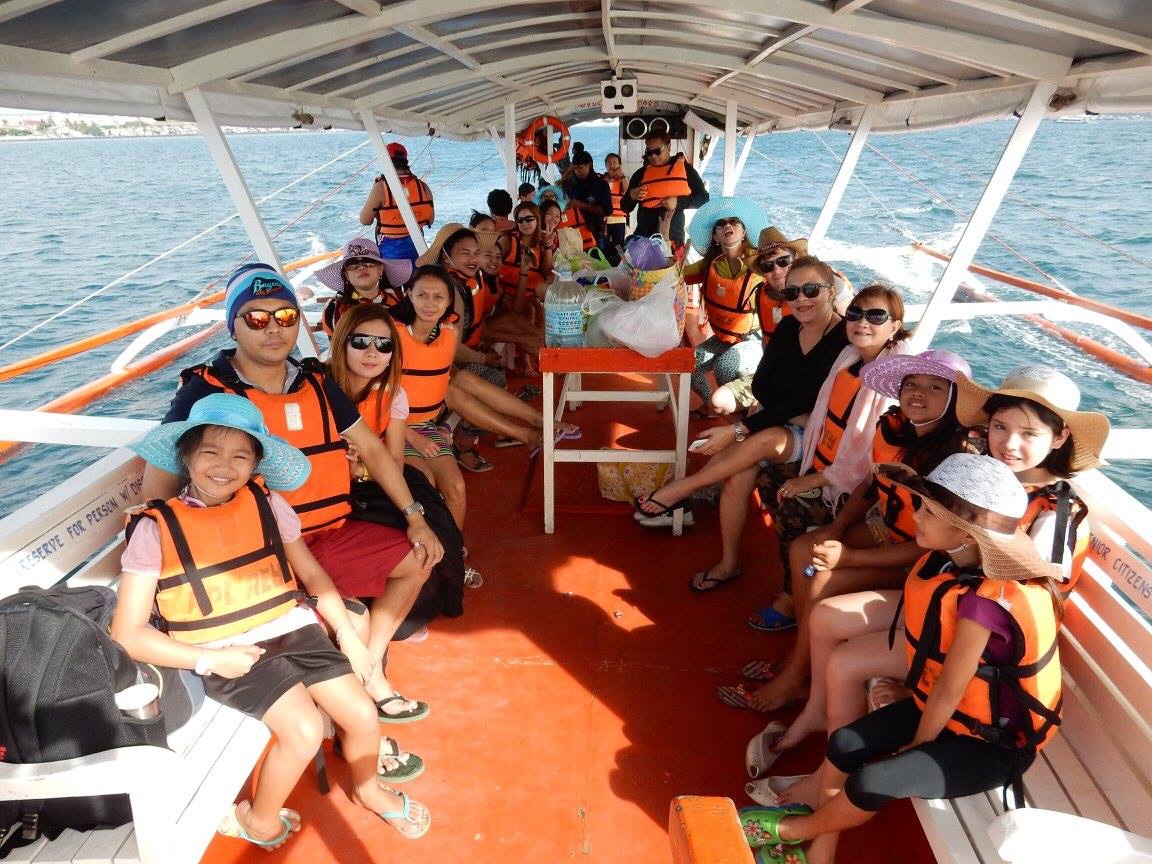
    Family Samal Outing 2017

    The party and merry making continue. Left-over lechon will turn into lechon paksiw. There is also a belief that whatever you do on the first day of the year will forecast what will happen for the rest of the year. If you wake up late on January 1, expect that you will always wake up late. If you spend, you will always be spending. If you cry, then your year will be full of tears. In bisaya, we say “malihian“. My mama would say to us to do good things on the first day of the year and we will be lucky the whole year. “Magpalihi ug swerte.” She also told us not to spend a single cent or else money will fly away and we will keep spending the whole year and we will go broke. Lol.

    In Japan, it is very famous to watch the first sunrise of the year (hatsuhi/hatsuhinode) and people go to temples or shrines to pray (hatsumode).

    [wpvideo JxWGAn34]

    The first day of the year is one of the happiest days for children because they get otoshidama, which is money gift from parents and relatives. People flock to the stores for its hatsuuri (first sales) and buy their fukubukuro (lucky bags). These lucky bags are sold for a certain price with random unknown things inside. The total value is more than the sale price.

    If you notice – hatsuhi, hatsuhinode, hatsumoude, hatsuuri, all starts with hatsu. It’s because hatsu (初) means first and that is how Japanese values and enjoys the “firsts” of the year.

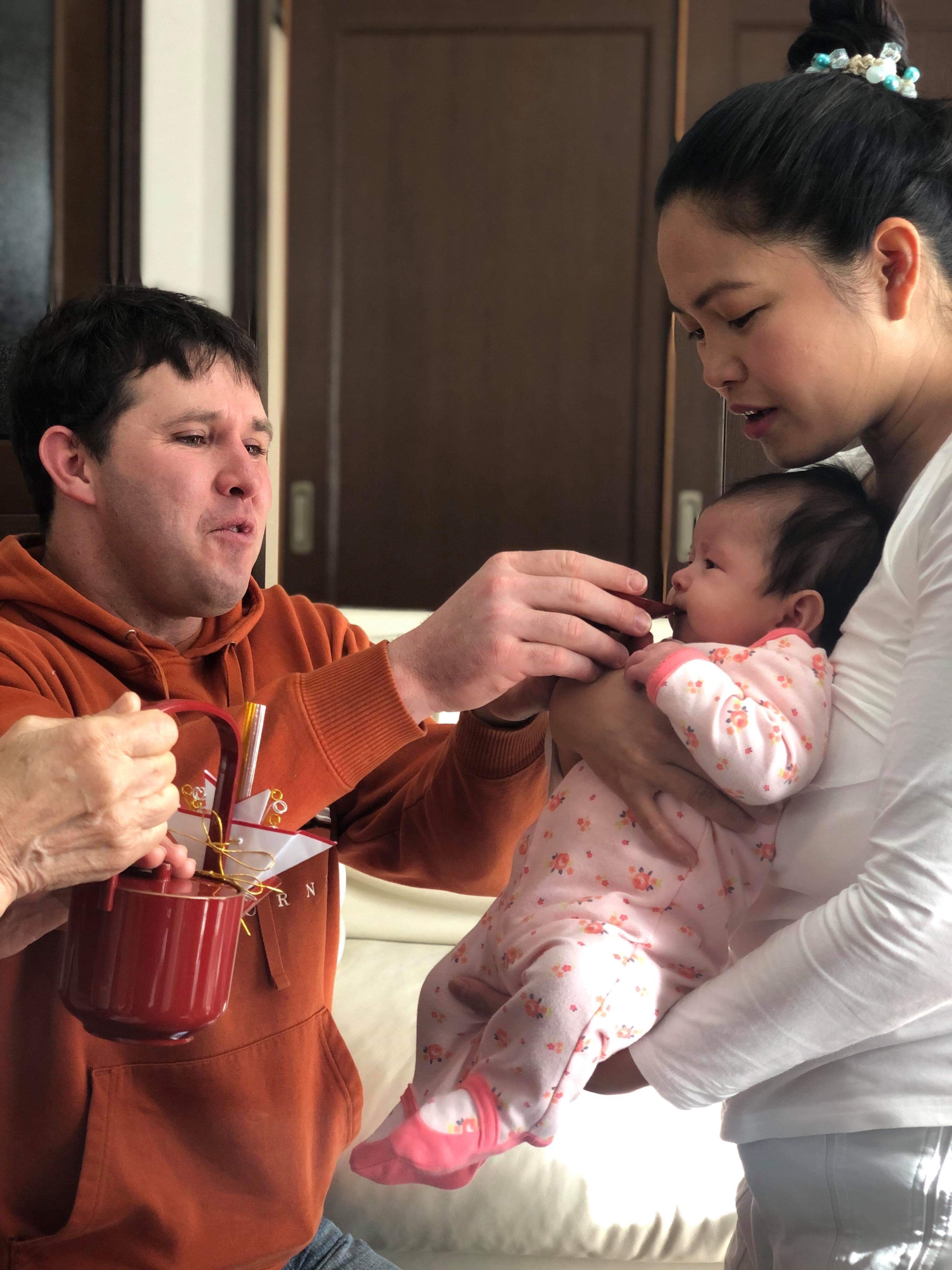
    My sister’s Japanese family gather on the first day of the year in the parents’ house and review the year that passed. They also express their aspirations for the new year and they drink otoso (お屠蘇) New Year’s sake. The drinking of otoso starts from the youngest in the family up to the oldest.

    Mari ‘s first new year and first otoso

    Conclusion

    New Year’s is the most celebrated event around the world. It doesn’t matter where you are from or what race you belong. People celebrate New Year’s regardless of religion.

    Both Filipinos and Japanese celebrate it. Both value the gathering of families to welcome the new year. It is in the same manner that most go back to their parents’ home to celebrate and do things (although done differently) to attract good fortune for the whole year to come. Filipinos party and make noise to welcome the new year while Japanese enjoy the firsts of the year. Although the food prepared is entirely different, they share the idea of good luck, hope for good health and longevity.

    If you ask me which celebration I prefer, I am sure I will have a hard time answering your question. It is hard for me to choose. Of course, there is no place like home. I like to celebrate this event with my family, with the merriment, with parties left and right, with the noise of excitement and bliss. But I also like the simplicity, the practicality, and the idea of enjoying the firsts of the year.

    If you have reached this part, thank you for your time reading this article. I hope you enjoyed it and learned something from it and I hope you enjoyed your New Year’s celebration where ever in the world you are from.

    Happy new year!

    Akemashite omedetou gozaimasu!

    あけましておめでとうございます!

  • How to invite your family to Japan

    How to invite your family to Japan

    japanese flag

    I have been living in Japan for almost seven years already (I will be seven years exactly on September 24th.)​

    With that span of time, I have invited my family to visit Japan three times already.

    The first time was in the spring of 2017. I invited four family members – my mother, two sisters (eldest and youngest), and my sister-in-law.

    The second time was this year`s spring. I invited four family members again this time – my mother, my sister (second eldest), my youngest brother and his daughter, my niece.

    The third time was two months ago. Only my mother and my youngest sister came at this time.

    Few friends, both Filipino and Japanese, asked me how I did the invitation process.

    So, in this article, I will give you the details of how I invited my family to Japan in the hope that it will help somebody planning to do the same.

    First of all, you have to have savings and a job here to be able to show that you are capable to be a guarantor. In my first year of work here, when I had an instructor’s visa, I invited my sister but the application was denied because the agency said my savings were not enough. I don’t know if that is still the policy now, but that was what happened with me five years ago.

    Three years later since my arrival in Japan, my visa was changed from Instructor’s Visa to Spouse of a Permanent Resident because as the word ‘spouse’ means, I got married to a Permanent Resident.

    I don’t think your visa status is important to be able to invite but it helps. Whether you are a student, working visa, or spouse, you can still invite as long as you fulfill the requirements.

    I wasn’t really planning to invite my family to Japan anymore, but the promo of Cebu Pacific (Piso Fare) got me thinking. I was in the US in July of 2016 when I found out the airline promo and right there and then booked their travel ticket for spring 2017. I got a very good deal for four people round trip. Imagine, P1 fare! I can`t remember anymore how much I paid exactly for four people but it was very cheap. I only paid the taxes and fuel surcharge etc.


    At the back of my head, I thought if their visa will not be approved, it would not hurt that much to lose the money I used to purchase the travel ticket because it was just a promo fare but at least I tried.

    But I was optimistic they will get approved. I`m not gonna waste this chance.

    Next, I went to uncle Google to check the requirements for visiting Japan.

    For the information of non-Filipino readers, yes, we Filipinos need to get a visa to most countries to be able to travel.

    It did not take me long to arrive on this website: https://www.mofa.go.jp/j_info/visit/visa/index.html

    That`s the website of the Ministry of Foreign Affairs of Japan. There you can check everything about visa and coming to Japan.

    To make it easier for you, I copied here the necessary documents to be prepared for visiting relatives:

    (Provided by visa applicant)
    ① Valid Passport
    ② Visa application Form
    ③ 1 Photo(Passport Size)
    ④ Birth certificate (Note1)
    Including the birth certificate that can attest that the relationship of the applicant to the Japanese relatives is within the third degree.
    [Examples] when a spouse of Philippine nationality residing in Japan invites her younger brother, 2 certificates – the younger brother’s (applicant) and spouse’s one- are required.
    ⑤ Marriage certificate (if married)
    ⑥ Proof of sufficient funds to defray all the expenses while in Japan
    ・A certificate of income or tax payment issued by a public agency
    ・Certificate of deposit balance

    (Provided from Japan)
    ⑦ Invitation Letter
    ⑧ Documents explaining the reason for invitation (copies of medical checkup,maternal health log, etc.)
    ⑨ Family register ’Kosekitohon’ (when the inviting person or his/her spouse is Japanese)
    ⑩ Itinerary during stay in Japan
    ⑪ A certificate of residence ‘Jyuminhyo’ (with description of his/ her family relationship with all family members)
    (Note) When the guarantor is a foreign national, submit a photocopy of the both sides of the valid Residence card , a Certificate of residence with full details except for Individual
    Number(“My Number”) and Resident Record Code, and a photo copy of his/her  passport(including the pages of status items,the record of entry/departure, and of residence permit)

    (Please submit the following documents if the  guarantor pays a part or all of the travel expenses)
    ⑫ Letter of guarantee
    ⑬ More than one of the following documents pertaining to the guarantor:
    (a) The latest Certificate of Income / Taxation issued by the head of administration of the place of residence, or a certificate of tax payment (Form 2) issued by the
    director of the tax office
    (Note1) Each certificate should indicate the gross income for the previous year.
    (Note2)Statement of Tax Withholding is not acceptable.
    (b)A copy of the counterfoil of final tax return with the seal of reception of the Tax Office. (e-Tax: please submit Receipt Notification and Final Tax Return)
    (c)A certificate of deposit balance 

    You can download the forms on the website I mentioned above.

    And for further details, you can check this link: https://www.mofa.go.jp/files/000121323.pdf 

    They have included necessary forms in that link as well.

    Take note that for visiting visa, you have to submit these documents through accredited agencies. The list of accredited agencies are also in the link.

    In my case, my family submitted the documents to Discovery Agency, Inc., Davao Branch (address: Door 109G/ F Court View Inn Bldg., Quimpo Blvd. Cor. Sandawa Road, Davao City, telephone numbers: 082-285-7188, 082-284-4114, 082-321-1315, 0915-326-0111(GLOBE), 0920-210-4677(SMART), 0923-423-2207(SUN)

    After about two weeks of submission, my family was notified about the result. The agency asked them to pay P2,500 for each visa. And that was it. They got their passports with a Japanese visa in it.

    Next, I asked them to get travel insurance thru Pacific Cross. It is not the best but it is better than nothing.

    Inviting a family to visit Japan seems complicated at first but as long as you communicate with the travel agency, they will help you comply with everything so you can get your visa approved.

    If this information is too much for you, I advise you go direct to the travel agency nearest you or just give them a call and I am pretty sure they will assist you all the way.

    Good luck to you and may you enjoy having your family in Japan.

  • Temporary Visitor Visa extension of my mother and sister in Japan

    Temporary Visitor Visa extension of my mother and sister in Japan

    Originally, my mother and sister`s visa is good for only 90 days. They came here last July 20th and scheduled to go back home to the Philippines on October 13th. That would be about two weeks before my due date which is October 30th.

    Upon consideration of many things, we decided to extend them a little bit so they can be with me and help me when I give birth and see baby girl in person. We were worried if they can`t adjust to the weather changes (summer to autumn) since Philippines is always summer and it might be too much for them to brace the cold. Yes, autumn is cold for them just like as spring was. To make the story short, despite that worry, we decided to extend them.

    The first thing I did was  booked another ticket online and deferred the payment for another 24 hours (so I can have time to think it over and find other means). I also googled the requirements for extension and found the downloadable application form.

    The next day, I called the immigration office to know for sure the requirements for extension. The lady who got my call dictated me the following requirements:

    1. Application from (which you can download online)
    2. Personal appearance of the applicants
    3. Passport of the applicants
    4. Reason for Extension (can be written in a separate sheet of paper)
    5. Return ticket (open date is recommended since the approval of extension is not one hundred percent sure and there is a possibility that it will be denied)
    6. Income Tax Certificate (mine and my husband`s) or shotoku kazei shomeisho  in Japanese
    7. Bankbook balance ( optional but will really help to show your capacity to sponsor )

    After that, I called the airline (Cebu Pacific) US hotline thru Skype so and I found out I can just re-book the original ticket and save some good thousand yen than buying a new ticket. I ignored the return ticket I booked yesterday (automatically forfeited after 24 hours of booking without payment  settlement) and processed the re-booking. It took me about 40 minutes to re-book but thank goodness Skype calls are free of charge.

    I changed their return ticket from October 13th to November 23rd. I know the immigration lady told me to get an open ticket but the airline said it is not possible. I just trusted that their visa application will be approved no matter what.

    After that, I filled up the application forms and went to bank then to the city hall to gather the rest of the requirements.

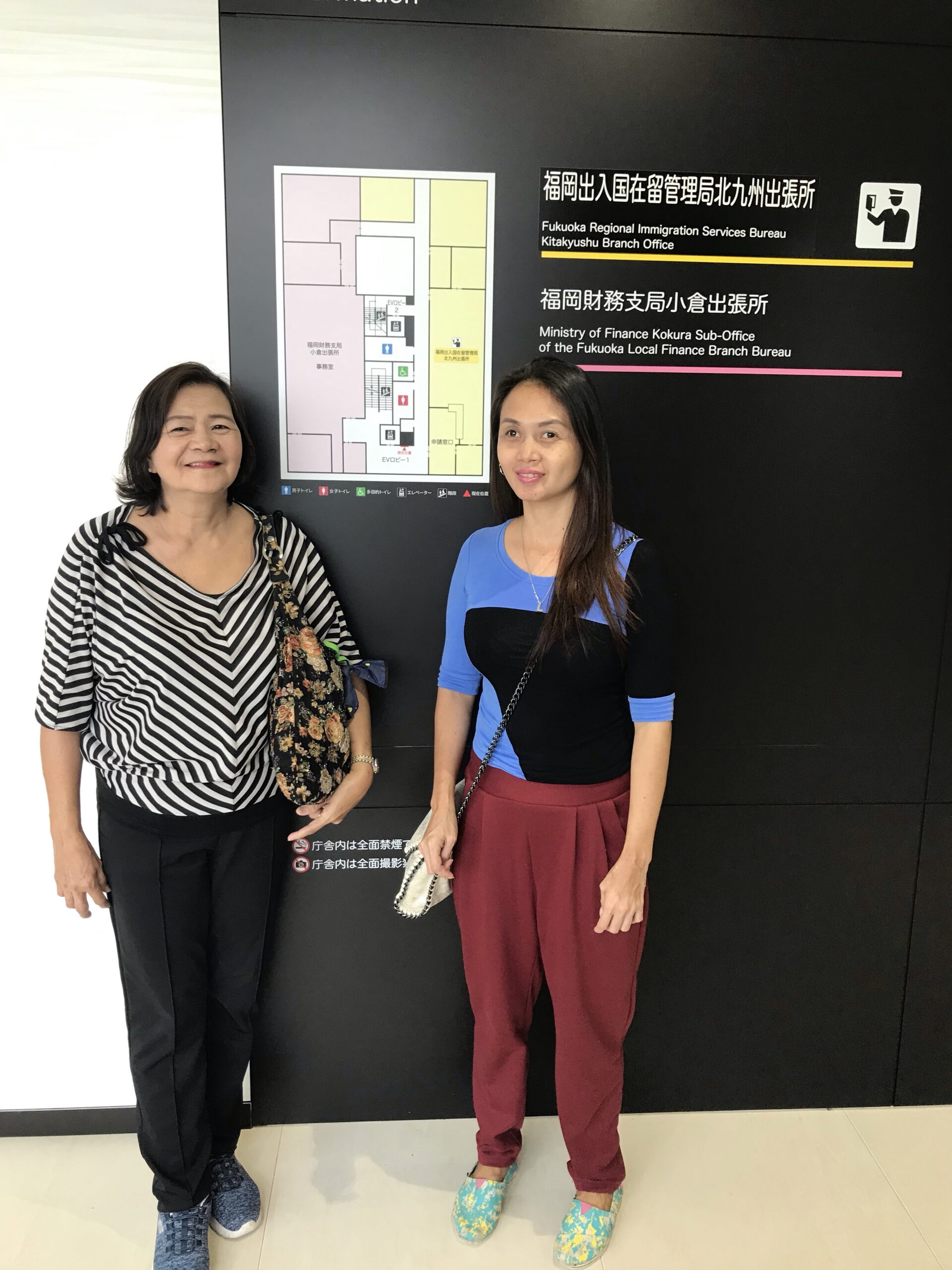
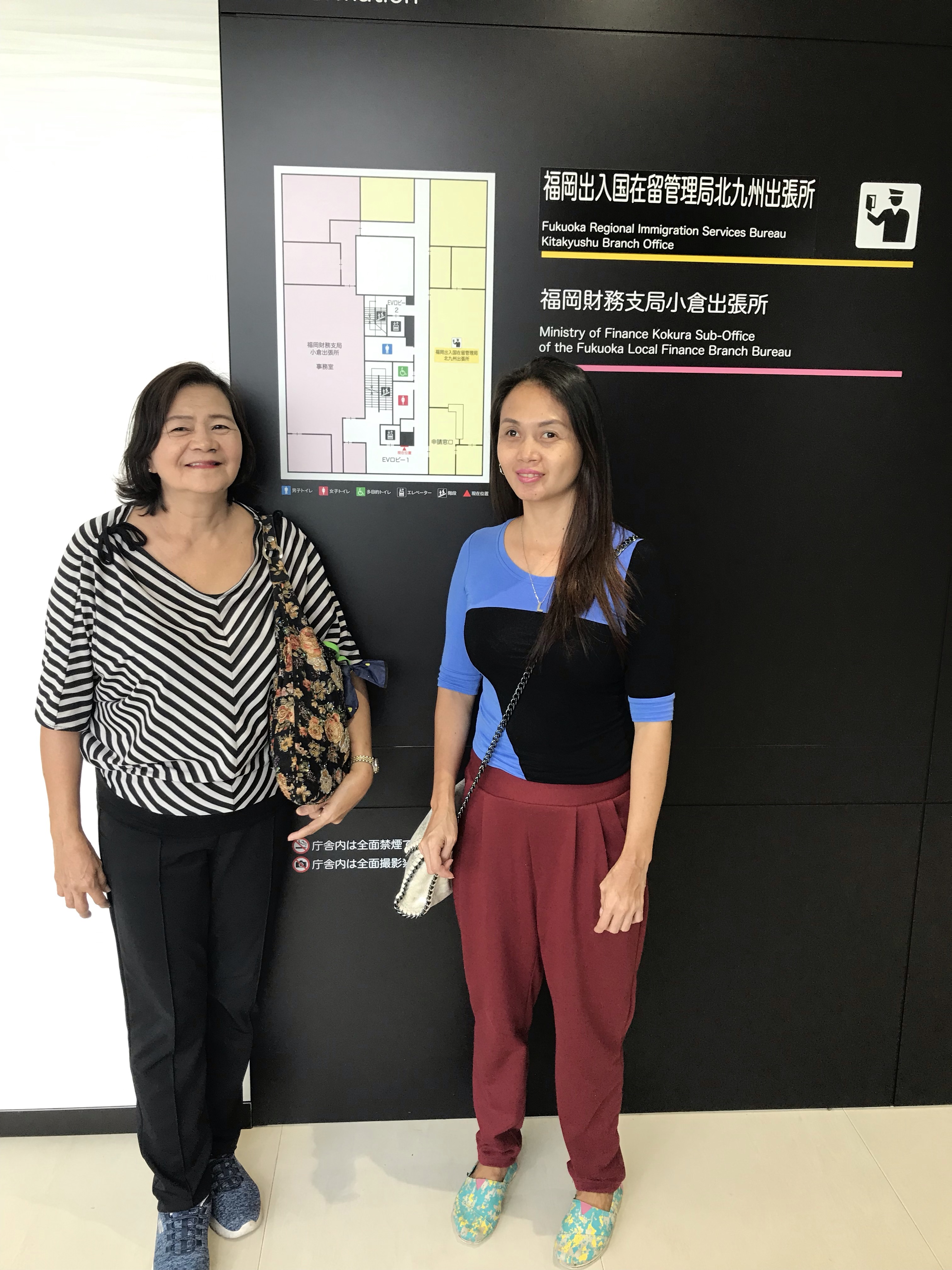
    On that same day, a very rainy day, I took my mother and my sister to the immigration in Kitakyushu to file for the extension.

    The lady behind the counter checked the documents and asked me for my Juuminhyou (Residence Certificate) but I don`t have it and told her it was not mentioned when I called that morning to verify the requirements. So, instead, she asked for my Residence card and that was sufficient. She also asked my mother and sister to sign the application and checked the forms again. There were some items I missed to fill-up and she guided me to write them down.

    While waiting for her to process the documents, she asked me to write my address down on a small piece of paper. One tip guys. If there is one thing you need to master in writing Japanese, it should be your address and your name of course. You will write these in any Japanese forms. Again, NAME AND ADDRESS.

    After that, it was done. We were told to come back if we receive some postcard.

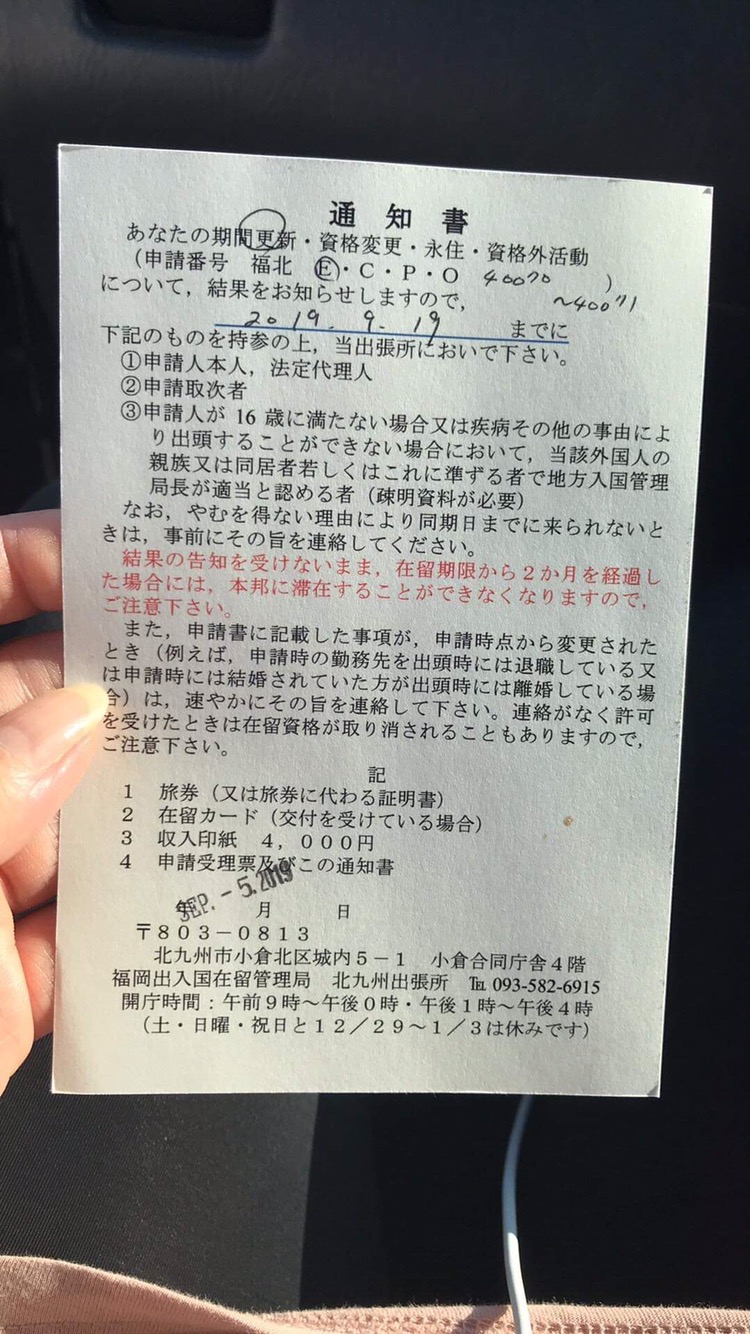
    That was Wednesday, September 3rd when we filed the extension and the postcard came Sunday, September 8 although the postcard was stamped September 5th, meaning, it was released two days later upon application. That was FAST!. It was actually the fastest transaction I have ever made with the immigration. It usually takes three weeks to two months to process renewal or changing status. when I filed for permanent residency, it took almost three months. I guess they hurried knowing that I`m pregnant and could give birth anytime soon.

    A week after we filed the extension, we were back to claim the result. We brought  the postcard (通知書)or written notification and their passports. We also needed to buy two ¥4,000. revenue stamp. My mother and sister signed a document (each for one of them) and I attached the revenue stamp on it and that was it. The lady called me and handed me back the passports showing the new visa which expires in January 16th. They actually extended for another 90 days. That was great to know. We could buy another return ticket later in January if we want but it`s not a very good idea because of the winter cold. And the budget. Lol.

    Before heading back home, we went to the nearby Kokura castle, took some pictures, had lunch at the Riverwalk, enjoyed shopping at Can Do (a very nice hyakuen shop), got tired and went home.

    I hope this article entertained you somehow and more importantly help some readers in their plans of extending their family`s temporary visitor visa.

    Below is the link where you can download the application form and read about the requirements.

    http://www.immi-moj.go.jp/english/tetuduki/kanri/shyorui/03.html

    That`s the website of Immigration Services Agency of Japan.

    This link  (http://www.immi-moj.go.jp/soshiki/kikou/fukuoka.html) will help you locate Fukuoka Immigration Bureau.

    I chose Kitakyushu because that is where I am comfortable at and it is not as busy compared to the one in Fukuoka City. Fukuoka City used to have it in the airport but since they changed the location to somewhere in Hakata, I have`t been there.  Even the immigration officer wondered whether my place is closer to Kitakyushu than to Fukuoka. I am actually residing in between these two cities. I preferred Kitakyushu. Not so many people and you can finish your transaction fast.

  • English Bulletin Boards

    English Bulletin Boards

    One of the not so many tasks of an ALT (Assistant Language Teacher) in Japan is updating the school’s English Bulletin Board.

    In my school where I’m assigned, in fact, the only school I am assigned (normally ALTs are assigned to more than one school), I make sure to update our English Board every month.

    In the first semester (April, May, June, July), I kept the board pretty simple. I put up some world updates, some English greetings and words, and also a daily update of day, date and weather.

    I started changing the board according to the monthly event/theme in the second semester, that is from September, right after summer vacation in August.

    But, unfortunately, I forgot to take a picture of my September board.

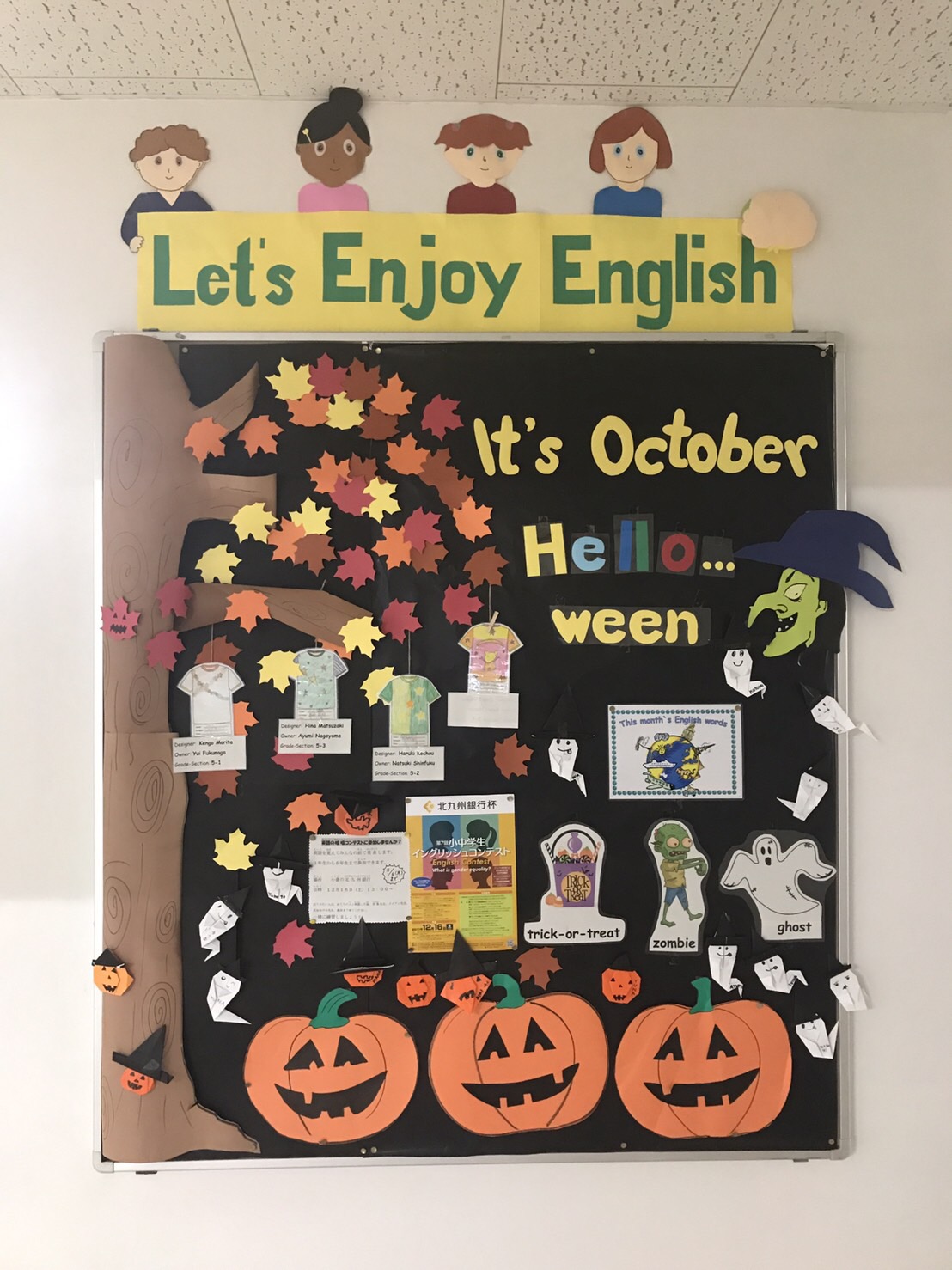
    So let’s start with October.


    As you can see, it’s Helloween, I mean, Halloween theme. I just put a little twist to the word to make it more catchy. I made three big jack-o-lanterns and aligned it under a maple tree. I printed one maple leaf and traced it to colored papers, of course autumn colors since it’s autumn and just put it all over the cut out tree. The origamis are made by students during lunch break, when they come to the ‘English Lounge’, well, basically just tables and chairs in front of the English board and we gather there and chat while making origamis.

    Next is November.

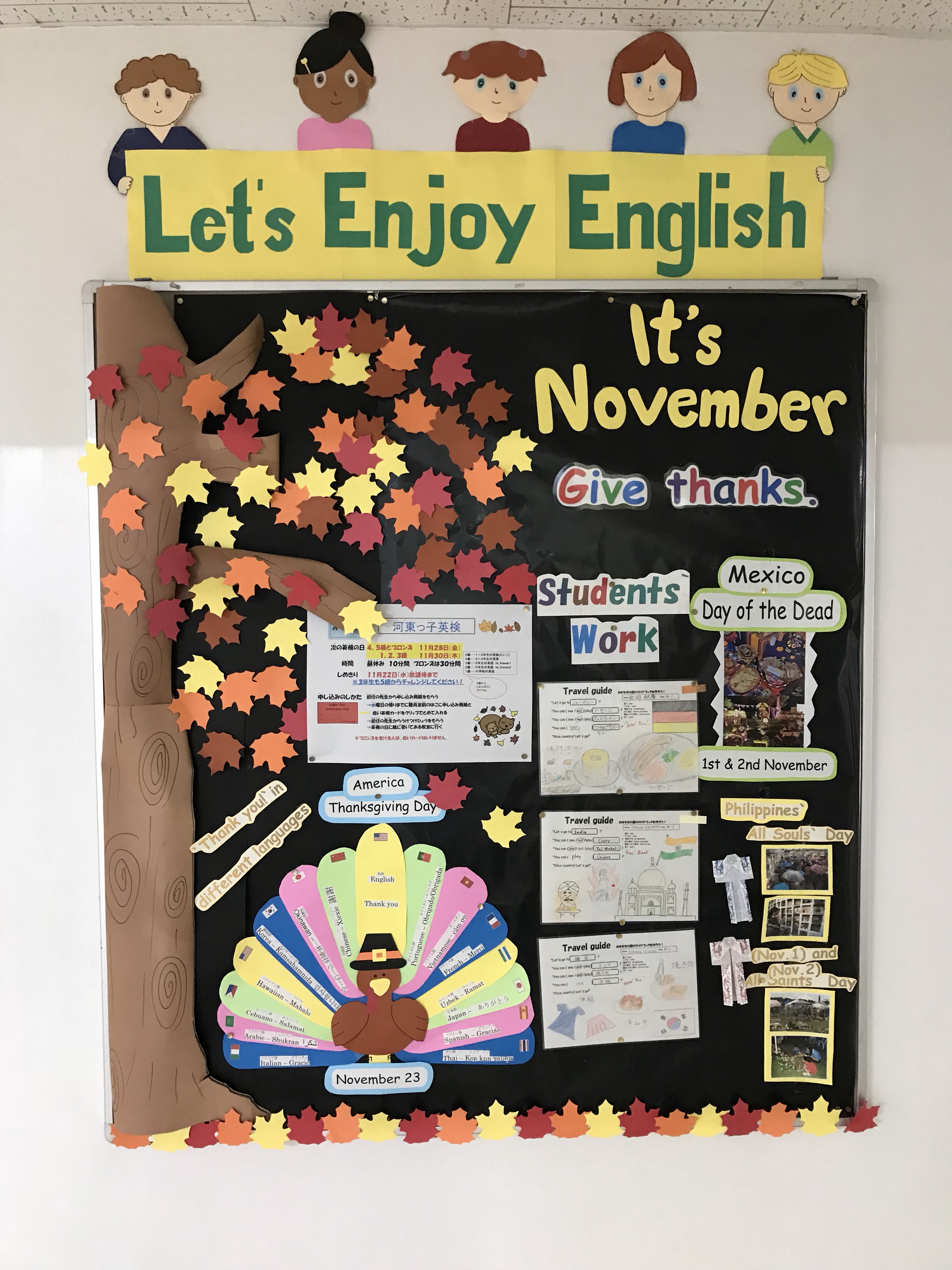
    I kept the maple tree in November board since it still autumn but I removed the jack-o-lanterns and other Halloween things and put a colorful turkey on it. November is Thanksgiving so that explains the ‘Give Thanks’, right? If you look closely, the turkey’s feathers contain ‘Thank you’ in different languages. Some (that Mexico thing) are reused from the previous years’ bulletin board. It’s a waste to throw them away. Why not recycle, right?

    Here comes December.

    The black background has been there for three months. I find black background so easy to decorate but I admit, I was getting sick of it, so I added white background below it to represent snow. The students like the snowman but I personally like the reindeer. Those are all cut-outs. Well, I had a plenty of time to make these things. 🙂

    The January board was not really the best but I have to tell you, this is the most, should I say, tedious, to make. I decided to make cut-outs of Snoopy and friends’ characters since it is year of the dog. All the red letters are cut-out too, but when I put a white background into it, it looked like printed words. :-/ The new year greetings in different languages are printed. Nothing complicated. And below is the outcome.

    Next week, I will update the bulletin board for February. I already prepared some heart cut-outs but I still don’t know the final outcome. Nothing in mind. We’ll just see.

  • Why is summer vacation in Japan not a vacation for students at all

    Why is summer vacation in Japan not a vacation for students at all

    Most kids around the world look forward to summer vacation. For most of them, it is the best time of the year. Free from the tiring things in school, listening to the teachers sermon, doing projects and endless homework.

    But, not in Japan. Although summer is fun in Japan with so many festivals that you can go and you can even watch fireworks while wearing your yukata (summer kimono), eating kakigori or shave ice, most kids, elementary and junior high school somewhat hate summer.

    Why? For one reason. Homework.


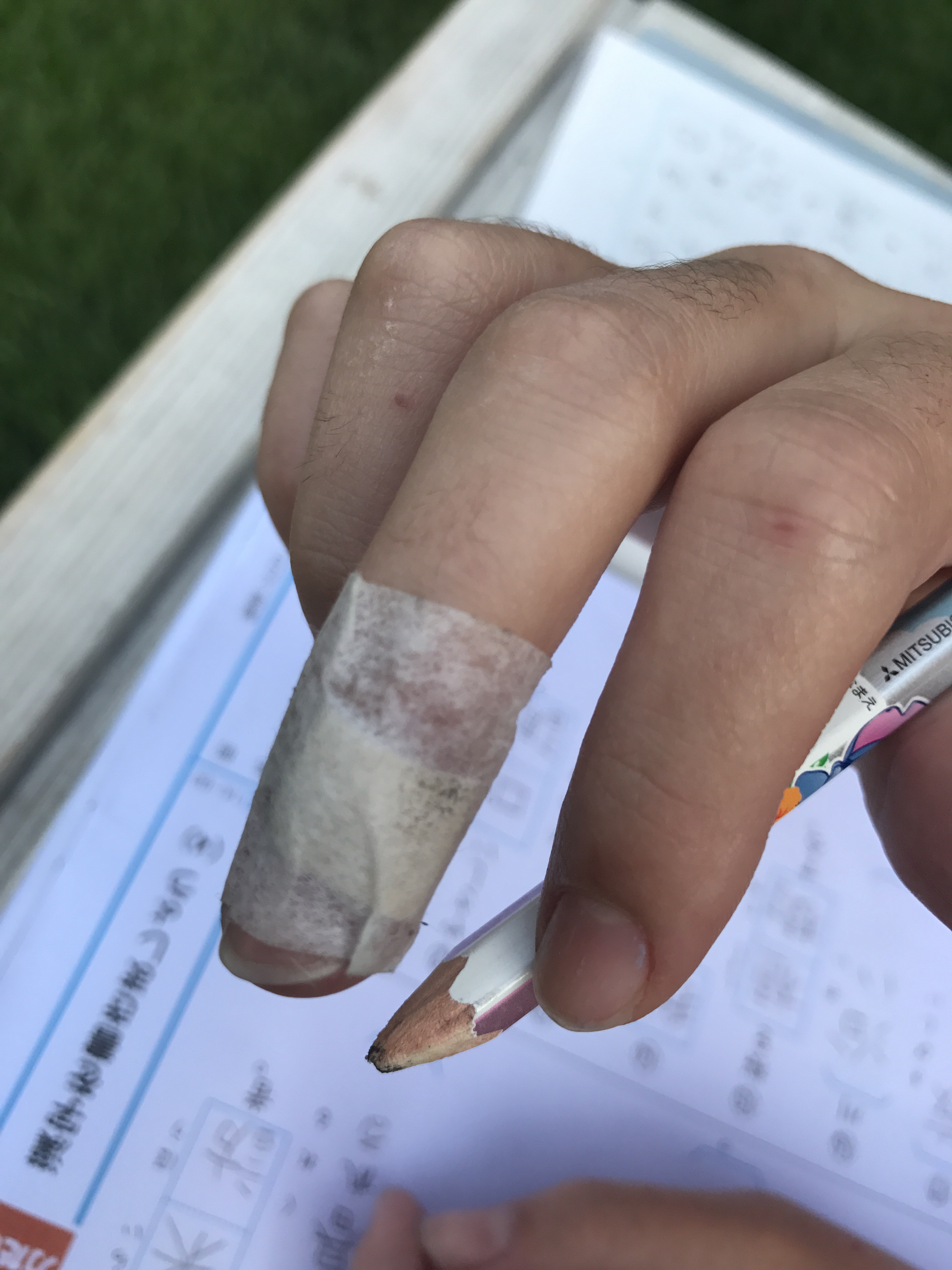
    And it’s not just a piece of paper with few mathematical problems to solve. It is a set of three to five book/booklets, some of them are inch-thick and most are half-inch thick. It can literally hurt a child’s finger because of doing too much  homework.

    Japan doesn’t consider summer break a vacation for students. They consider it a time for independent study. For students to study on their own in the convenience of their homes.


    Unlike the US and the Philippines, summer vacation in Japan is during school year, not between school year. April is when classes starts and mid-July to August is summer break. Classes resume in September and close in March. Between March and April, they have like  a two-week spring break, and that is between grades, when kids don’t get tons of homework like in summer break.

    Its not only the students who don’t like summer homework. Somehow, it becomes tedious for parents, too, who, during summer, becomes the “teacher substitute”, reminding their children to keep track of their homework. Parents are also the ones who check their children’s homework. Some parents make the schedule, how many pages a day and how many hours a day should their children dedicate for doing homework.

    The most stressful part of summer is the last week, when both parents and children realize that they only have few days to finish a bunch of unfinished homework , including the daily summer diary.

    Both Japanese and non-Japanese often discuss about whether this practice of summer homework is good or not. Some say that it’s a good way for training children to become independent and responsible. Some say that it’s too much in a way that it deprives children to enjoy their childhood.

    How about you? What’s your take on this?

    How do you spend your summer vacation?

  • Our Experience of a Cancelled Flight

    Our Experience of a Cancelled Flight

    The Long Awaited Day

    The 21st of July. We, the sleepyheads, specially my dear husband, miraculously woke up before our alarm. Our long awaited  summer vacation will start today. We’ll be flying to his homeland, the so-called land of the free, the USA. We’ll be out for a while in the land of the rising sun, Japan.

    We got up early to prepare for a looong flight. The flight would be 19 hours and 30 minutes, well, shorter than the flight we had last year, and so far, the shortest we got. We didn’t want to do multiple and long lay-overs, never again.

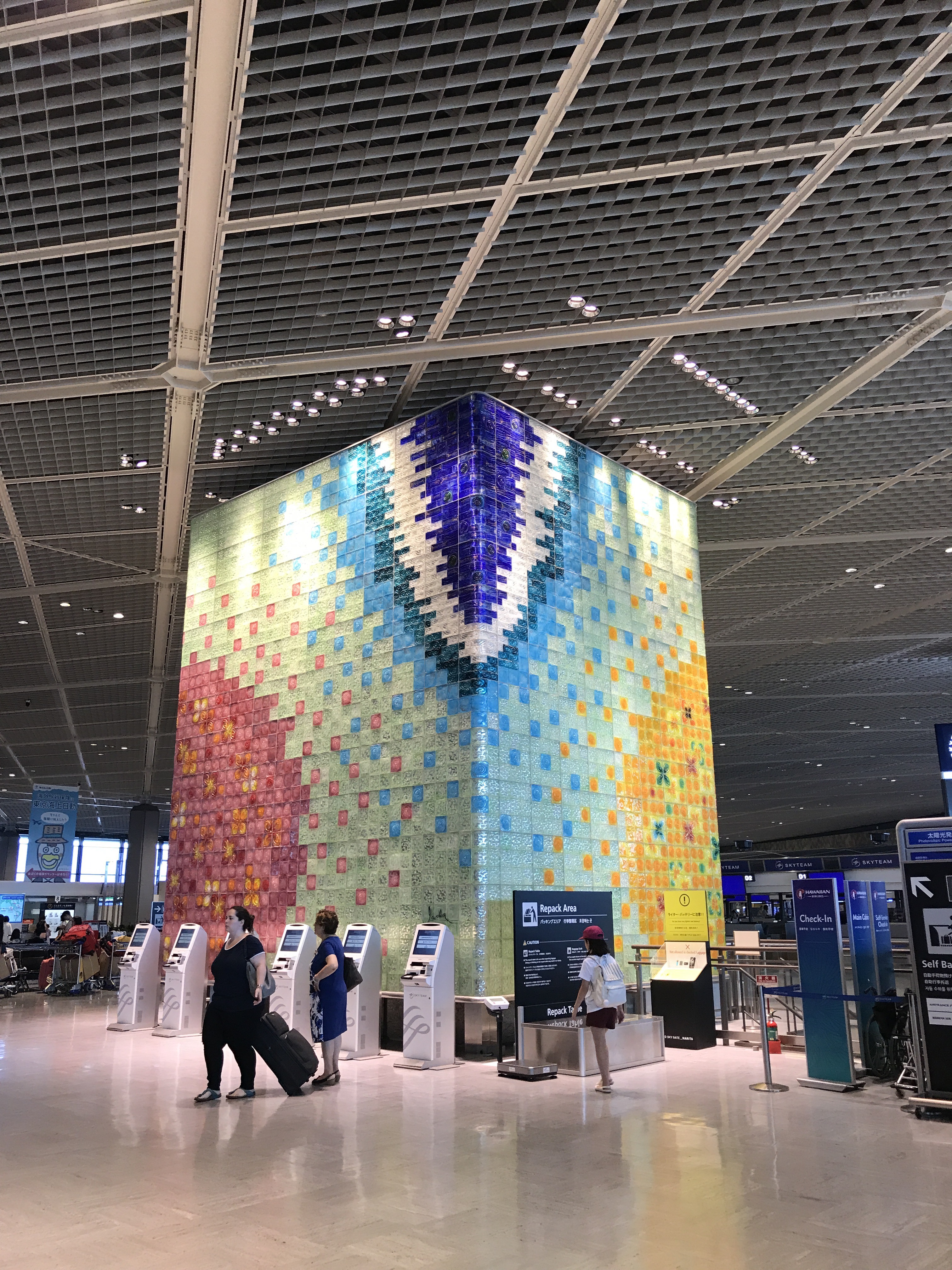
    Our flight have two stops. One at Narita, Tokyo and one at Los Angeles, California. Our flight to Narita was not until 1:35 in the afternoon but we decided to get to the airport early to avoid the cramming and stress we usually get in traveling. By the way, we live in Fukuoka, southwestern part of Japan. About an hour and a half to Tokyo.

    Everything was fine going to Narita. The flight was on time and the teller didn’t ask me unnecessary questions regarding my documents like the last time we flew to the US. It was smooth until we landed in Narita.

    The bad news

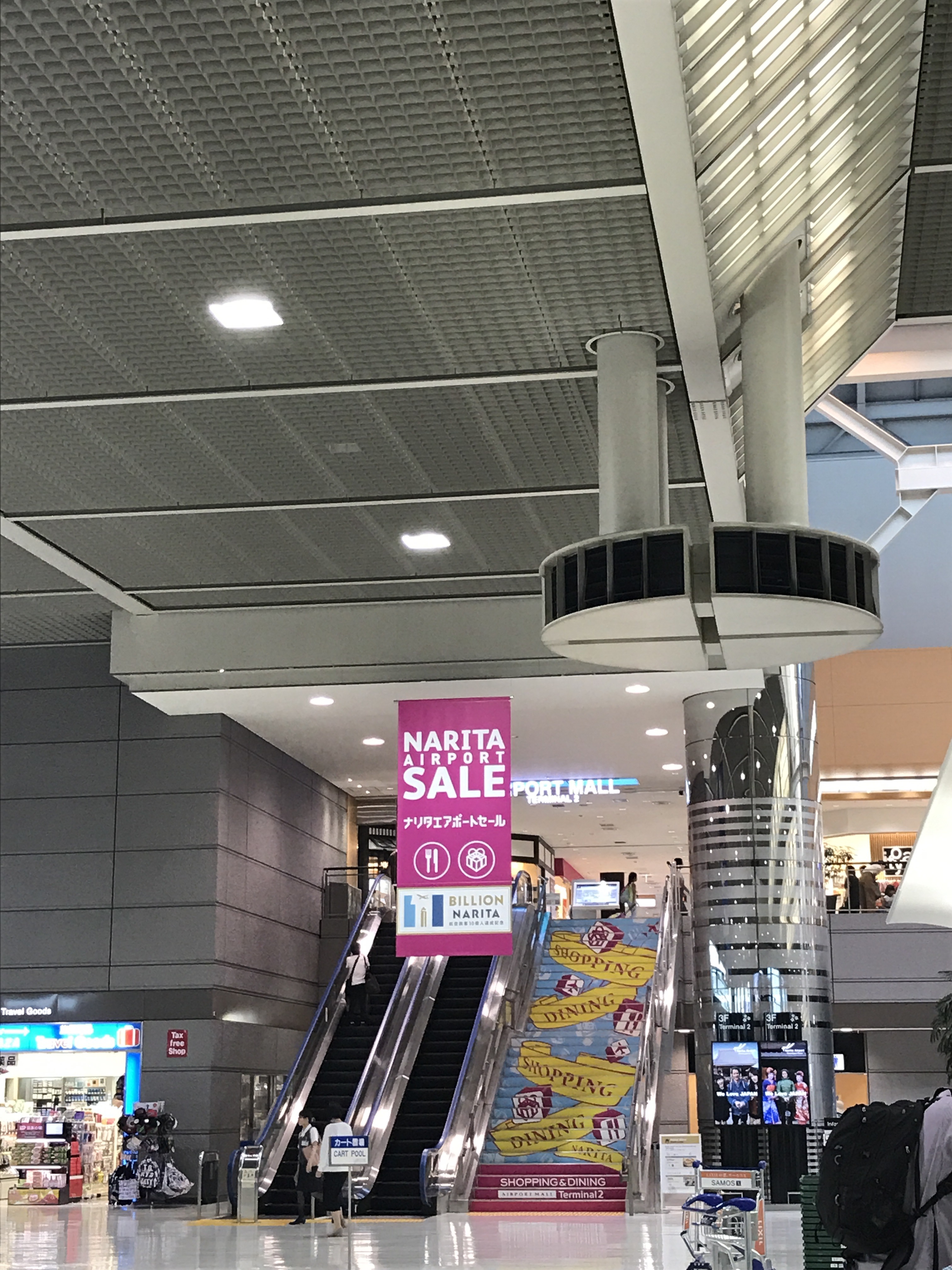
    We looked for our connecting flight to Los Angeles upon landing in Narita. We only had like two hours lay-over, just enough time to check-in and go through immigration. But to our dismay, our flight was cancelled due to maintenance.
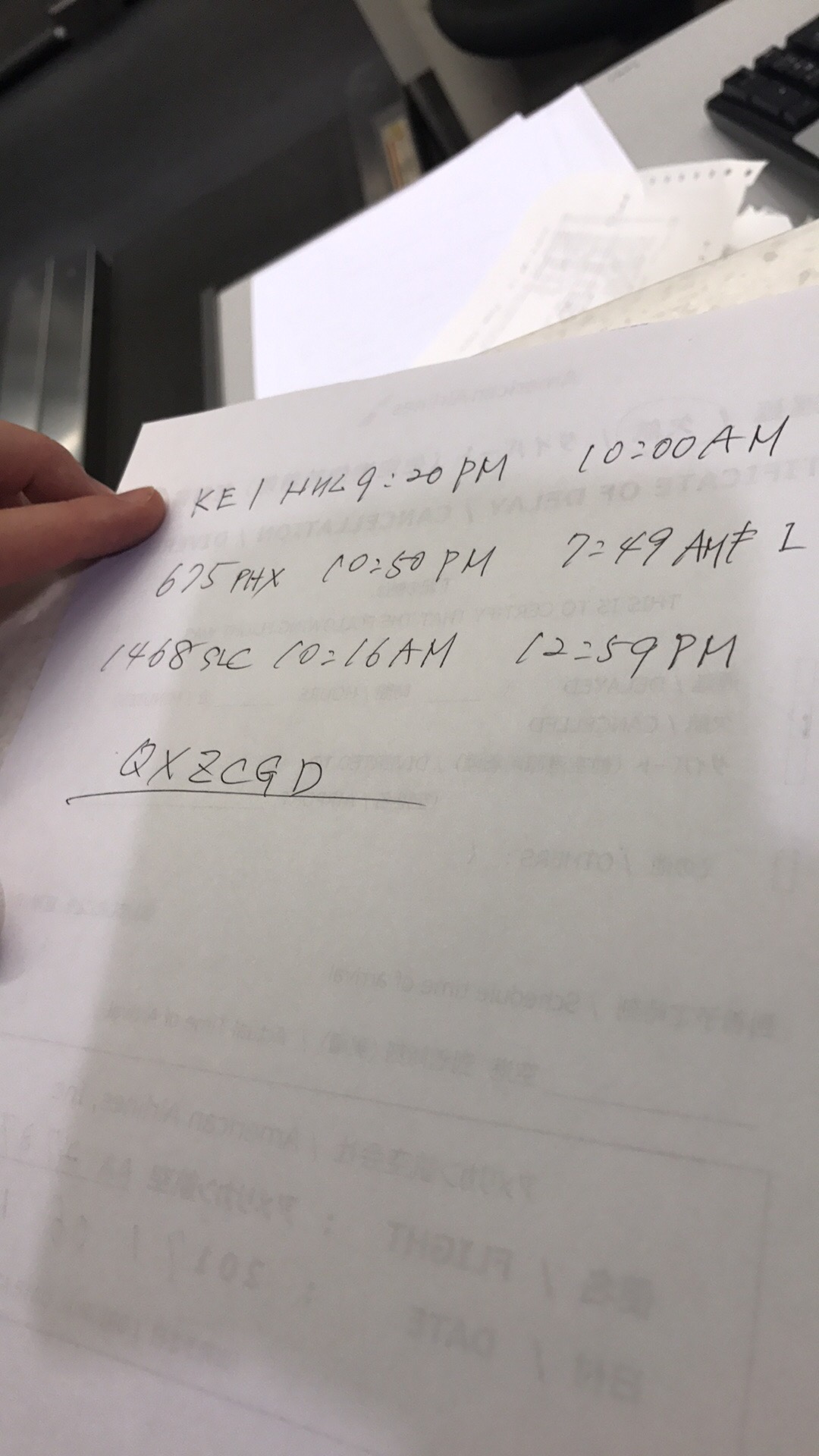
    We were directed to the Customer Assistance Counter where a lady in her late 40’s or early 50’s told us after making several clicks on her computer and phone calls to who knows who that the best that she could find is a flight later that evening which will take us to Honolulu where there is a 12-hour lay-over and then from there a connecting flight to Phoenix and finally to Salt Lake. Upon hearing that, my usually friendly and jolly husband raised his voice to disagreement. He insisted to get a better offer since we, in the first place,  chose this flight because we did not want to go through the hassle of multiple and long lay-over flights. The lady, then told us to wait again, this time it was longer. I don’t like waiting at all. It was exhausting.

    [wpvideo 3X9Y9Gpr]

    ​Finally, after almost an hour, the lady offered us a better deal. We could stay in Tokyo for a night with free hotel accommodation and get on the flight the next day, or if not, accept the first offer (the long lay-over in Honolulu). Although, I kind of wanted to go to Honolulu, too, since I’ve never been there before, but I just hate long travels and the thought of getting on and off several planes made me sick already. Finally, the lady made all the necessary arrangements for our changed flight and free hotel accommodation.

    We were almost settled but then we realized we don’t have a change of clothing with us since our luggage has already been checked in and we’re not going to get until we arrive in the US.

    But, thanks to UNIQLO we could get reasonably unexpensive decent-enough clothing to survive until the next day.

    The complementary hotel accommodation 

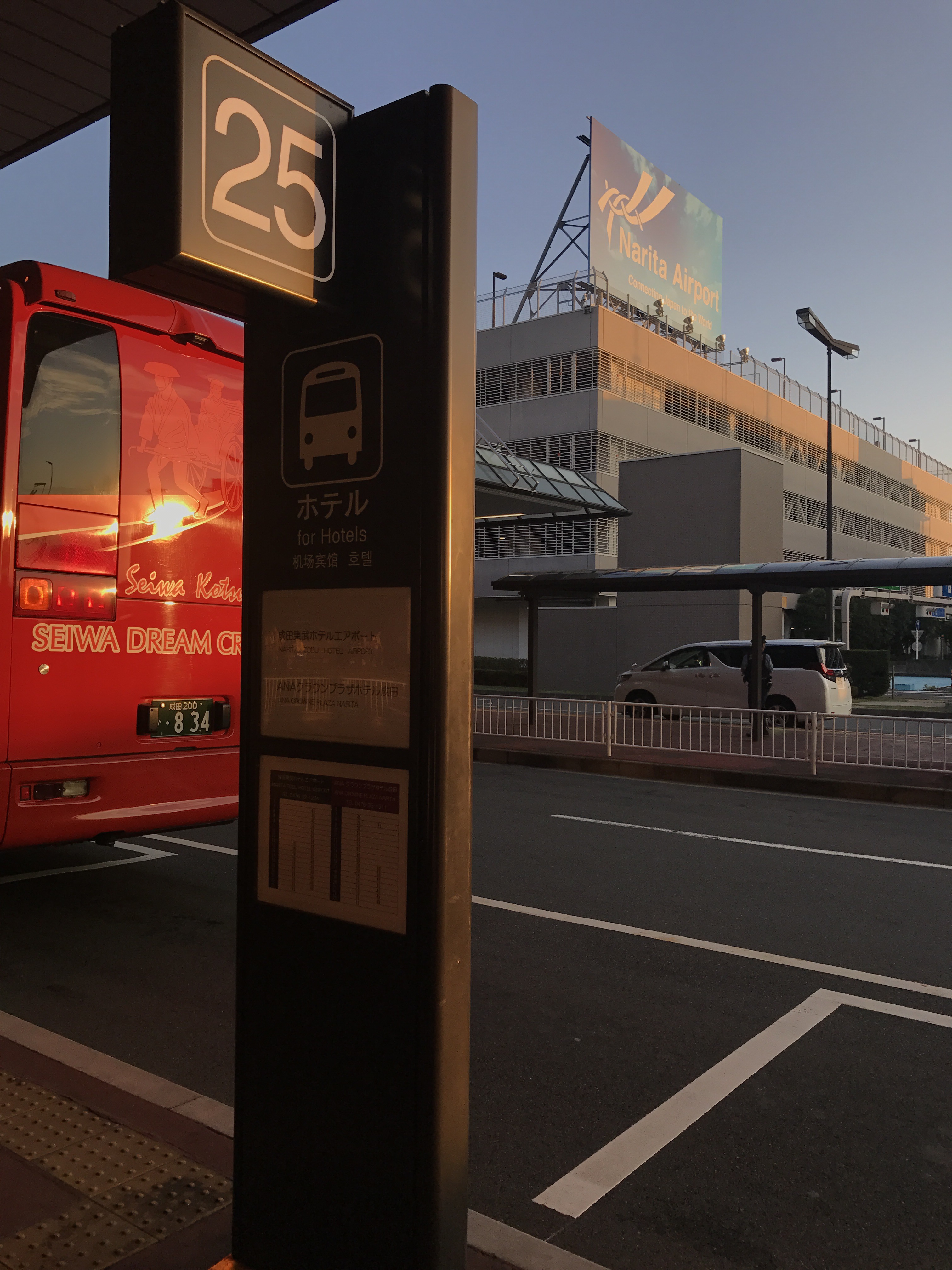
    The shuttle bus  came on time and took us to the hotel.

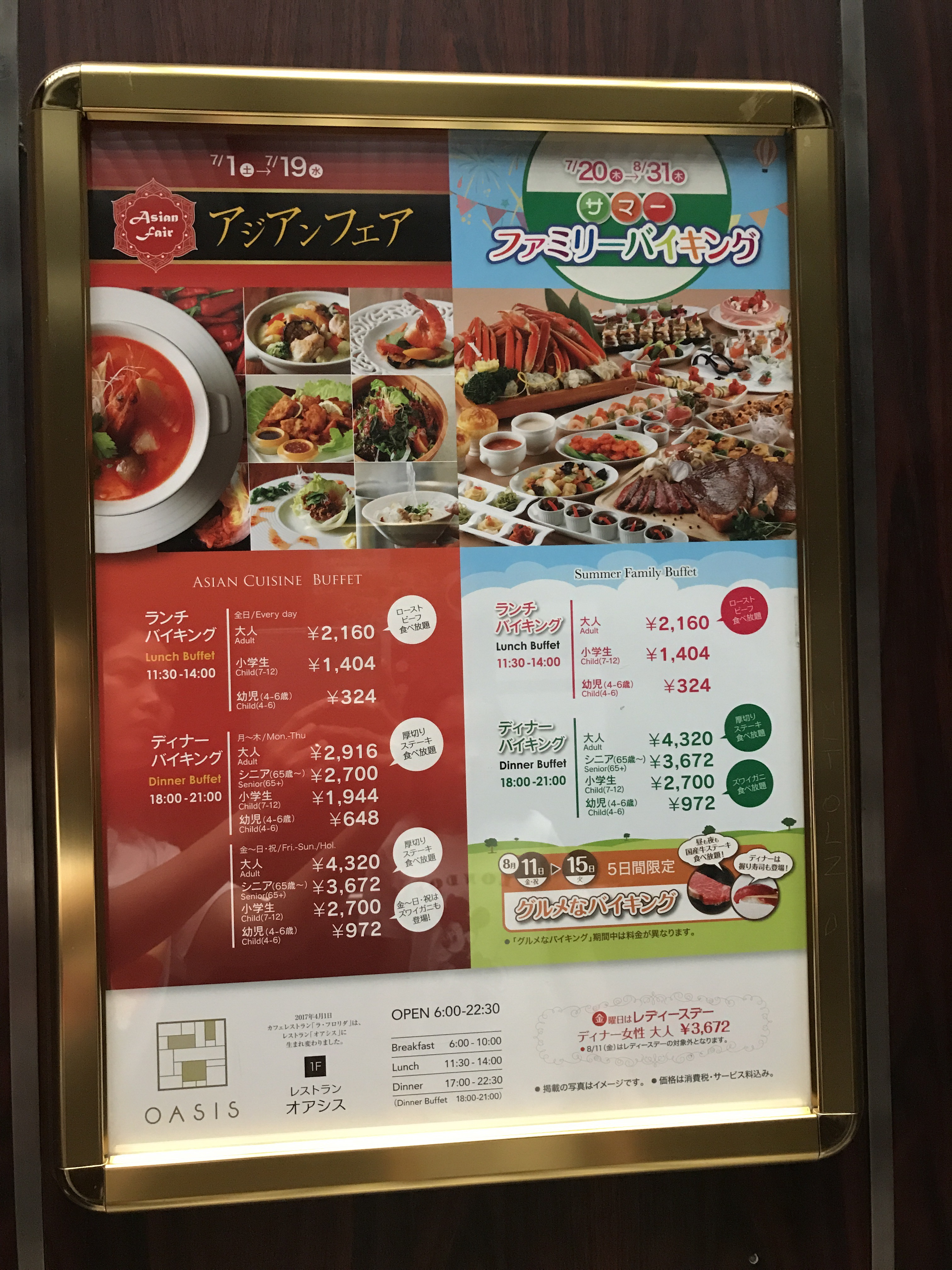
    While inside the bus we saw a poster of a restaurant offering buffet. We got excited for a moment there but we quickly dismissed the idea of us getting into a nice hotel, the more of having a buffet dinner and breakfast. For sure we’re going to get a less than average accommodation and more or less a piece of bread or cereal and a cup of drink for our meals.


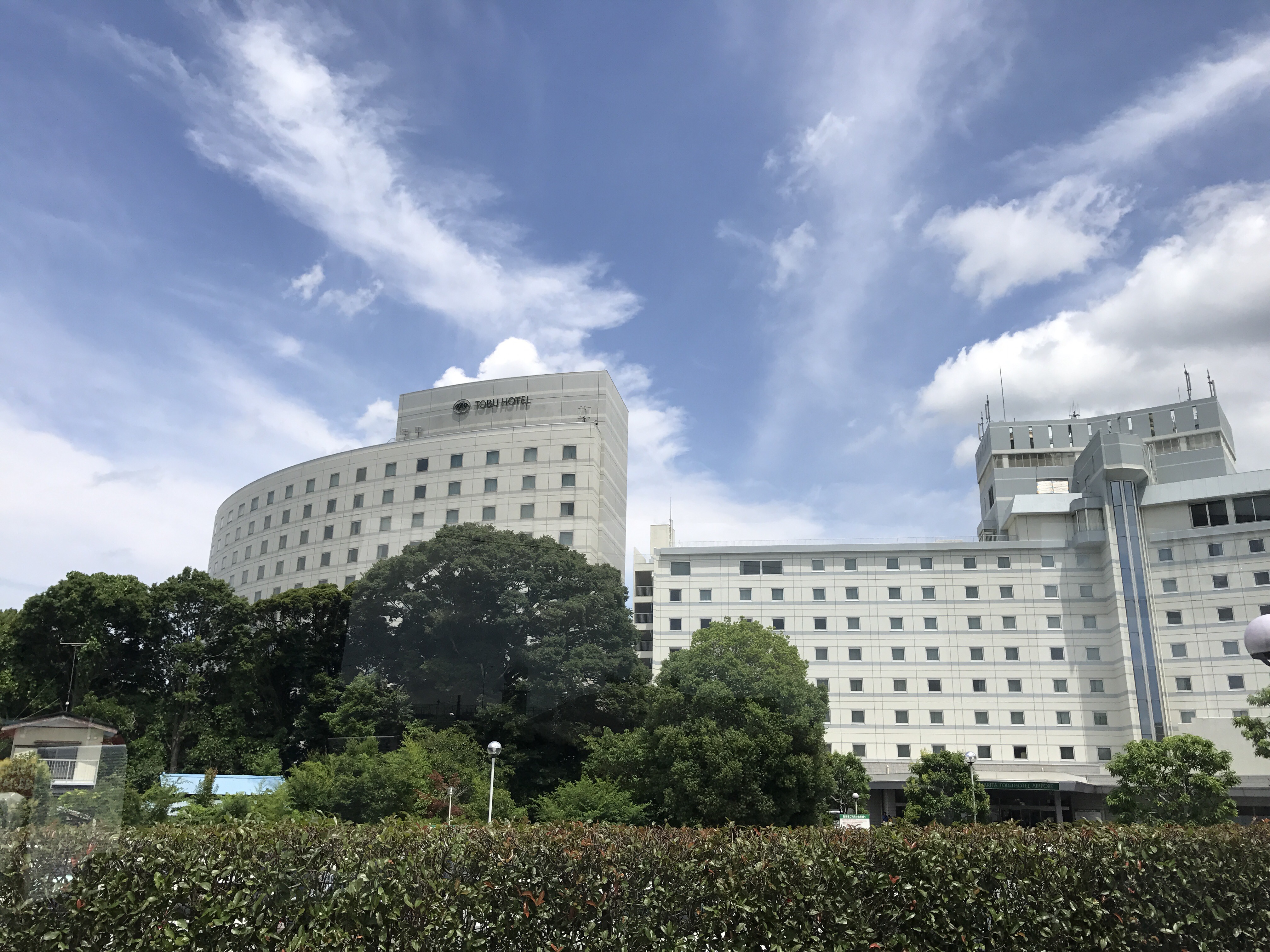
    After about 20 minutes, we arrived at our hotel and we were happy to see that it’s more than what we expected.

    It’s quite big, the lobby is nice, and receptionists are friendly and quick.

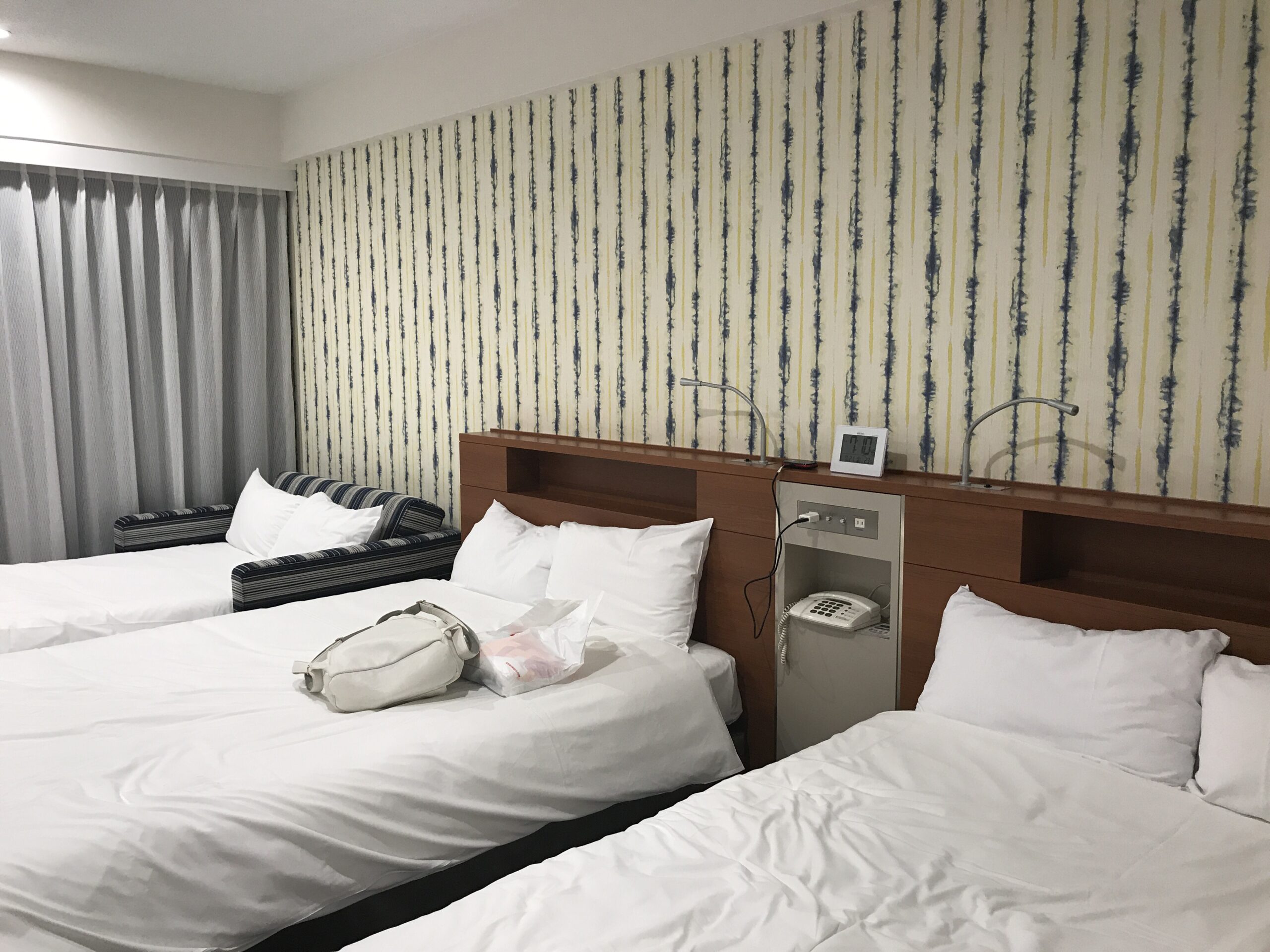
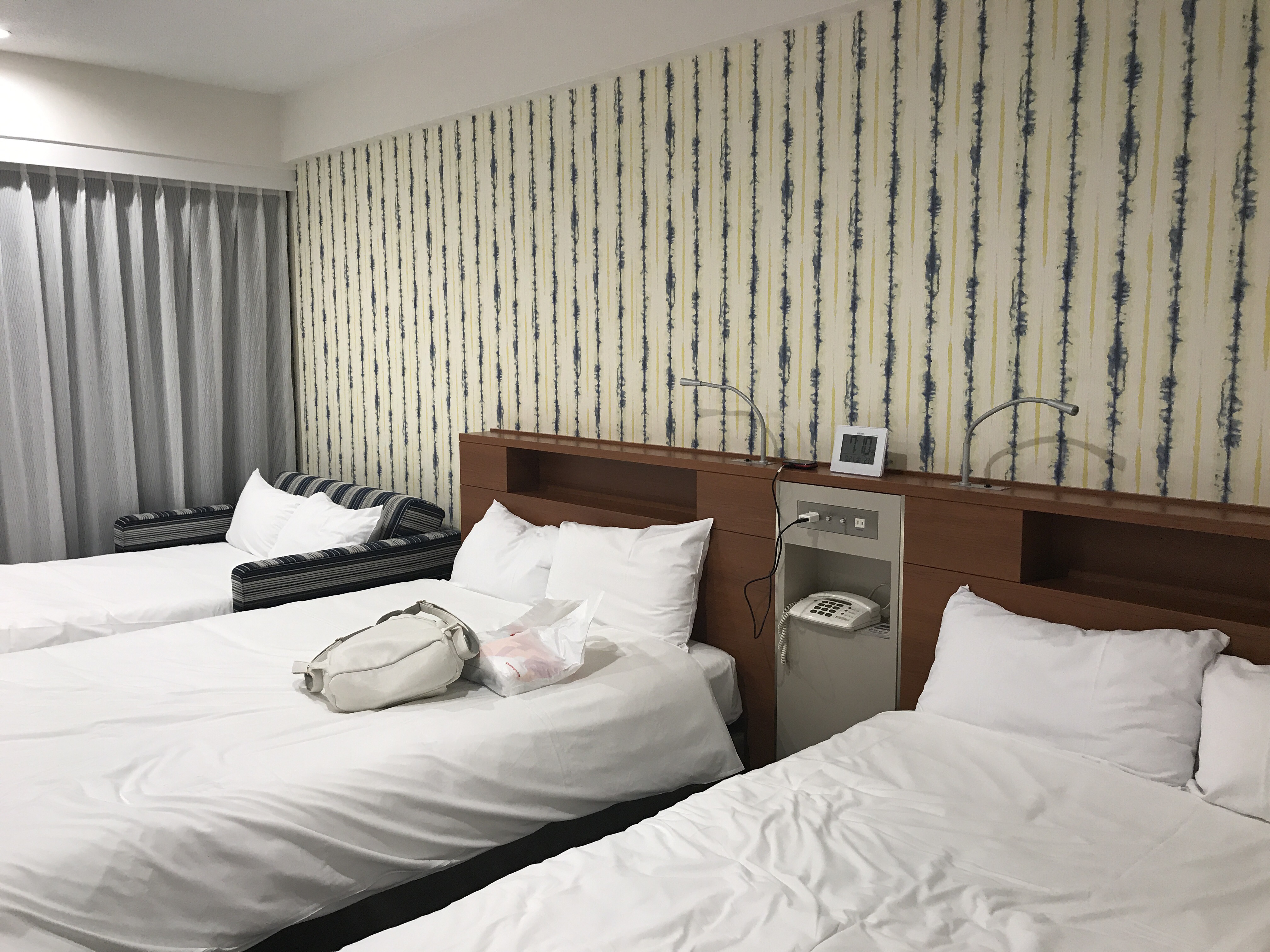
    We were even more happy when we opened our room and saw that we got three beds, one for each of us.

    The best part of our cancelled flight is the buffet dinner and breakfast included in our hotel accommodation.  The restaurant was spacious and well-lighted and clean. the waiters and waitresses were pleasant and attentive. The food was great. There was steak, meat dishes, salads, fruits, desserts, ice cream, drink bar, and the best part was the winter crabs for dinner buffet. We ate crabs that night like we never had before. And the breakfast was equally fulfilling.


    We left that hotel and headed to the airport the next day with the new perspective about cancelled flights. Not all cancelled flights are bad after all. Sometimes it’s just another opportunity to experience a new place.

  • Setsubun and Risshun: Say Goodbye to Winter and Hello to Spring

    Setsubun and Risshun: Say Goodbye to Winter and Hello to Spring

    The freezing cold of winter makes people long for spring. Spring, the time when flowers bloom. It is when the temperature goes up gradually. It is when people start going outdoors again. The weather is not too cold. Just “choudo ii”, as the Japanese say, meaning just right. The cold turns to cool. Everything turns bright and gay with flowers blooming and weather warming up. Adios to the dark and gloomy winter. But, when exactly is spring? In Japan, they have a celebration that marks the end of winter.

    What is Setsubun?

    Setsubun (節分) means seasonal divison. The kanji 節 means ‘season’ and the kanji 分means ‘part’. Setsubun’s original meaning is the last day of any season. Spring Setsubun, usually February third or fourth,is the last day of winter in the traditional Japanese calendar. Setsubun is said to be the old New Year’s Eve celebration basing on the Lunar New Year.

    How is Setsubun celebrated?


    On this day, Japanese people hold the mamemaki 豆まきor bean throwing ceremony for driving away bad luck and attracting good luck. It is a ceremony where they throw beans at the ‘devil’ and chant “Oni wa soto. Fuku wa uchi”, which means “Demons out. Blessings in.” Other translation says “Demons out. Happiness in.” Demons in this case represent bad luck. The chant is said to drive away all the bad things out, and bringing the good things in. People visit shrines and temples to pray. Big shrines sometimes hold a big throwing ceremony and lots of people come to attend. Shrines are beautifully decorated and somebody who is assigned as demons wear elaborate whole body costumes. Shrine priests also wear their special clothes. Sometimes, the city or town’s leaders come to attend to. When you go to supermarkets and grocery stores and even convenience stores, setsubun decorations are displayed. You can see the fuku or happy face and demon masks. Demons are usually in color red and color blue. Normally, Japanese people do their own ceremony at their homes. The demon is usually played by the father. After work, fathers wear a devil’s mask and come home to surprise the kids. The kids together with their moms throw beans at the ‘devil’ and chant.  Families with kids celebrate this ceremony more than those families without kids. Maybe, it’s because kids really believe that devils are real, while adults, they know it is just a pretend.

    What to eat


    goinjapanesque.com

    After having fun throwing beans at the devil, each family member picks up the beans and eats them with the number according to their age. That is to be said, five year-olds for example get to eat five beans and eighty-year olds get to eat eighty beans. It must be hard for grandpa and grandma to eat all those beans, I guess.
    Recently, about three to four years ago, my Japanese friend said that on Setsubun, Japanese eat ehoumaki (恵方巻き). Ehoumaki is a long sushi roll. It is said that eating ehoumaki attracts good luck. There are various kinds of ehoumaki. The one I had in school lunch consists of cucumber and crab stick. I saw in the television news that one shrine in Japan celebrated Setsubun by distributing ehoumaki to about a thousand shrine vsitors and they eat them altogether for good luck and happiness.

    My Experience


    I love festivals and I love learning Japanese culture. I have learned about Setsubun in the university where I studied Japanese. We did a short bean-throwing ceremony in the class and we chose our male classmate to act as the demon. It was fun but it was short and we wanted more. Upon hearing that there was a big bean-throwing ceremony in town, my friend and I decided to attend. We went to Kushida Shrine in Hakata, Fukuoka. 〒812-0026 Fukuoka Prefecture, Fukuoka, Hakata-ku, Kamikawabatamachi, 1, 博多区上川端町1−41

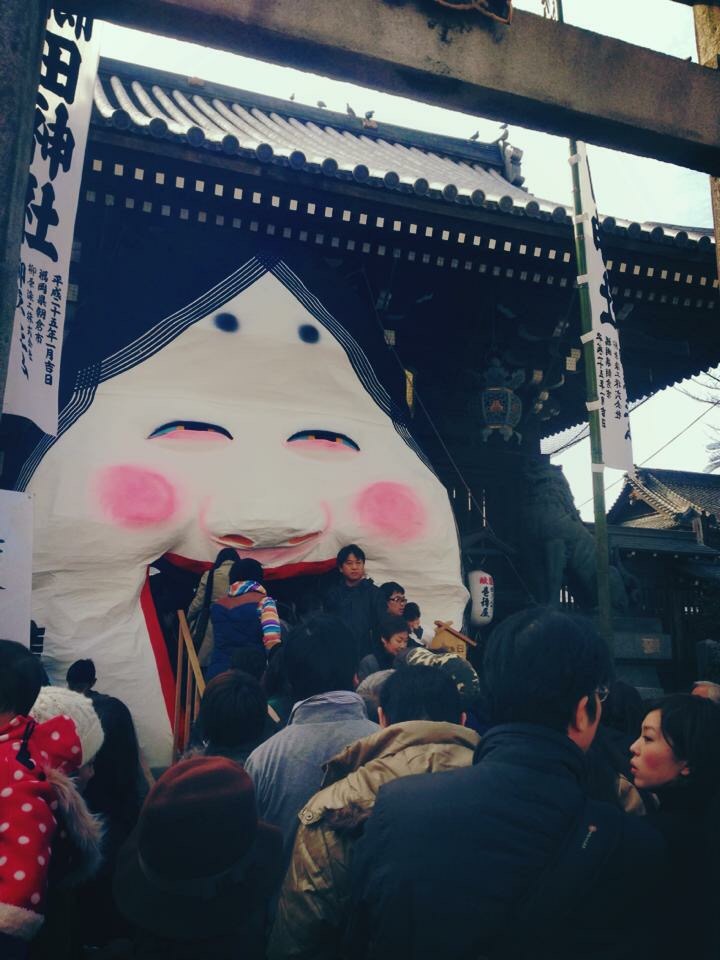
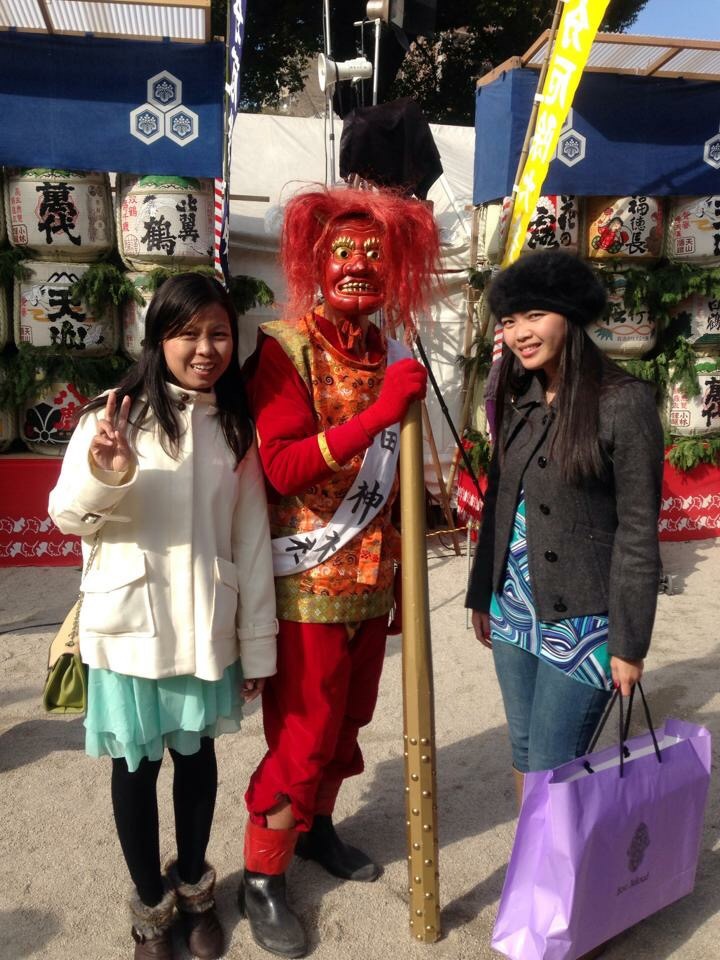
    In the entrance of the shrine was a big face of Fuku or the happy face. You can enter the shrine only through the mouth of the Fuku. The lines were long but my friend and I waited for our turn. Just waiting in line made us feel so excited. We could feel the energy around. The shrine was so full of people. Everybody was excited to get inside and join the ceremony. Inside, the shrine was so beautifully decorated. We saw Japanese priests in costumes and we saw some demons, too. The red demon was kind of cute so my friend had our picture taken with him.


    During the highlight of the ceremony, the guests and priests on the stage throw the beans while saying the chant and the people on the ground tried to catch the beans. We tried to catch some beans, too. We had so much fun. It was a very good experience for me and my friend. Now that she left Japan back to her country for good, while I stayed here and work, we always look back to those times we went to Kushida Shrine every Setsubun.


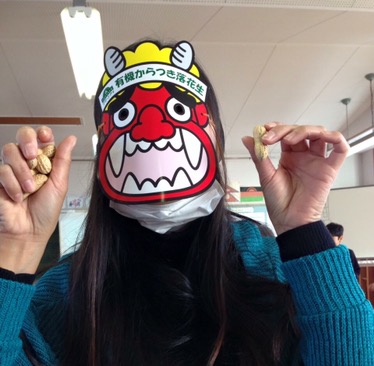
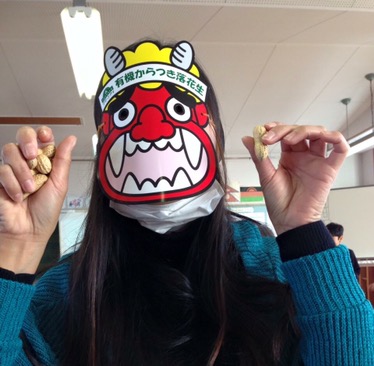
    As a teacher here in Japan, I myself experienced becoming the demon. I wore the demon mask and my students throw peanuts at me. I ran around trying to avoid there throw but, you know, kids are very energetic; of course, and I got hit many times. I lost, as it should be. It was so much fun. We picked up the peanuts after and ate according to our age. Well, I had lots of peanuts as you guess. In my school this year, we had ehoumaki for lunch and everyone got a pack of fukumame. Everybody was happy.

    Risshun (立春)


    Comes the next day, February fourth, is the risshun, or the first day of spring according to the traditional lunisolar calendar. Even though it is still cold around the month of February, even though many people still wear all their winter clothes, with their necks still wrap with thick scarves, it is not as cold compared with the previous months of January and December. Around the month of February, plums start to blossom. Plum blossom is the early sign of spring. And this time, we can say, “Indeed, spring has come.”