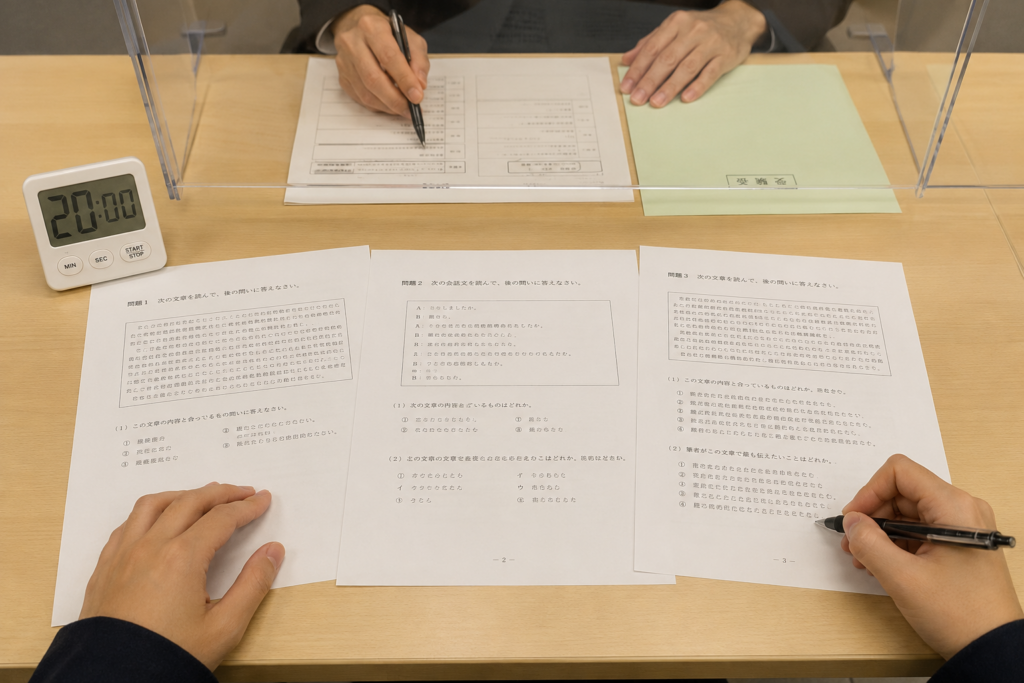
The timer started.
I had exactly 20 minutes.
The first section required me to read a passage aloud. After that, I had to convert hiragana into katakana and katakana into hiragana.
This time, I felt much more confident.
For the past year, I had practiced writing katakana over and over again. I must have written each character more than 20 times.
Unlike last year.
Last year, I completely froze. I was shocked that I couldn’t even remember how to write ク and ネ. I had spent so much time preparing for the interview questions that I neglected the writing portion of the test altogether. Ironically, I never even reached the interview because I failed the written exam.
This year was different.
I made sure I could write every katakana character perfectly before coming.
And I did.
The next page was a reading comprehension exercise. I read another passage and answered four comprehension questions based on what I had read. The first question was given. It was literal. You can find the answer right away. The second one, I had to analyze the passage. The third and fourth were tricky. It used the word 全て but I could only find one answer. Until now, I’m thinking of there were really more than one answer.
Did I do good?
I think I did well.
At least, I hope I did.
Then again, I also thought I had done well last year. My score ended up being only two out of four, and the second examiner decided not to let me pass.
It was frustrating.
Finally, I turned to the last page.
The composition.
The lady explained that I needed to write at least four lines. If I wrote fewer than that, I would automatically fail. She also reminded me not to write everything in hiragana. I had to use kanji whenever possible.
The prompt, as far as I can remember, was:
どんな天気が好きですか。その日の過ごし方を書いてください。
“What kind of weather do you like? Please write about how you spend your day.”
At first, I felt relieved.
I write in my Japanese diary regularly. Not every single day, but often enough that writing about the weather seemed easy. Every diary entry begins with the date, the day of the week, and the weather.
My first thought was to write 晴れ because it’s almost always sunny during the summer.
Then my confidence disappeared.
I suddenly couldn’t remember the kanji for 晴れ. I knew part of it, but I wasn’t completely sure, and I didn’t want to risk writing it incorrectly.
So I changed my answer.
I chose 雨 instead because I was certain I could write that kanji.
I began with:
私の好きな天気は雨です。雨の日に家でゆっくりします。娘とテレビを見ます。
(I like rainy weather. On rainy days, I relax at home. I watch TV with my daughter.)
I wanted to write 一緒に遊びます (“We play together”), but I couldn’t confidently remember the kanji for 遊ぶ or 一緒, so I decided not to risk it.
Instead, I kept writing.
I wrote that I also enjoy watching the rain because it feels mysterious. It reminds me of many childhood memories. Then I mentioned that I like flowers and that I have many different kinds in my garden. I wrote that on rainy days I don’t have to water them. Finally, I mentioned that although I like hydrangeas, cherry blossoms are my favorite because they are a symbol of Japan.
Somewhere along the way, my mind got stuck.
I couldn’t think clearly anymore.
I just kept writing whatever came to mind until I filled the entire space.
Looking back, I probably could have kept it much simpler. I could have written something like, “I watch TV with my daughter,” or, “I eat ramen.”
But it was done.
There was nothing I could change.
All I could do was hope for the best.
I finished the composition with about a minute left on the timer. That gave me just enough time to review the first two pages.
Thankfully, I caught one small mistake.
I had forgotten to add the small circle and the two strokes needed to write ポランド correctly.
That tiny review might have saved me from losing another point.
Reader responses