Blog

  • Hello world!

    Welcome to WordPress. This is your first post. Edit or delete it, then start writing!

  • Awakening

    It’s almost midnight, but I’m fully awake. With my phone in my hands tapping letters on the screen, under the blanket.

    I’m feeling guilty. I promised myself to not use screens before bedtime anymore. But here I am again.

    In the silence of this night, I can hear my daughter’s breathing. And inside me, I can feel my ideas bursting. Something, I haven’t had for a long time.

    Tonight, after reading A Long Way Home: A Memoir, I feel the need to open this blog again.

    It’s hard to believe that my last post was two years ago! Nothing after that.

    For two years, I was busy being a mother. A teacher. And everything in between.

    This morning, I bought the book.Tonight, I finished it.

    And somehow, the writer in me has once again awaken from a long deep sleep. I have been wanting to write something meaningful. But, time has passed, and no letter was tapped. No sentences were formed. Nothing is written.

    Tonight is different.

    Tonight, I am writing.

    My sentences might not be perfect. The grammar might be off. Maybe , I just want to be me.

    As imperfect as a human as I am.

    We are now living in a world relying on artificial intelligence. Photos can be edited to perfection. Sentences are polished in seconds, and information is one finger tap away.

    But with these “perfection”, we somehow lose the real “connection”.

    Maybe writing doesn’t need to be perfect. It just needs to be done.

    So tonight, under the blanket, to the sound of soft snoring, I tap letters on my phone—and finally, I write again.

  • April – the Start of a New Beginning in Japan

    The end of March is, in fact, one of the busiest times for moving companies, as university students relocate closer to their chosen universities or entire families move to accommodate a husband’s new job.

    Alongside excitement, there are also uncertainties and anxieties. Kindergarten parents, while mostly excited, may feel a bit worried about parent-child separation. Similarly, new students moving up to higher grades or levels may experience anxiety about meeting new friends or coping with new challenges. First-time employees or transferred workers may also feel uncertain about fitting in and being productive right away.

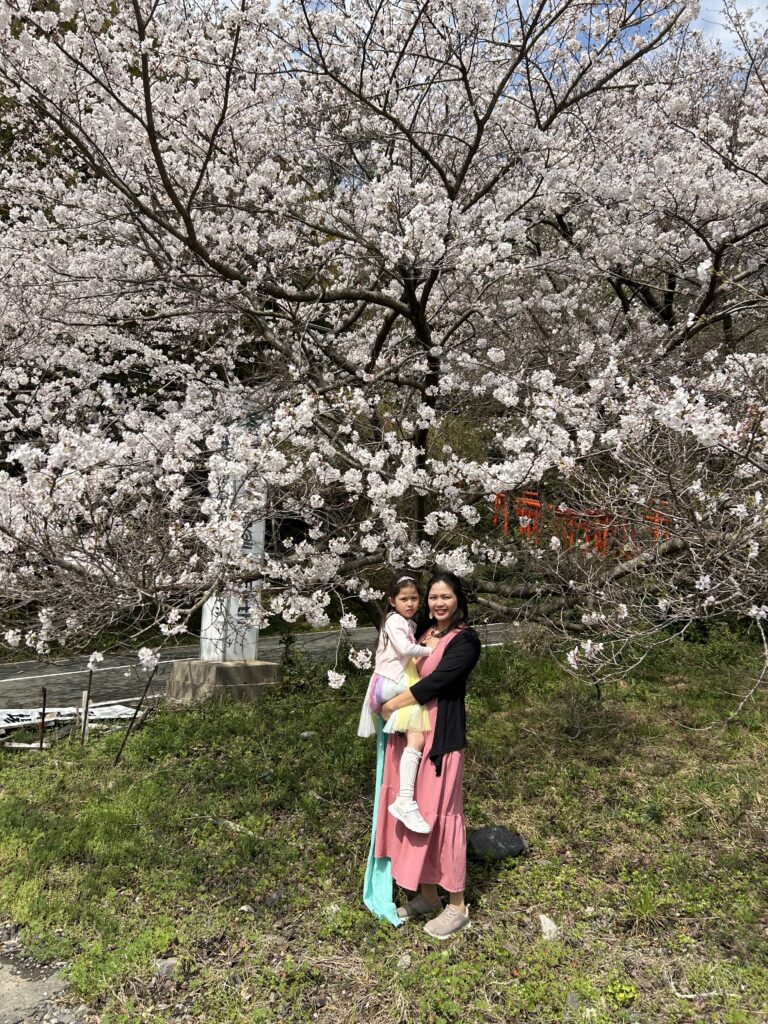
    Nevertheless, this season is filled with hope. It’s a fresh start, the beginning of another cycle towards the fulfillment of our goals. Like cherry blossoms, the cycle begins: we bud, we bloom, the flowers fade, and the leaves sprout. We are ready to face another year full of challenges and uncertainties, but most of all, a year full of determination and motivation to navigate life’s ups and downs.

  • Mari’s Great-grandma

    Mari’s Great-grandma

    No one is ever ready to face the passing of a loved one, no matter how sick or old they are. It is the only truth that people keep on denying. Losing a loved one is so surreal.

    Sunday morning of March 3rd, 2024, past 11 in the morning, Japanese time, was Saturday evening of March 2nd in the US – the shocking moment when we got a sad news that grandma Done had passed away. I immediately got my husband Casey’s attention, and then we called Mom on the phone. Mom confirmed that Grandma passed away in her sleep. Our faces showed shock, and our hearts felt broken.

    My little daughter Mari noticed my teary eyes and asked why. So, I told her that her dear great-grandma had passed away. She might be too young to understand the concept, but since my father passed away nine years ago, long before she was born, I have been teaching her what that means. It means that the person is gone forever. You can’t see them anymore. You can’t talk to them anymore, but, that person can see you. They can hear you. They are where you are, every time you think of them. That they live in our hearts forever, and stay in our memories.

    Grandma Pat, as I call her, was one of the most amazing people I have ever met in my life. I can count such people with my fingers. The day my husband brought me to meet them for the first time in their beautiful house, I was amazed and awed by how spotless and clean their beautiful home was. Homes like theirs were something I had only seen on TV or at open houses. It made me feel I have to watch my every step to avoid making a mess or leaving a mark wherever I went. Their first living room was elegantly styled, and inviting, perfectly arranged. The second, main living room was cozy and dainty in white covers, nicely decorated with her handmade creations. I was truly amazed at how she could keep her house sparkling despite her age.

    On the second floor, where her sewing room was located, I was even more impressed with how everything was so organized. It was almost unbelievable because my image of a sewing room was totally different – piled clothing, textile cuttings, scissors, threads, – thanks to those seamstress neighbors who used to sew my school uniform. Grandma’s sewing room was different. It was very organized and showcased a spectacular display of her creations and arts. The threads and textiles were organized by colors in drawers and closets. The walls were beautifully adorned with finished products and original creations. It was like a dream place for sewers and seamstresses.

    She was an amazing artist. Yes, sewing is an art and she made a lot of obra maestra. I was fortunate to be one of the lucky people who received her wonderfully handmade bags. I actually got two and I love using them. The bags are durable, lightweight, convenient, and very functional with spacious pockets. My daughter Mari, her great-grandchild, received a neatly sewn sling bag the first time they met. A cute bag that is perfect for her size and it comes with a matching purse. It is light blue and pink, with cute rabbits and a pink ribbon on it. She also lovingly taught Hana, my stepdaughter, how to sew and was very impressed with her skills. She was very happy that Hana likes sewing just like her. Sewing even made her appear on TV for a truly impressive cause. She sewed hundreds of masks during the pandemic, and her heroic act made everyone who knows her proud.

    I wanted to ask her a lot of questions, and I regret that I couldn’t. Either my timing was bad, and I couldn’t keep up with the conversation when we visited them, or I was just always at a loss for words. I couldn’t interrupt my husband when he started talking endlessly with Grandma and Grandpa. The last time we visited them, was also my daughter’s first time meeting them. I was very worried that my daughter, who was just a very active two-year old toddler, would make a mess in their very neat and orderly house. My mind was preoccupied with worrying about my daughter, causing me to miss a truly wonderful opportunity to bond with them. I wanted to ask her more about being a mother, raising children, being a wife, being a sister, aging gracefully, or just listening to her stories about her life and experiences in general.

    Nevertheless, I experienced firsthand her home-cooked meals, brief conversations about how she loves and thinks about her children and grandchildren, and she also took us out to some nice restaurants. We spent great times together with her equally wonderful sister, sweet lady, aunt Janet.

    Grandma was always with Molly, her pet dog, just as she was always with Grandpa. If I’m not mistaken, they were married for 68 wonderful years! Amazing, isn’t it? They are the only couples I know who have been together for that very long. Sharing love, sharing wonderful years, and lasting memories together. I can only wish to age gracefully like them and spend a wonderful lifetime with my husband as well. Molly, on the other hand, is truly, the cutest dog I’ve ever seen. She is small and white, with her ears cutely hanging on both sides makes her even cuter. She sits perfectly on Grandma’s lap. I never heard her bark, and she always has this cute face that beckons everyone, even non-pet owners like me, and especially our daughters. We love Molly.

    Thinking that Grandma is gone is shocking and heartbreaking for everyone in the family. Most of all, Granpa – I can never fathom Grandpa’s feeling of loss. And what about Molly? If we could only use Doraemon’s “Doko demo doa”, “Anywhere Door in English, we would want to instantly transport ourselves to the US to be with the family in this time of mourning, offering each other hugs and comfort. Since we are so far away and facing different circumstances, we can only wish that will happen. However, Mom comforted us, reassuring us that grandma is now watching all over us. There is no more pain for her, as she passed peacefully in her sleep, just as she wished.

    As I am writing this narrative, it still hasn’t sunk in that she’s physically gone from this earth. We can no longer meet her or hug her anymore when we visit our family in the US. Her face, her smile, her lovely voice – they are still so clear in my head and I am sure Grandma will live forever in our hearts and memories.

  • 11 Things in Japan That Surprised Me As a Filipino

    11 Things in Japan That Surprised Me As a Filipino

    I came to Japan in the spring of 2011 when my sister who lives in Japan invited me for a month-long spring vacation. During my stay (and even up to now) there are several things that surprised me.

    11. There are many elderlies. It is a known fact that Japan is an aging country. When I first came here, I was surprised to see people looking beyond their sixties/seventies working as traffic aid, gardener, and even working in the malls. In my country the Philippines, most people you see around are young. Mall workers are usually in their 20s to early 30s. It is also uncommon in the Philippines to see groups of elderly hanging out in a restaurant or taking a walk in the park. Whereas in Japan, this is fairly common.

    10. People wear masks. I was very surprised to see many people wearing masks when I first came to Japan. I asked my sister if there was a spreading disease or something but she said people wear it for protection, especially for people who are having kafun allergies, which was fairly common during springtime. In the Philippines, if you wear a mask, people will speculate that you are ill and need to wear a mask to avoid spreading the “contagious disease”. When I came back to the Philippines, my students were all very surprised and kept asking me if I were sick when I wore a mask to protect me from chalk dust from writing on the blackboard.

    https://maryanila.com/post/maryanilasasil.wordpress.com/393

    9. Some fruits, vegetables, and spices are oversized. I was so amazed when my sister took me to the supermarket. The ginger was big and the other vegetables were as well. Eggplants, tomatoes, and bell peppers were bigger than the usual size I have seen in my country. Eggplants also came in different shapes. The round eggplants amazed me the most. That feeling of amazement from seeing something different is a precious experience. I don’t get that same feeling anymore for being here for a long time already.

    8. There are many buildings they called apartments and mansions. I was also amazed by the buildings in Japan. There are many apartments and mansions. The smaller buildings are called apartments and the high rise are mansions. Some are government housing dedicated to low-income families. In the Philippines, big houses are called mansions, and the mansions in Japan are what we call condominiums. Although condominiums in the Philippines usually have more elaborate designs and hotel-like lobbies, complete with amenities such as swimming pools and clubhouses. These are for Filipinos who can afford them. Housing in the Philippines is still way behind developed countries. People below the poverty line mostly live in shabby houses in lots that they don’t own. ‘Squatter’ as they are called. I hope one day the Philippines can also provide government housing like in Japan to improve the living conditions of the impoverished.

    7. Most people wear subtle colors. Unlike in the Philippines where color and variety is the more popular trend, in Japan, I noticed that this was not the case. Most Japanese wear colors that don’t make them stand out from the crowd. They like to blend in and match the season. Pastel colors are the trend in spring. I also noticed that most Japanese don’t wear revealing clothes. Filipinos on the other hand, have no problem wearing colorful, sometimes showy attire. We like to be different and it is okay to stand out in the crowd. When we went to Huis Ten Bosch, a famous tourist spot in Kyushu, I made sure to wear the most colorful attire to match the happy and festive mood I had. That time, I was told that my outfit was really colorful and “medatsu”. Medatsu means to stand out. I thought it was a compliment. Maybe it was or maybe not. Now, that I have been here for a long time, being medatsu is rather a thing to be avoided. It is better to blend in than to stand out in Japan.

    6. People bow when they greet. When my sister said Konichiwa, which means hello, I noticed that she did a slight bow to the person she was greeting. I noticed that other people do it too. Vendors and restaurant staff sometimes do it by welcoming their guests. The funny thing is sometimes I noticed my sister do a slight bow even when talking on the phone. In the Philippines, bowing is not a common practice. Instead, we move our heads or eyebrows up with a smile to greet a friend coming our way.

    A tip: when you leave Japan, try to sit on the window side and watch the airport workers wave goodbye and bow to the leaving plane.

    5. Japanese money bills are big and always look new. In the Philippines, we call Japanese money “lapad” which means wide. Before coming to Japan, I didn’t know that Japanese money is actually big in size, the reason why it is called ‘lapad’. Japanese money bills are always crisp and new. In the Philippines, it is not unusual to see folded (sometimes dirty, stapled, and marked) bills, Recently, when the Philippine government released a new one-thousand peso bill with a strict handling guideline that says no folding of the bill, there was a mass uproar against it.

    4. Vending Machines are everywhere.

    Vending machines are everywhere in Japan. They are in train stations, bus stops, near a park, tourist spots, or outside an apartment complex. Or just along the streets. Vending machines are not limited to bottled drinks. There are also those that sell ice cream, coffee, hot choco, cigarettes, and snacks. I was surprised to see one selling condoms! Whereas in the Philippines, I haven’t seen or experienced buying in a vending machine. We have “sari-sari store” – a small residential shop that sells anything. Sari-sari means variety. The more complete and wide the selection of merchandise a sari-sari store has, the more popular it becomes in the neighborhood. Sari-sari stores are also everywhere. In a busy neighborhood, you will be surprised to see the number of sari-sari stores and that most houses have their own sari-sari.

    https://www.facebook.com/reel/648557470394369/?s=fb_shorts_tab&stack_idx=0

    3. Toilets are fantastic!

    Nothing beats Japanese toilets! I was very impressed with its very high technology and efficiency. Most toilets in shopping malls are very clean, have an automatic flush, and have different buttons for different purposes. Bidet’s water pressure – Strong? Gentle? Do you need a massage? Do you want to flush with a little water? A lot? Do you want to hide the sound of your pee with a recorded sound? Go ahead. Just press the right button. Make sure not to press the “call an emergency” button or else the alarm will sound and a couple of responders will come to your “rescue”. I had trouble one time I was in a hospital to visit a patient. I wanted to flush but pressed the wrong button. The alarm sounded and two nurses came. My mom also accidentally pressed the emergency button in a toilet at a subway station. Two women came rushing to the site. But, not all toilets in Japan are that hi-tech. The very old traditional style squat toilet still exists and usually found in a community park or old buildings. For women, watch where you face when squatting and how far your legs are apart if you don’t want to get your feet wet with the splash. In most households in Japan, toilets are high-tech. My sister’s toilet automatically opens and closes its lid and automatically flushes when you leave. Philippine toilets are pretty much basic. A small cubicle, a toilet bowl usually with no cover and if you’re lucky, some tissue paper. Don’t be surprised to be asked to pay for toilet fees in some malls or bus stops, too. Also a different fee for pee only and poo.

    https://www.facebook.com/reel/1926606887699633/?s=fb_shorts_tab&stack_idx=0

    https://www.facebook.com/reel/1832445813780571/?s=fb_shorts_tab&stack_idx=0

    2. People line up for their turn. I was very impressed with how disciplined and patient Japanese people are. They line up getting on and off a bus or a train. They line up to go up and down the escalator. They are always very patient and just wait for their turn. No complaints. No overtaking. Everything is in order. Whereas in my country, most people are impatient and just want to be the first. Many jump lines which sometimes can cause disagreements. Even inside the church when taking communion, in Japan, they do it by the proximity of the seat to the priest. But in the Philippines, everyone just flocks towards the priest to be the first. There are many instances that I can compare and contrast Japanese and Filipinos but this “waiting in line” in Japan is something that the whole world, especially my country, should learn and adapt to.

    1. It is very clean and orderly in Japan! The cleanliness and orderliness in Japan will impress every visitor. I loved how the streets are very clean and clutter-free. There are no trash that can be seen on streets. There are no broken roads and almost no open dirt that could turn to mud on rainy days. There are no excessive posters on building walls. Cars and other vehicles look new and well-maintained. Public toilets are clean and free. There are no beggars or obvious homeless people in sight. Houses are clean outside. Parks and playgrounds are plenty. Flowers and greeneries are everywhere. I never heard a car honk and even myself have never ever used the horn while driving for almost seven years already. Traffic is smooth. Japanese people dress nicely and neatly. No loud noise from car stereos or neighbors’ karaoke. It is peaceful, clean and orderly.

    I fell in love with Japan the moment I arrived here. I wished to stay longer and it happened. I wished to stay even longer and now I am still here. A permanent resident and settled. I now call Japan my home. But despite that, there is still no place like my original home – the Philippines – where even though there is a big social disparity, everyone finds happiness in the littlest of things. People celebrate the littlest success. Scarcity doesn’t matter when Filipinos want to celebrate. And that is one thing hard to find in Japan. Japanese are frugal, practical and private people whereas Filipinos are celebratory and mostly open and happy people.

    https://maryanila.com/post/maryanilasasil.wordpress.com/608

  • The end of my breastfeeding journey

    Breastfeeding is hard in the beginning, harder in the end, and hardest when it’s over.

    I literally cried silent tears tonight afte my little girl, for the fifth night, slept without breastfeeding. I felt the distance between us when she decided to sleep on her own under the blanket in a position she chose. Not in my chest nor in my shoulder, but on her pillow, cuddled on her side.

    For many months I tried to stop her doing it. I complained that it’s painful with her teeth so sharp. That she’s too big for it already. I was trying to make her grow up and be a big girl but she won’t. She likes to be a baby. She likes to be carried. She likes the comfort and warmth.

    And now, that she can finally sleep without it, my foolish heart is regretting. I want to nurse her again just like when she was a newborn. I should have not complained. I should have given it more willingly. Without making her feel guilty for wanting it at her age. Two years and eight months in our breastfeeding journey may be long to some people, even to me. But now that it is over, it felt short. It felt abrupt.

    It is the end.Or I hope so. Or I hope not.

  • Why the end of my breastfeeding journey brought me to tears

    May 15, 2022. Two years, six months, three weeks, and two days, for the first time, my little one snoozed without the boobie in her mouth. She believed the story I made there was wasabi in my boobies and she won’t latch because of that. But after that, we were back to where we were. We continued on our breastfeeding journey with constant pull and push. I always tell her to stop already. That she is too big for it. That with her sharp teeth it hurts. But she won`t just let go like that. She likes to be a baby. To be carried in my arms like when she was just a newborn. She likes the comfort and the warmth it gives her. It is her most favorite part of me. It is her most favorite place to be close to me. It is also the easiest way to get her to calm down when she cries. When she gets sad or sleepy. It is a tool I used to get her attention and sometimes bribe her or scare her when she does something bad. I am not a perfect mom. And I do tell her sometimes `No more boobies for you`.

    Now, July 16, 2022, Saturday, five nights have passed that she did not breastfeed anymore. It started when I went to the clinic and got medicine for my upset stomach. I told her she can`t breastfeed because I took medicine and the medicine is inside my boobies. I was surprised she did not hysterically refuse. Although she attempted to breastfeed a few times, she stopped trying when I reminded her about the medicine. She settled with hugging, touching, and kissing. This is the longest so far that she missed breastfeeding.

    And tonight, I literally cried when again, my little one snoozed without me giving her the boobies. Instead, she hid under the blanket and slept on her side. I thought she was just playing hide and seek but she was not. She was actually trying to find a comfortable position to sleep.

    I was hurt. I felt that she did not need me anymore. I miss the times her having to fall asleep on my chest. Those times when couldn`t sleep without the boobies. She is growing up and she can sleep on her own already. I was foolish for feeling that way. For many days and nights, since she became a toddler, I always complain when she breastfeed – It hurts. It`s too much. When is she going to stop? But now, that she stops, I want to go back again and nurse her and hold her in my arms.

    Breastfeeding is hard. Weaning is hard. But letting go is the hardest. And moving on is a challenge I have to take.

    I cried tonight and I am afraid that tomorrow, I might give in again and breastfeed her again. A part of me is telling, yes, it is fine. Carry her more. Hug her more. Nurse her more. But, my head says no. It is time to let go and let her grow and be a big girl already.

  • Lines of a Toddler

    “By Myself”

    My little one who is two years and eight months old as of writing, is always trying her skills and practicing her independence.

    Her favorite line to say these days is “By myself”, telling me to let her do things by herself. If not, she will morphed into a disappointed, frustrated, angry little human and I have to let her restart things from where she wants it to be.

    In the toilet, when I close the toilet lid and flush, she’ll be mad and say “By myself!” And she will open the lid again to close it again and flush it again. By herself.

    When I turn on the faucet to wash my hands, she will say “By myself! And she will turn it off to turn it on again. By herself. The same with getting soap from the dispenser. She doesn’t like it when I put soap in her hands. She wants to do it by herself.

    When I close the door upon leaving the toilet, the little human who follows me everywhere I go gives me a disappointed look and says “By myself!” And she will open the door again to close it again. By herself.

    When I start vacuuming the floor, she will grab it from me and say “By myself!” And the war will start. I want to do it by myself too, to finish faster. And a vacuum is not a toy! The usual ending is we do it together until my patience lasts or her boredom strikes.

    In the garden, when I water the plants with a hose, she will grab it from me and say “By myself!” And another war will start. Oftentimes she likes to over water some plants which I really don’t allow. Especially when she starts watering the house walls, the gravel, or when she points the hose higher she can wet things or people over the fence. The solution is we take turns by counting. I water the plants while I count 1-20 and then it will be her turn for another 20 counts but with my hands guiding her hands to which she doesn’t really like and she keeps saying “By myself! By myself! while trying to let go of my hands from hers.

    She is trying her skills and so eager to do things on her own, yet she’s still too little she still needs me most of the time.

    I Know How

    She learned this phrase when I started praising her for what she does well. Or when she does something new. I tell her “Wow! You know how! With all big smiles and praise. At first, she copies the same exact line “You know how!” until I taught her to use ‘I’ instead of ‘you’.

    She says “I know how” when she successfully completes her puzzles; when she buckles her stroller; when she puts on her shoes right, and I can’t remember the rest of the scenarios.

  • Gardening Trouble

    One trouble about gardening is planting without knowing the characteristics of the plant.


    I fell in love at first sight and bought this “beautiful” tiny plant with attractive neon green leaves a year ago and planted it on the ground. I was happy with it all spring and summer until I noticed it was spreading and had extending runners. Once the runners touch the ground, it roots and form another plant. It’s spreading!!


    So I removed it from the ground and discovered that the roots had already spread. I dug them out and moved some in the pot.

    Now, it’s spring, I noticed that it’s back growing profusely. It’s scary! Even though it’s a beautiful plant but too much and too many of them spreading and invading other plants is a terrible sight.

    I had a similar experience with mint. When we moved in our house, the garden was bare. My friend, a gorgeous Japanese lady, gifted me a container garden with beautiful flowers for our front door and a few cuttings of mint to plant in the ground.

    After a few months, those innocent mint cuttings turned into a colony! Although they smell awesome, they are choking my roses and they started sprouting all over the space. I uprooted them and moved some of it to the rocky and not very favorable side of the garden for plants to grow. And guess what. It made a colony there again despite the condition. I had to uproot them and contain them in a pot.

    Now, I still see them sprung from the ground from time to time and I just uproot them right away.

    With this “beautiful” neon-green colored plant, which I found out to be ground ivy/creeping Charlie, also called grecoma in Japan, the trouble of digging them out has just began. But it looks like I can’t stop it from spreading since it has spread to areas I can hardly reach :-(.

    Oh, well. I don’t know what to do.

  • 10 Differences Between Elementary Schools in Japan and the Philippines

    1. Teachers in Japan do not have a permanent school assignment. They change schools. They can only teach in one school for three to four years the longest. They have to move to another school within the city or the neighboring cities. New teachers change from one to three years and veteran teachers who are about to retire can stay in the same school for up to seven years.

    In the Philippines, most teachers stay in their assigned schools until retirement, unless they want to be transferred to another school for personal reasons or for promotion.

    2. Teachers in Japan change grade level assignments. Not only that teachers have to change schools in Japan, they also have to change their grade levels assignments. For example, a teacher who teaches first grade this year will most probably be teaching second year the following year. They follow the students they are teaching. Few teachers remain in the same grade for consecutive years.

    Whereas in the Philippines, most teachers stay in the same grade level until retirement. It is not uncommon for siblings to have the same first grade teacher.

    3. Class schedule in Japan changes everyday. Class schedule in Japan is not fixed for the whole year unlike in the Philippines. The schedule is announced a week or a day before usually on Fridays. It is very easy to change the class schedule in Japan because all subjects are taught at equal amounts of time. Each subject is taught at 45 or 50 minutes. Unlike in the Philippines, academic subjects like Math and Science are taught up to one hour or longer and shorter time for non-academic subjects like Music or Home Economics.

    I was very surprised about this when I came to work in Japanese public elementary schools because in the Philippines we decide on the schedule at the beginning of the school year. Teachers gather and spend a good amount of time making the schedule that would fit every teacher’s individual schedule and every class’ individual schedule. It’s not easy to make the schedule work for every teacher and every class. Once decided, we follow this schedule from start (June) to end (March) unless there are important changes that we need to do.

    4. Japan is a country that values equality and uniformity. Equality in schools is observed through equal treatment of students in terms of opportunities and participation in activities. For example, on a Sports Day, all students participate regardless of their physical abilities. Everyone can participate in racing whether he runs fast or slow or even in wheelchair. Whereas in the Philippines, competition is common. We have all sorts of school competition (Quiz Bee, Spelling, Beauty Contest, Money Contest, Sports Meet, etc.) which is not very common in Japan. It is a battle of the fittest in the Philippines. And only the fittest and the brightest shine. Uniformity is also a very important attribute of Japanese schools and the whole society in general. This can be seen through uniform designs of school bags, school shoes, haircuts and even hair color in junior high schools and high schools. Wearing black suits over white inner is common and considered standard for students on the job training and for those looking for a job. Subtle, basic colors are the staples. It is not pleasing to stand out like a sore thumb in Japan, which is the opposite in the Philippines. Filipinos like individuality and assortment and we like to stand out. Medatsu is a Japanese word which means to stand out. In Japan, you don’t want to be a medatsu, but in the Philippines, being a medatsu is encouraged.

    5. Outdoor and indoor shoes shoes culture in Japan. The footwear worn from the house and outdoors will not be allowed to be worn inside the school buildings. Each class/student has their own shoe box. Upon entering the school building, outdoor shoes are changed to indoor shoes. Japanese are very particular about cleanliness. Indoor shoes help to avoid dirt getting inside the school building from outside.

    In my native land, this custom doesn’t exist. Although some individual teachers require their students to bring indoor shoes, and have their own classroom shoe box, this is not considered a standard for everyone to follow. It’s all up to the teacher or the principal.

    6. Japanese teachers should be able to play the piano and swim before they can pass to be a licensed teacher. In Japan, each elementary school teacher is expected to teach music, play the piano of course and to teach swimming in the school’s swimming pool.

    Most public schools in the Philippines don’t have a single piano. Even the small private schools don’t. Teachers teach music even without the ability of playing any musical instrument. It is not a requirement. But, Filipinos love to sing. And I wonder why even though we lack many musical instruments, which sometimes we can only see in pictures or drawings that teachers ask the students to draw (draw the three types of musical instrument: brass, wind and percussion and make a scrap book in music class), we can still sing out loud from the bottoms of our hearts. 🙂 Many Filipinos are famous singers locally and internationally.

    For an elementary student in the Philippines, having a swimming pool in the school is like living the dream. Filipinos love swimming. Most occasions like birthdays we like to celebrate it in the beach. But, unlike Japanese, we don’t learn basic swimming skills in school. We learn it on our own. Pretty sure by just going to the beach often or the nearby river. Beaches in the Philippines are open all throughout the year and we even have night swimming. This is a big surprise to the Japanese people since they can only go swimming in the beach in summer. Night swimming is rare. Swimming schools are open all throughout the year but swimming pools are only open in summer.

    7. School lunch in Japan is prepared at schools or school lunch centers. School lunch is one of the best features in Japanese schools. I have a different detailed blog about it here. I like Japanese school lunch. It saves me from the hassle of preparing my own packed lunch and saves me some yen since school lunch is cheaper compared to buying food outside. It’s nutritious, well-balanced and well prepared. Japanese students help in the distribution of their school lunch. Whereas in the Philippines, students can opt to bring their lunch boxes, buy at the school canteen or go home and eat if their houses are close to school.

    8. Japanese children walk to school on their own (with exemption of those living in far-flung countryside). Chaperon and giving children rides to school are greatly discouraged and most often not allowed in Japan. Students go to school by groups according to their area of residence. In the beginning of classes in April, parents and guardians will accompany grade one students on their way to school but only up to few meters away from their houses. Not all the way to school.

    It’s a different scene in the Philippines. In the beginning of class, about 90% of grade one students are taken to school by their guardians. Guardians even stay to watch the class from the classroom windows. Although this is discouraged by the school, some parents couldn’t help but watch their kids in class. In the weeks that follows, fewer guardians do this. Many children, especially lower grades, are taken to school (up to the school gate) by their guardians all throughout the year. In some private schools, there are car pool companies that take children to school for a specific amount of fee.

    The difference lies about the distance and safety. In Japan, students should go to the nearest elementary school in their area, not in any school they want to go unless they want to go to a private school. It’s usually a few minute walk from their houses. Except if you’re living in the inaka (country side) where your school can sometimes be as far as an hour walk. In the cities, there are traffic volunteers (usually the elderlies) that guide students in their way to school making sure of the safety of the road. Parents, teachers and principals also help in doing this. This is called ‘koutsu jidou’ in Japanese. Parents take turns doing this. It is very common to see the elementary school principal guiding the traffic and greeting students in front or near the school gate. In the beginning of classes, usually the whole month of April, teachers accompany students halfway on their way home where guardians are waiting to take them up to their houses. This is only done in the beginning and when students get used to it, they go to school and go home with their own groups. Whereas in the Philippines, many parents opt to send their children to central schools, the big schools in the heart of the city, which is very far away from their houses and nearly impossible to get to by foot. With the distance problem and the traffic, it is dangerous and impractical to walk to school.

    9. Recess time in Japan is not eating time. Classes in Japan usually starts at 8:30 in the morning. Four subjects are taught in the morning which usually last 45-50 minutes with 10-15 minutes interval. The nakayasumi is the mid-break and the longest break. During this time, students can go to the playground or to the library or just relax and have a break. In the Philippines, subjects are usually taught consecutively without intervals (for example, schedules are 8:00-9:00, 9:00-10:00) and during the recess time, students usually eat their baons (bring to school snacks), or go to the school canteen, or buy at the canteen tray delivered in their very own classroom. Baon can be food or money or both. This is a part of Philippine culture that most school children look forward to and recess time is jokingly everyone’s favorite subject.

    10. Bringing money to school is okay in the Philippines but not in Japan. As mentioned above, students can buy food to eat during recess time in the Philippines and students can bring money as much as their parents can afford to give them. In Japan, it is uncommon for students to bring money to school and if they do, there is a limitation, for example, elementary students can only bring ¥100, junior high schools ¥300. There is nothing to buy at the school so there is no need for money. Japanese students are also not allowed to bring their own snacks or use accessories or bring CDs etcetera.

    These are only few of the many differences between the elementary and junior high schools in Japan and the Philippines. These differences are of course very normal and not written to make one country look better or bad. These differences are part of the culture and that is what makes each country unique.