Author: Maryan

  • Elementary School Recognition in the Philippines compared to Closing Ceremony in Japan

    Elementary School Recognition in the Philippines compared to Closing Ceremony in Japan

    In the Philippines

    Elementary School Recognition in the Philippines is always treated like a festival, a big event for honor students and a busy day (and days prior to it) for teachers. It is also being looked forward to in the beginning of class by students whether one can receive awards (and rewards) from parents.

    I remember when I was still an elementary student, my parents, especially my father, would always motivate me to get the highest honor if I want to get a reward. I was around second or third grade when I was told that if I get the first  honors, I could get a bicycle. I was only second, so I got a pair of shoes instead. But, that is how parents always motivate their children to do better in school. Or my family at least.

    School Recognition in the Philippines is the survival of the fittest and the battle of the brains and charms. Students are awarded according to their abilities and performance. We have the top awards: first, second and third honors. Sometimes we give fourth and so on. We also have the best awards: Best in English, Best in Math, Best in Science, Best in Filipino….name all subjects and we have “Best” awards for that. Another awards, the most awards: Most Neat, Most Diligent, Most, Behave, Most Punctual, Most Generous…name all adjectives and maybe we have an award for that..:-) Of course, we have the other awards: Boy Scout of the Year, Girl Scout of the Year, Drum and Lyre Member, etc.
    CIMG0416

    Students and parents work hard to get any of these awards. And some (if not most) teachers employ this “trophy” to motivate (or scare) students to do their best and get a passing or if not a failing mark.

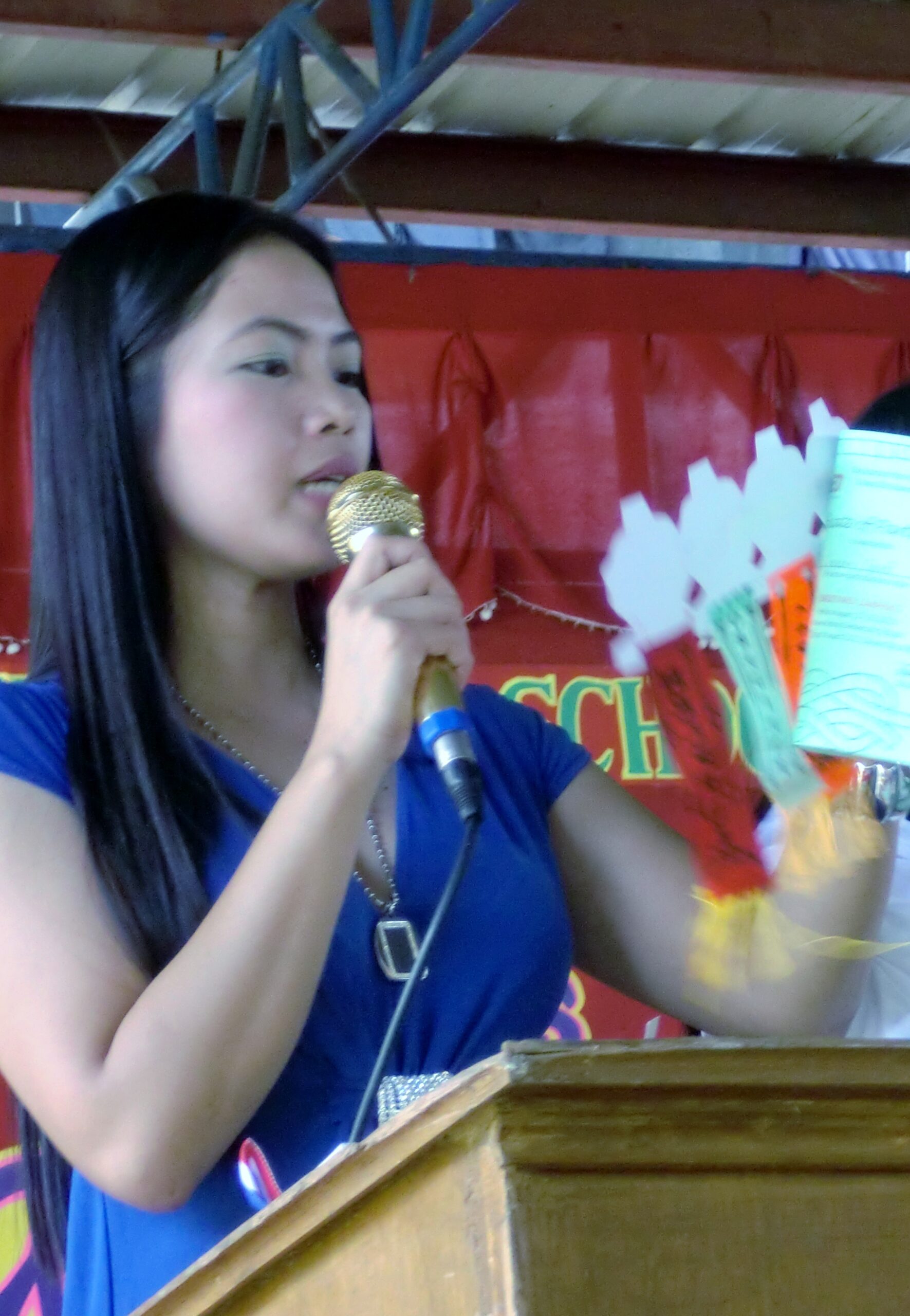
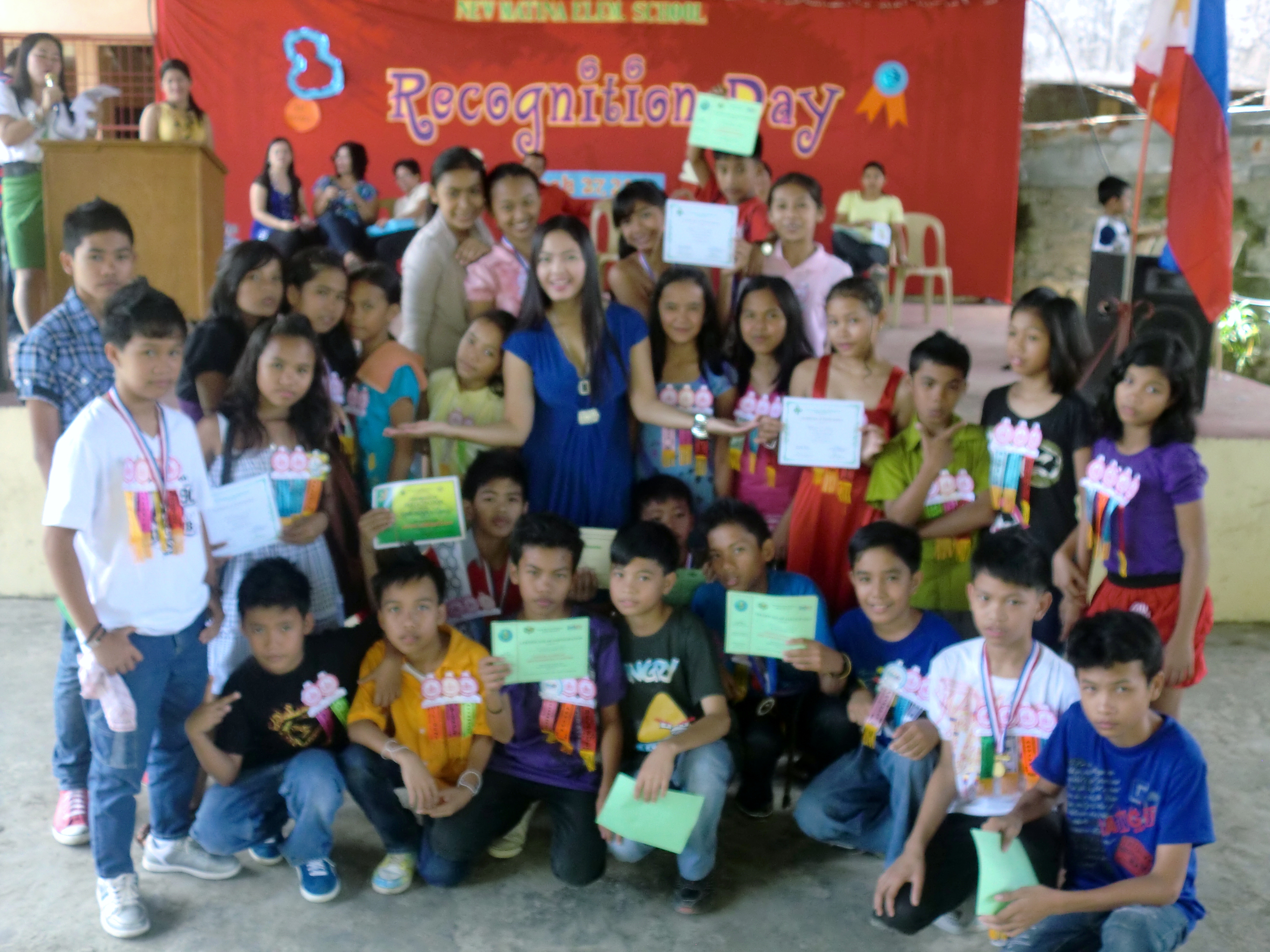
    On Recognition Day, the school stage is well decorated complete with loud speaker and a podium. Students with awards and recognition are all excited and happy. They are dressed in mostly new clothes and shoes, very proud to go up to the stage together with their parents or guardians, who, in most cases, also wear nice clothes just for the event to receive their awards, a ribbon or a medal or a certificate.

    As for teachers, this is not a very easy task. When I was an elementary teacher, this recognition season somehow gave me a headache. I was the type of teacher who wants to acknowledge the students effort, may it big or small. I wanted to give all my students an award, even if it says Most whatever adjective to recognize the students` effort for the whole year. But of course, not all students do their best. And those things gave me headache thinking what award to give to all my students. My fellow teachers would tell me not to worry about that too much and just give a few. After all, it is not going to be an award or a special award in that matter if everyone can get it anyway. There was a year I remember that I  did not give anything to few students who I had a hard time dealing with. This was to teach a lesson to everyone that if you want to get something, you have to work hard for it. But, it did not turn out nice. Those students felt bad of course for getting nothing, and my heart was crushed seeing them sad. And since then, I always make sure that no matter how slow (or bad) some students are, I would work hard and motivate them to join something like Boy Scout so I can give them something on Recognition Day.

    In Japan

    On the other hand, in Japan, closing ceremony is a totally different scene. Japan is a country that values equality and simplicity. Things like competition for honors and awards, like what we have in the Philippines, doesn`t really exist. Days approachinrg the last day of school seem to be ordinary days. Students go to school and learn and teachers teach. In the Philippines, days approaching the last day of school, we tend to have “irregular” class since teachers are busy preparing for the Recognition Day and some students are busy rehearsing their dance and song presentation for the event.

    On the last day of school, before spring break in Japan, they have what is called 終了式 read as shuuryushiki, which means closing ceremony. All students and teachers gather in the gym usually in the third or fourth period. That means to say, they go to their classroom in a regular manner during the first and second period. Nothing really festive. Some classes do owakarenokai or closing party but it is not the party you have in mind. They just do a simple blackboard decoration and teachers and students do something which is really not big of a deal. It is a simple looking back-goodbye party. Most schools also have a school owakarenokai where all students gather in the gym and each grade will do a song or recitation performance. Nothing extravagant costumes or props. But for sure, a very good performance. They also make it special for the sixth graders who are leaving the elementary school life.

    [wpvideo vgPk6GfE ]

    During the closing ceremony, as everyone is gathered in the gym, teachers will remind the students how to spend spring vacation right. They talk about the do`s and don`ts and there is a lot of them. Some of the do`s are `Do your homework`, `Do go home early`, and more of don`ts like `Do not go to game centers`, `Do not talk to strangers`, `Do not go home after dark` and all these warnings to make sure that the children are safe and do well during spring break. They have some kind of awarding but in my experience, I have only seen the librarian gave award to students who read the most books and that`s it. When students go home, they bring with them their report card and that contains their performance in school.

    Cultural Difference

    I can see the cultural difference in both countries. In the Philippines where people are mostly competitive, fun-loving and and value honor and pride and in Japan where people prefer simplicity and equality. Of course, there are advantages and disadvantages of both but this is our way of life. This is our culture. This is what makes us us. When I came here in Japan and witnessed how simple their closing ceremonies are, and how the slow learner students don`t get their pride crushed and feel and discriminated during Recognition Days as in the Philippines, I wished that we could do the same thing in the Philippines. A simple closing ceremony just like in Japan. But, if we did the same, I would never have the memories of going up to the stage with my parents and have my ribbons and medal don on my neck and of course the picture-taking. Who can forget.
     

  • English Bulletin Board for March

    English Bulletin Board for March


    Long overdue. I know. It`s July now and this article is about March Bulletin Board. This was my last BB in my previous school. I changed school since April, a new contract. I will tell you more about that in another article.

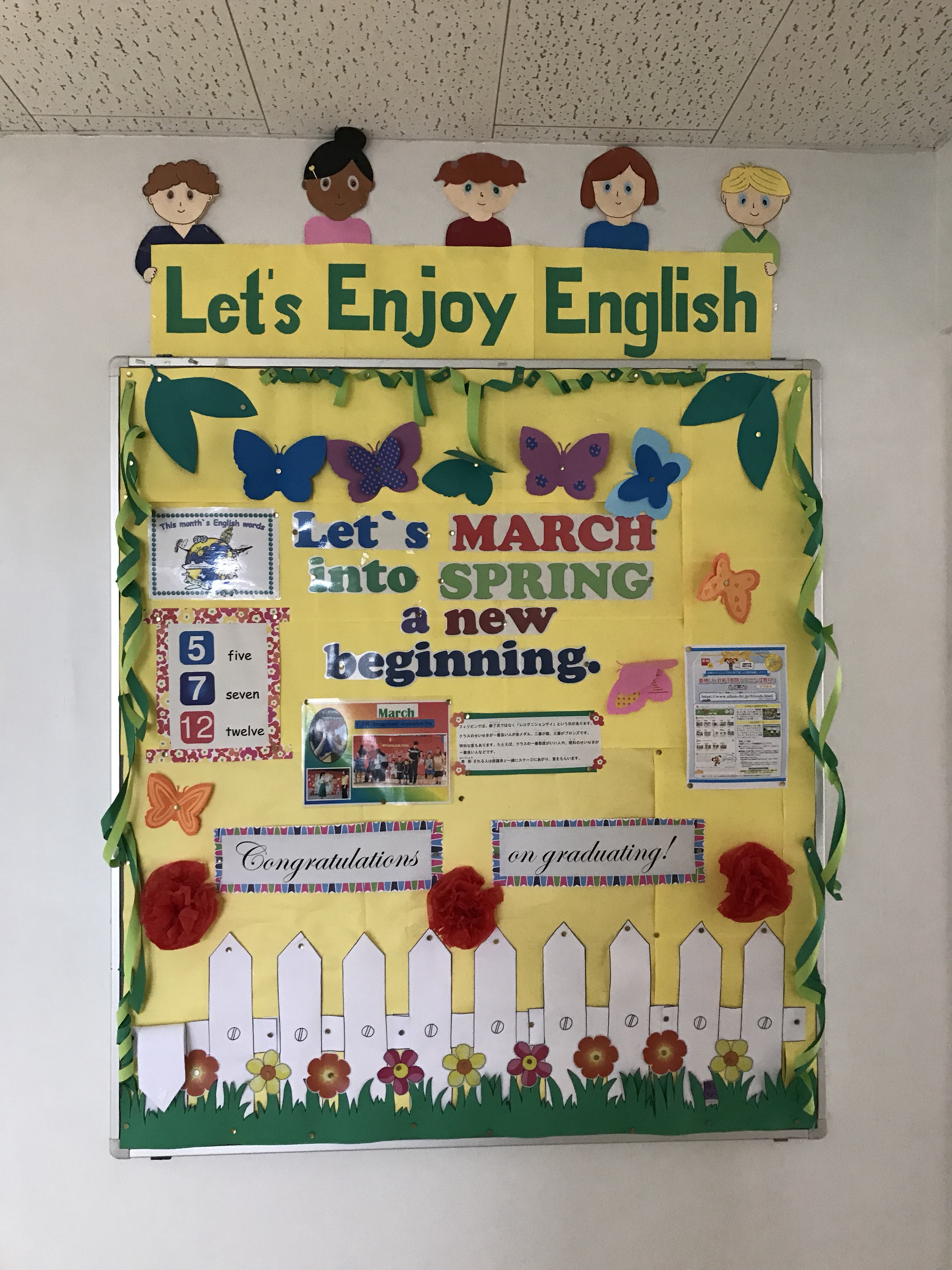
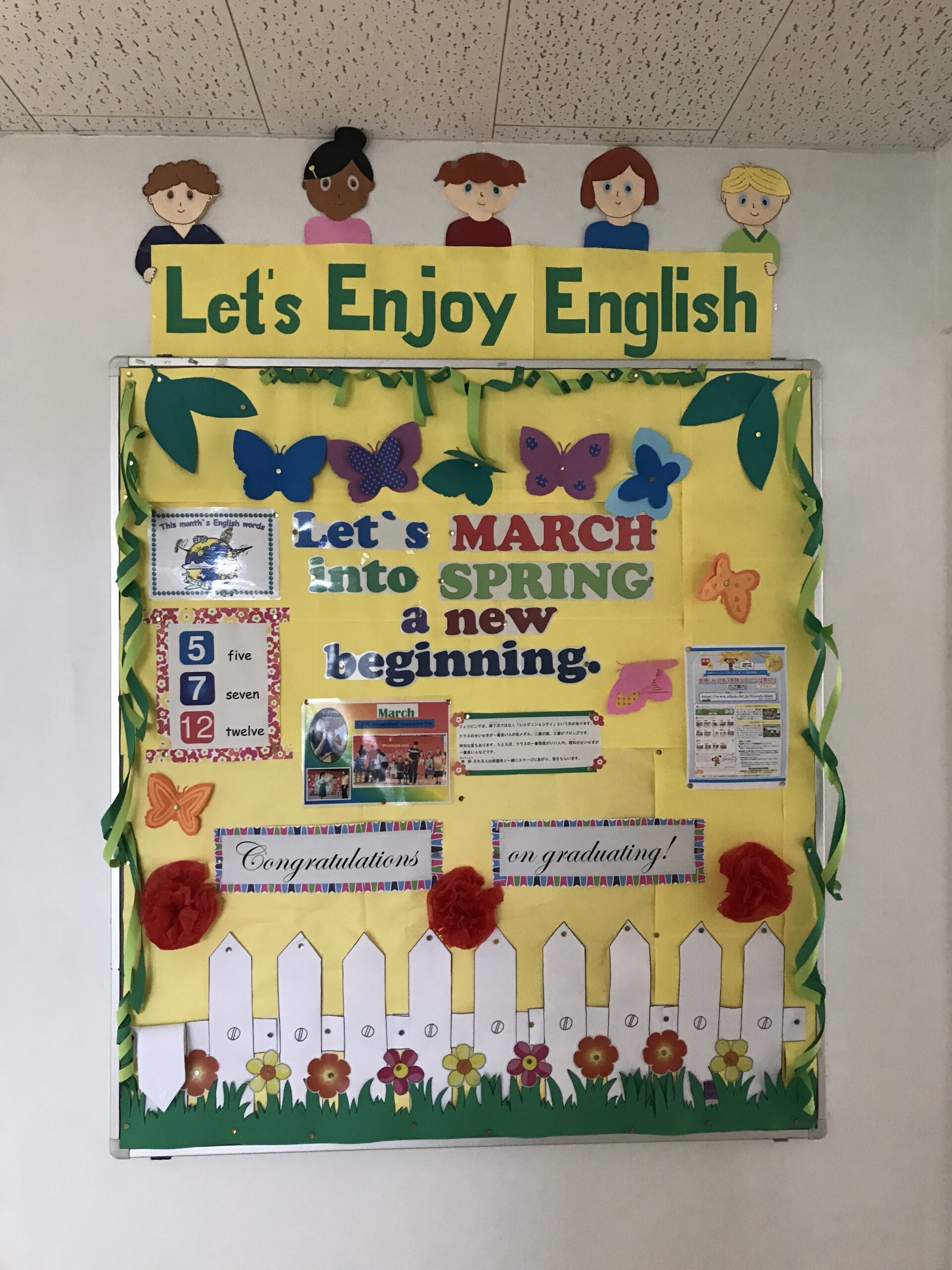
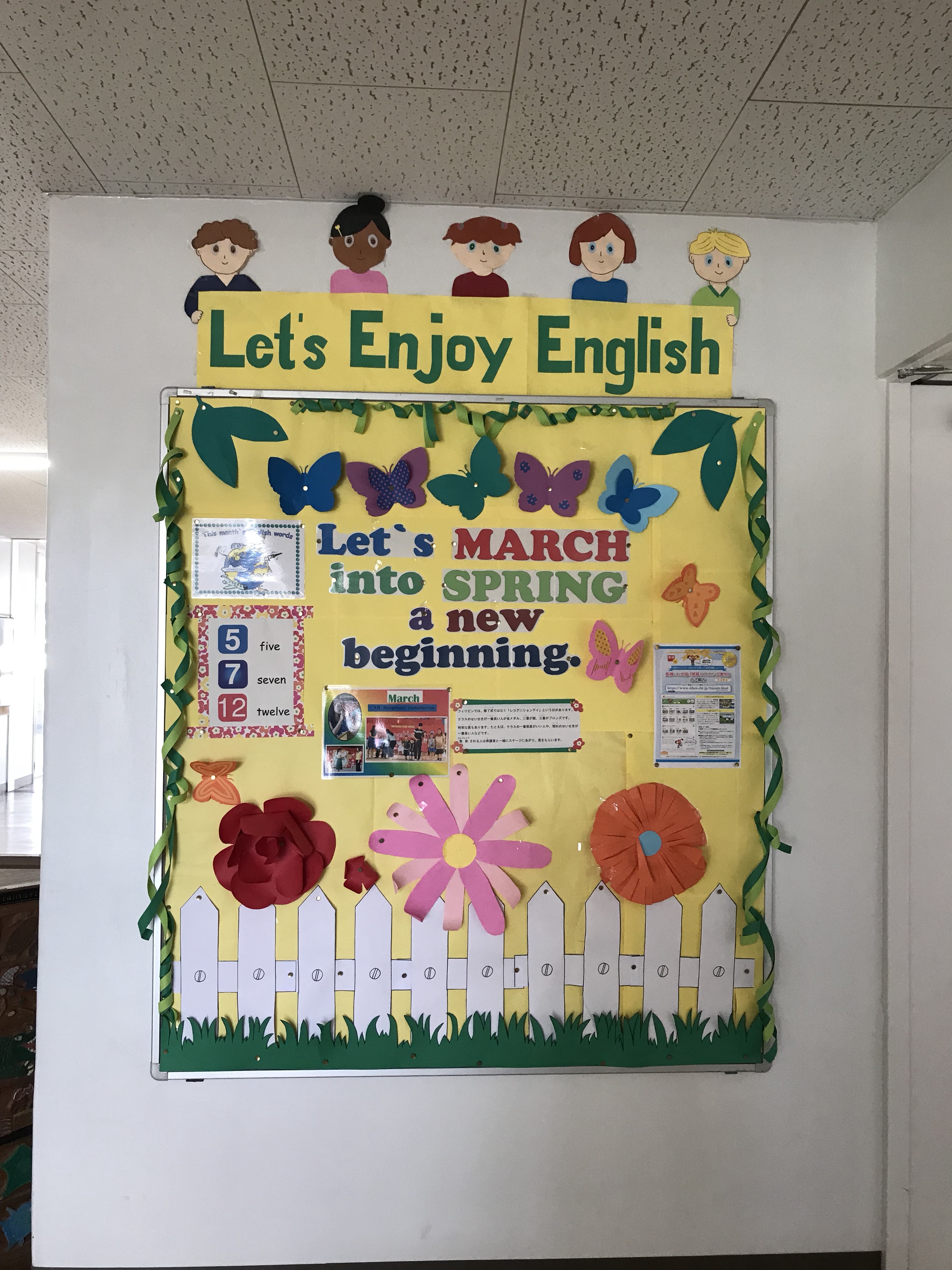
    As you can see, spring is the theme for my March BB. I made big 3D flowers and some butterflies. I also put some paper tendrils on the sides to act as borders.


    At the end part of March, I took away the flowers and changed it with congratulations message for the graduates. The picture in the middle with the word March  shows how we do Recognition and Closing Exercises in the Philippines. It is to show them the cultural difference between Philippines and Japan. And I will tell you more about that, too, in another article. See you, then.

  • English Bulletin Board for February

    English Bulletin Board for February

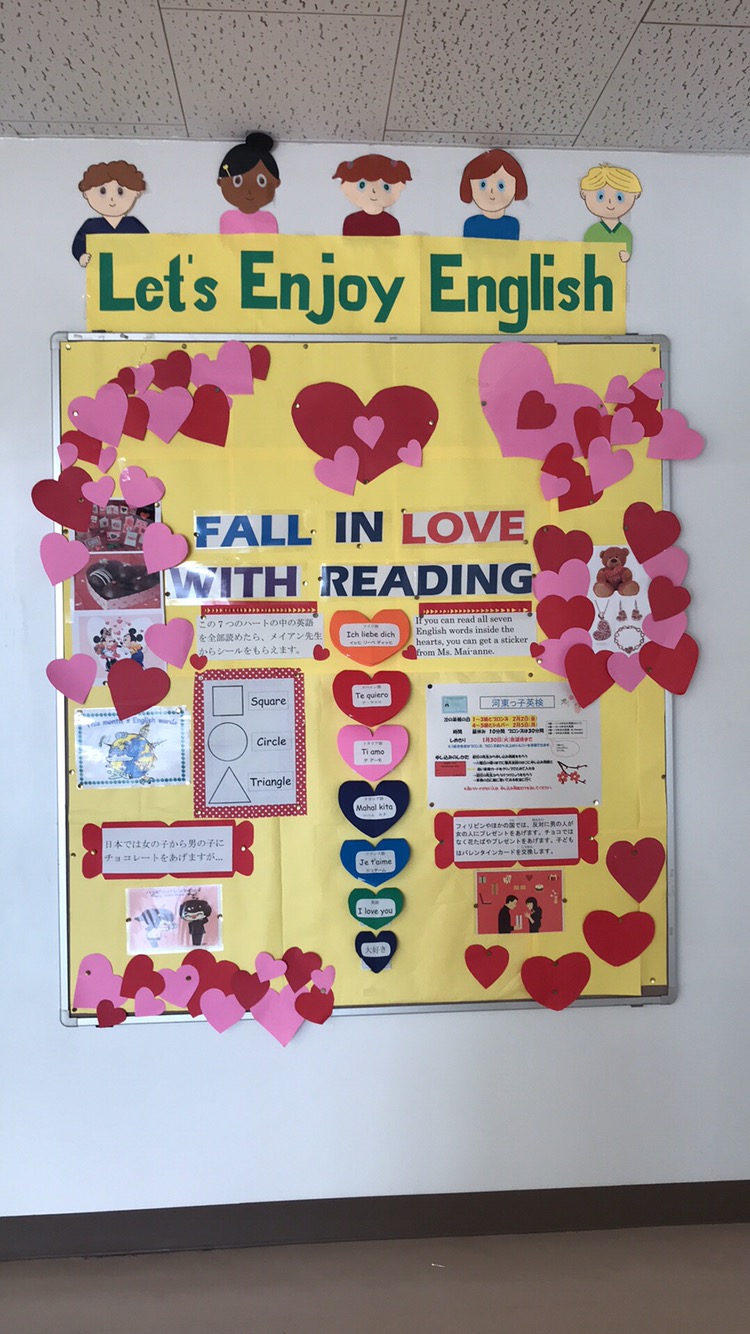
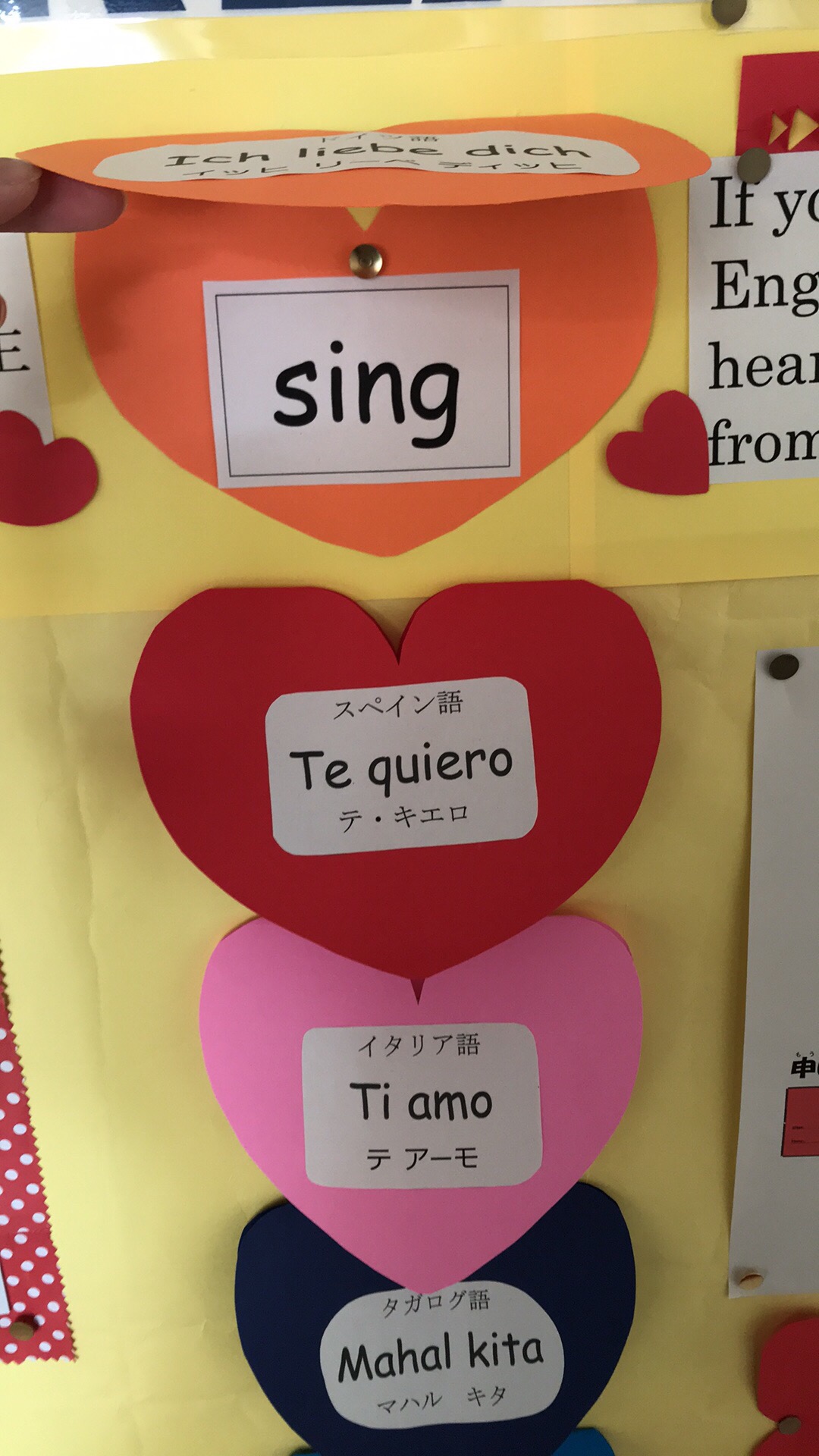
    The English bulletin board for this month, February, turned out to be the most interactive board so far and also the easiest one to make. We say that “Plan your work, and work your plan” , but this time, I really did not make a lot of planning for this board. I was scanning for ideas in google images and I found the line “The Language of Love” and so I decided to, again, translate a phrase to other languages, just like what I did in November and January. And since it`s Valentines, I chose the phrase “I Love You”. I researched the translation and printed them on an ordinary A4 paper and cut them out. I also found a line that says “Fall in love with reading”, and from that came the idea of making the board interactive.

    So, now I have to themes to choose from, the first “The Language of Love” and the other “Fall in love with reading”.

    While cutting folded heart shapes in different sizes, I was thinking of putting the “I love you” in many languages on top but I didn`t know what to put inside. Then, like a snap, the idea of putting random words inside the cut-out hearts was born.


    And came February 1st, the first day of the month, when I usually update the EB (English Board), I still couldn`t picture in mind what the final outcome would be.

    What I did first, was just use the old heart cut-outs I found in the English room that`s been sitting there in the cabinets for years. I put them on the sides to create a border effect. And then I put in the center, the theme of the month, the winning second choice `Fall in love with reading`. Below that, I lined up all the heart cut-outs and on both sides I put the instruction on how to do the challenge, in Japanese and in English.

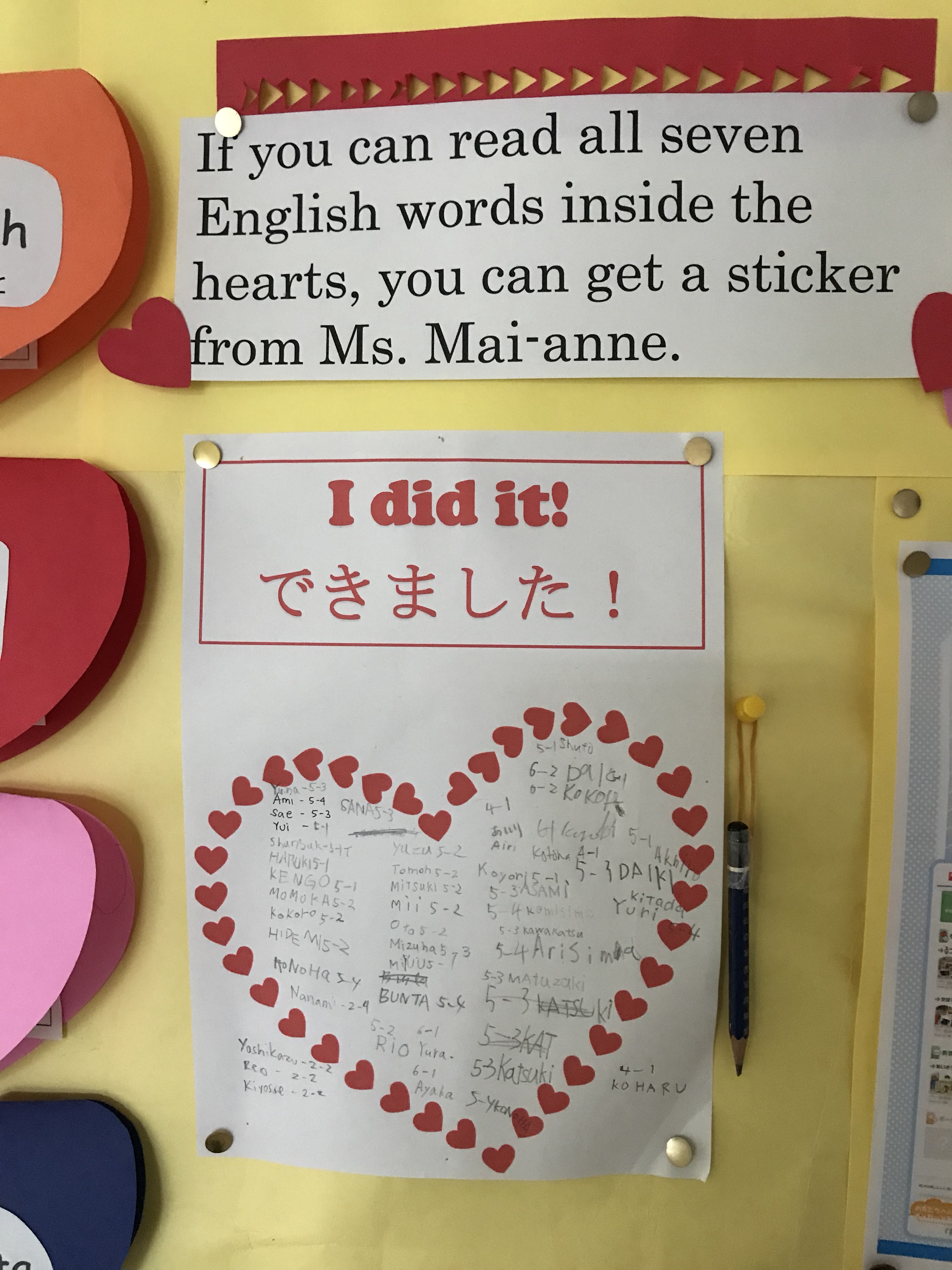
    I also put up a paper and a matching pencil where students can write their names after doing the challenge.

    After putting everything, there was still an empty space below so I decided to put up some pictures and explanation telling the difference of how Valentines is celebrated in Japan and other countries. I chose to write the explanation in Japanese because this is about culture, an aspect where they need to clearly understand what`s it is all about.

    The school principal said she liked it and I`m happy.

    In order to get the students do the challenge, I have to be near the EB during lunch break and recess time and encourage them to do it. Higher grades can basically do it, but with fourth graders, I have to teach them first or sometimes I just let them repeat after me.

    The words are actually very easy, but, you know, if it is not your primary language, it is a challenge. The words I used are sing (which students tend to pronounce as `shing`), like (they know from `I like apples`, but some would still say `lee-ke`), love (most of them get it, I don`t know why), bat (which students say `bato`), ten ( I would give them hint by counting 1-9), run, and finally the word win. Then, I award them with a sticker, one that they can never get in Japan (I got from the dollar store in the US). And finally, I let them write their names on the `I did it` paper.

    By the middle of the month, I got the paper full and I had to make another `I did it` paper to give space for new challengers.

    Few days from now I have to update the EB for March and before that I hope I can get more students do the challenge.

    March would be the last EB  I`d be making for this school since I don’t know what will happen in the coming school year (in April). Contracts might change and who knows if I`m staying or what. That’s ALT life in Japan. So, I have to make the March EB, the best. Pressure pa more. 🙂

  • How to distinguish Japanese from Korean and Chinese

    How to distinguish Japanese from Korean and Chinese

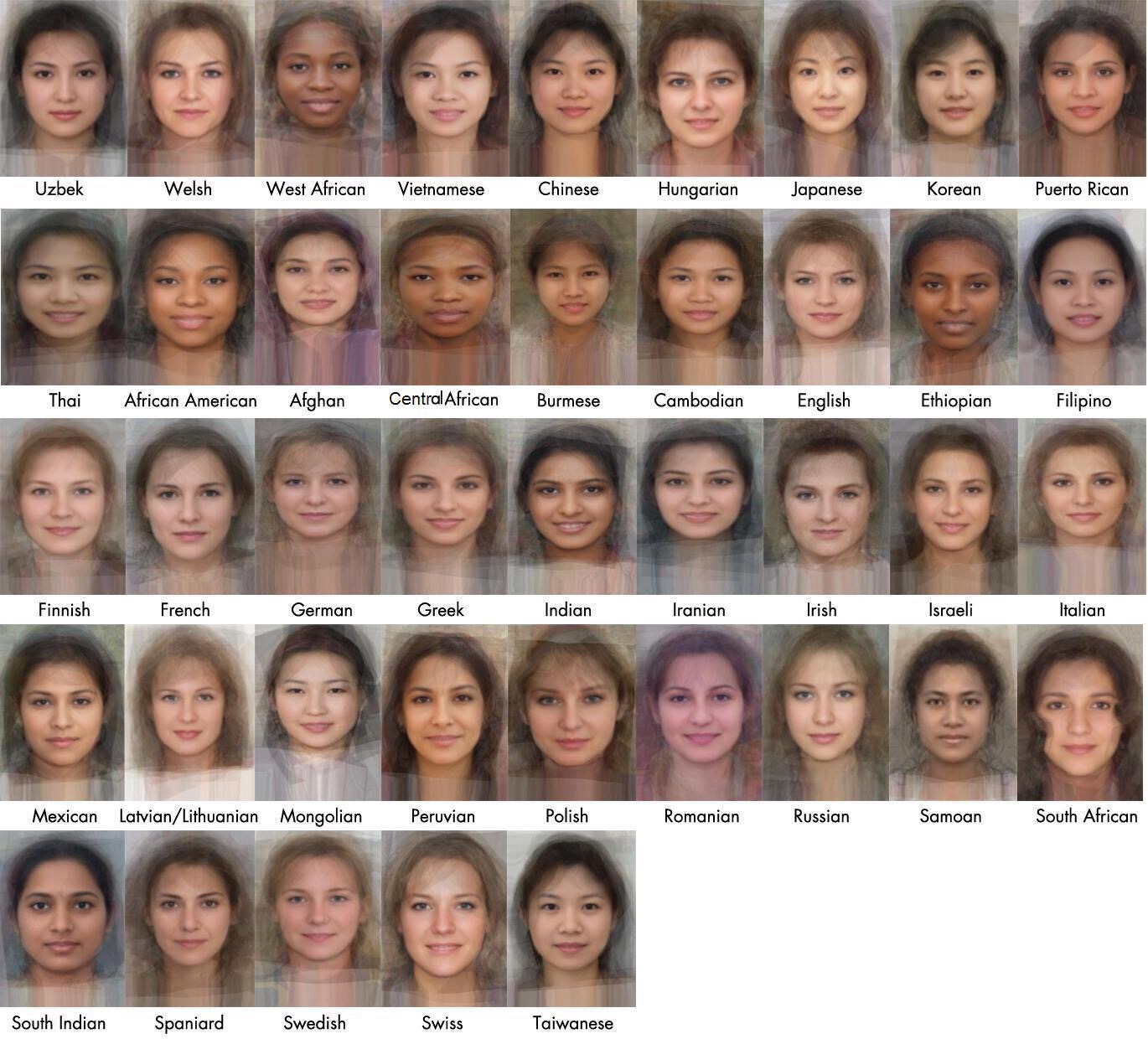
    Can you tell if a person comes from a specific country? Before coming to Japan, I had no idea how to distinguish Japanese, Korean and Chinese from one another. I had quite a few experience (when I was in the university as an international student) of trying to speak Japanese to a fellow student who I thought is Japanese, but after all, turned out to be Korean or Chinese (who is new to Japan and cannot speak Japanese). To avoid future embarrassment of assuming someone is not, let me discuss their similarities and differences. This is according to my observations and the opinions of my friends with who I discussed the subject.

    twitter.com

    Similarities

    1. Skin.

    preview.ph

    Japanese, Korean and Chinese, generally, have the same skin characteristics. It is popular that their skin is more resistant to aging and that they have fair, light porcelain-like skin. It is due to extreme sensitivity to environmental factors and chemical effects of some products, which can disrupt the pH balance. For this reason, advertising about skin beauty care in Asian countries is very economical as Japanese, Korean and Chinese (especially girls) have to be more careful with products and treatments they use on their skin. It is even impressive to see the number of skin care products build on the myth that Asian skin would look amazing and healthy for a long time. so, it is hard to tell who is who if you only look at their skin. 


    2. Body built


    theatlantic.com

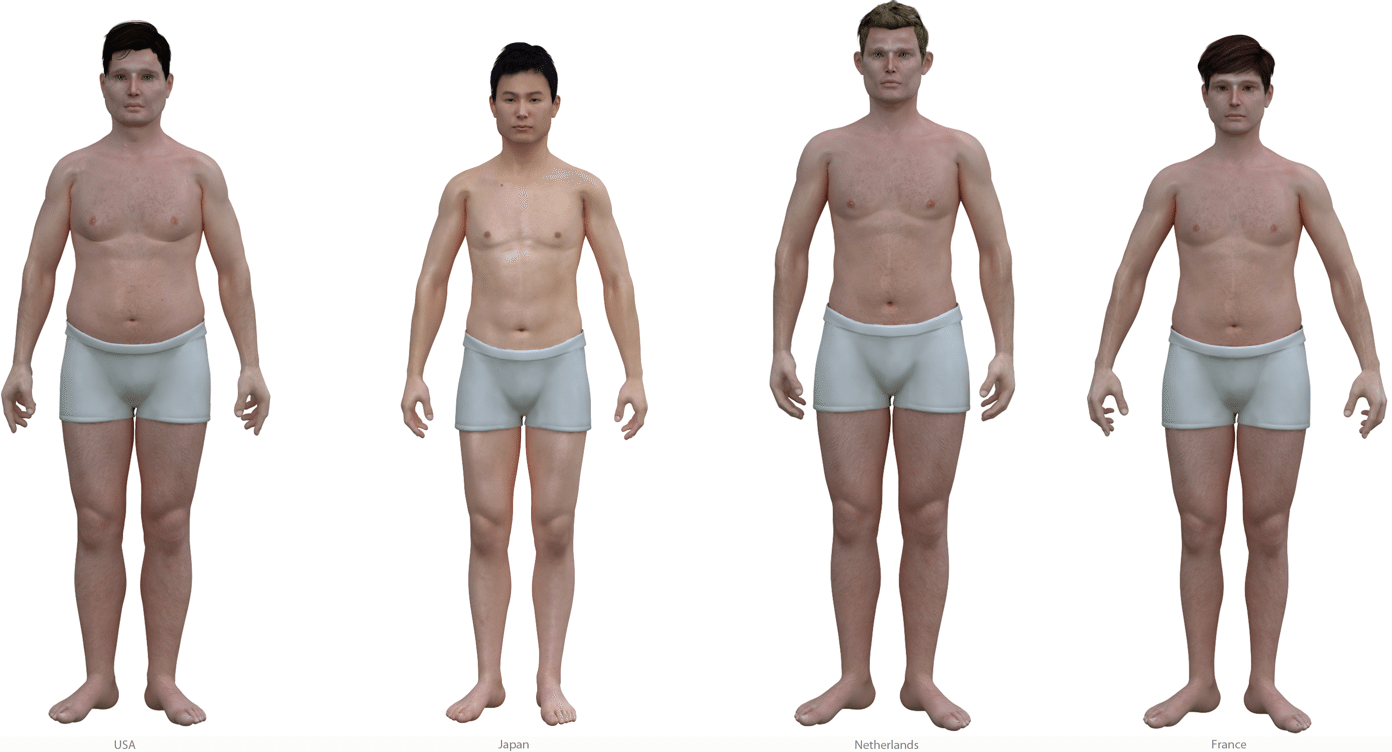
    There are of course differences in body built among Japanese, Korean and Chinese people.  As human as we are, we can be fat, thin, big or small. It all depends on our individual diet and consumption, not to mention our genes. Although we have a general impression as to how, for example, an American body tend to be (tall and big). Asians, specifically Japanese, Korean and Chinese, are typically of slim body built and kind of short in terms of height. But be careful not to label all of them slim and short, because, as I have said, everyone is different. Some can still be tall, big and fat.


    Differences

     1. Facial Features.

    onehallyu.com

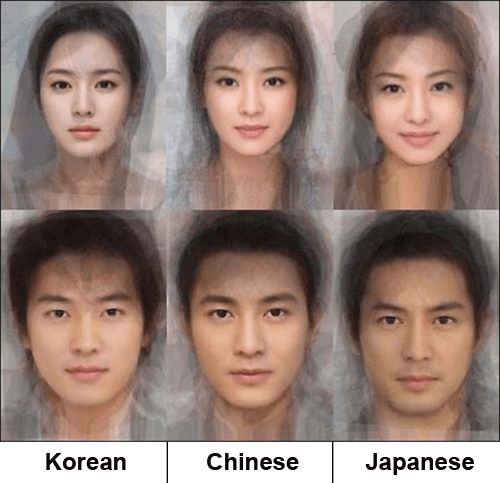
    They may look the same, but if you are a keen observer, there are a few distinguishing characteristics. The Japanese face is generally longer and wider, while the Korean face often has a more prominent jaw and high cheekbones. The Chinese face is typically round in shape. When it comes to the windows of the soul, the Japanese eyes are often described as angled upwards, contrary to the Chinese eyes which are usually angled downwards. Koreans often have smaller eyes.


    2. Dressing style

    Japanese street fashion


    thetokyogirl.com

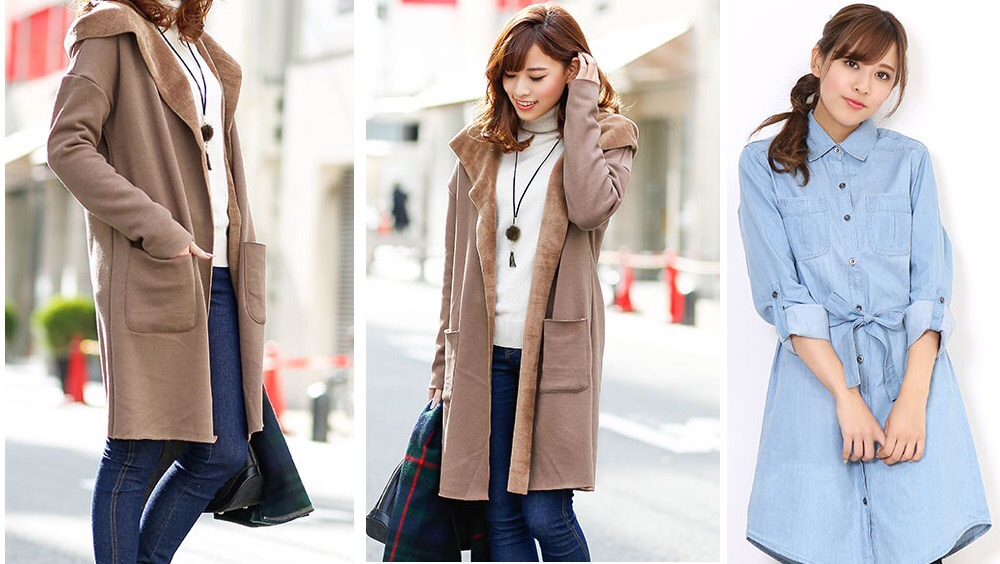
    My Japanese friend told me it is easy to tell whether a person is Japanese or Korean. Just look at how they dress. Japanese people value harmony and uniformity, hence, when they dress up, it is something aimed to blend with the majority. Plain, simple and subtle colors are the key to typical Japanese attire. Nothing that stands out. I observed that wearing suit is very common in Japan. May it be a final (research) presentation in school, a job internship, a job interview, graduation; Japanese usually wear suits, in black and white (inner). Very seldom you can see a coloured inner. 

    kore.am

    Contrary to Japanese, most Koreans wear bright and more colourful attire. I remember my Korean friend said in her culture presentation in school, that, unlike in Japan, they can wear nice colourful dresses when they do their internship and especially during job interview. Chinese, on the other hand, due to its high cultural diversity is difficult to distinguish


    Even up to now, after living for quite some time in Japan, it is still challenging for me to tell which is what, and who is who. Even people of the same race can look different. It is hard to generalize. We can never actually generalize. As the saying goes “Everyone is unique”.

  • What makes kanji difficult and challenging and what are the ways to overcome it?

    What makes kanji difficult and challenging and what are the ways to overcome it?

    Many Japanese language learners express difficulty about the language and most of them say that learning kanji is what makes it hard.

    Kanji is one of the three set of characters, together with Katakana and Hiragana, which make up the Japanese language. While Katakana and Hiragana symbolize sounds, Kanji symbolizes meaning.

    So, what makes kanji difficult and challenging? The answer is simple -it’s the way they are written and read. Let’s discuss them one by one.

    A. Writing

     The way to write kanji is based on strokes – number of strokes, stroke pattern. For example, the kanji for number one 一 read as ichi consist of only one stroke. That is from left to right. More complicated kanji, for example the kanji for difficult, 難しい read as muzukashii, 難 itself consists of eighteen strokes.

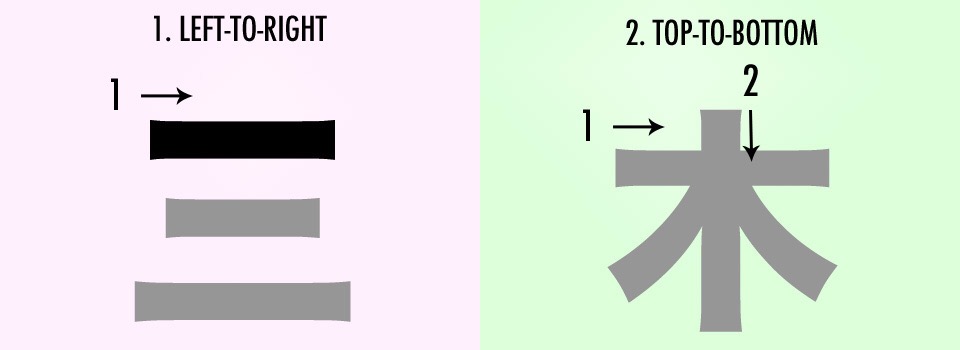
    When writing a kanji, the stroke should follow the following order:

    1. Left to right

    2. Top to bottom

    I was always amazed by how our Kanji teacher always could tell how I wrote the kanji in the wrong order. How could she know the order just by looking at the lines? Isn’t it amazing?

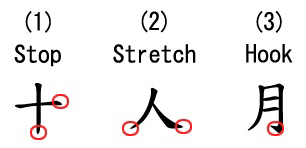
    Moreover, the way to end a stroke is categorized into three.

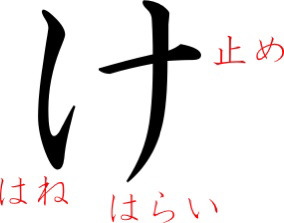
    1. Stop. Stop stoke is done by completely stopping your writing tool at the end and lifting it to start on to the next stroke. To make it simple, it looks like a straight line.

    2. Stretch. Stretch stroke is done by lifting your writing tool as you end the stroke. It looks like a curvy line.

    3. Hook. Hook is done when you make a small hook at the end of the stroke.

    If you fail to follow this rule, the meaning can completely change. The kanji for thousand 千 read sen, chi and dry 干 read as ho(su), kan for example look alike but they are, of course, different. The first stroke for千 is a slash stroke from right to left while干 is a stop stroke from left to right.

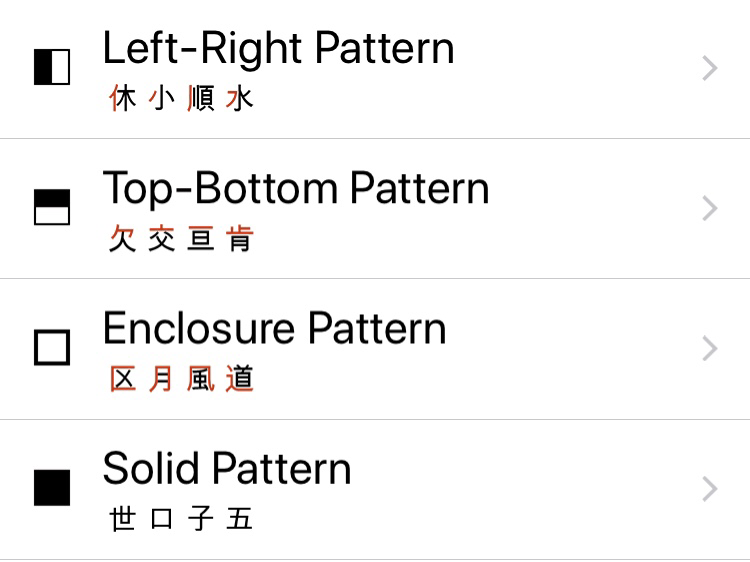
    Kanji characters are categorized into four patterns

    1. Left-Right

    2. Top-Bottom

    3. Enclosure

    4. Solid

    B. Reading

    Reading kanji is the most challenging part. This is where your memorization skill is tested and harnessed. Kanji has two basic kinds of reading, onyomi and konyomi.

    a. Onyomi 音読み, the Chinese reading. From the word itself, this reading is derived from the Chinese reading, although many of my Chinese friends say that they read kanji completely different from Japanese way of reading.

    A kanji character can have one on’yomi or more. It can have only on’yomi without kun’yomi or it can have both. On’yomi is used when two or more kanjis are put together to form a word. Say for example the word for teacher 先生 read as sensei. That is to say the on’yomi for the first kanji 先 is sen and the second kanji 生 which has two on’yomi sei and shou, uses sei in this case. But, it is not always the case. The kanji for birthday which is 誕生日 does not use on’yomi for each kanji character. There is only one reading for the kanji 誕, that is the on’yomi tan and no kunyomi. The kanji 生, this time uses shou which is changed to jou (and that is another way of switching sound), and the last kanji 日, uses not the on’yomi nichi or jitsu but the kun’yomi bi.

    b. Kun’yomi 訓読み, the Japanese reading, on the other hand, can be single or multiple. It is commonly used for reading a word with one kanji alone or kanji and hiragana combined. Let’s go back to our example word sensei 先生 (teacher). If 先 is used alone, this is read as saki or masu. 生, is one of the many kanji characters which has many kun’yomi. It can be read as the following:

    生きる ikiru (to live)

    生かすikasu ( to make use of)

    生けるikeru (to arrange, to plant)

    生まれる umareru (to be born)

    生れるumareru (to be born)

    生まれ umare (birthplace)

    生む umo (to give birth, to deliver, to produce)

    生える haeru (to grow, to spring, to sprout)

    生やす hayasu (to grow, to cultivate, to wear a beard)

    生 ki (pure, undiluted, raw, crude)

    生る naru (to bear fruit)

    生す nasu (to build up, to establish)

    生す musu (to grow of moss, etc.)

    Most words made up of multiple kanji use on’yomi and kanji-hiragana combinations use kun’yomi, but not in all cases. Say for example the word for Sunday, nichiyoubi 日曜日, where the first 日 uses the on’yomi nichi while the second 日 uses the kun’yomi bi.

    C. Meaning

    Since kanji are pictograph, each kanji represents a particular meaning. Can you tell why the following basic kanji carries each meaning?:

    人 person

    大 big

    山 mountain

    川 river

    口 mouth

    木 tree

    火 fire

    Most of the kanji above look like the object they represent, aren’t they? Some even has stories about how they come up to such meaning. Like the kanji for rest 休 (yasu-mi). the left part represents a person while the right part represents a tree. In short, a man “resting” under a tree. But, wait! It’s not that easy. Not all kanji can be explained by how it looks like. Most kanji are irrelevant to their meaning, that even Japanese cannot explain and the only thing you can do is memorize them. Look at the following examples and see if you can explain why such kanji carries the following meaning:

    瓶 bottle

    飲む drink

    蛙 frog

    色 color

    別 separate

    These are only a few. There are thousands of kanji that you have to learn. Don’t get discourage. Even Japanese don’t memorize all kanji there are. We only need to learn a few (like three thousand) to survive Japan

    Tips in learning kanji

    1. Write them down. That’s the only way to learn how to write it right. You have to learn the strokes. And you need to write it many times. Many many times. That’s how the Japanese learn kanji, too. Elementary kids have Japanese writing homework everyday where they have to write a set of kanji many times. And not only the single kanji itself but the word it forms. And not only the word, you have to write the sentence it is used. That way, it will stick in to your head.

    2. Find a meaningful connection of a kanji character to something that makes it easy for you to memorize. Imagine a story out of a character. For example, 低い hikui (low, short). The first stroke on the left is a person and the strokes on the right represents two legs stepping on something to be equal the height of the person because she is ‘short’.

    3. Read stories with audio background so you can listen while reading silently. After that, try reading it aloud. I found a website that has many Japanese stories with audio files. I like it very much because it shows me the kanji of the words I already know but never seen the kanji before. It helps a lot.

    4. Watch Japanese TV whether it’s news or drama. Don’t watch with English subtitles. Watch it with Japanese subtitles. Most Japanese news and some programs have Japanese subtitles.

    5. Read labels and packaging and try to understand some words you don’t know. Research. Research. Research. I tell you. One of the words that came out in JLPT N2 Vocabulary section is a word always seen from food packaging. And I regretted why I didn’t try to learn it before the test.

    6. Love it. If you hate kanji then you’ll never learn. You have to find the passion to learn each stroke, it’s meaning, it’s reading. You have to learn to appreciate how wonderful it is that a single character can mean many things when combined with many other characters. If you say you can’t, then you won’t. Our mind is so powerful. If you set your mind to refuse to learn then it will shut down and will never understand. It will only see the negative side of learning. Train your mind to open up to new things and new knowledge like learning a new kanji everyday and one day you’ll see the fruits of your labor.

    That’s all for now.

    If you want to say anything about this article, just leave your comments below.

  • All of us are a Memory

    Death is the only thing we know that is going to happen for sure, but still surprises us every time it comes. And it’s never a pleasant surprise. It’s devastating. Heart-breaking.

    The unacceptable truth that no matter what we do, no matter who we are, each one of us will end up as a memory.

    I’ve experienced the pain and emptiness that death has left behind many times already. I had a dear friend and co-teacher who was taken away by lung cancer. Within three months she was gone. I cried so hard from the bottom of my heart. Also, a college classmate was taken away by breast cancer a year ago. As far as I know, two of my former grade six students passed away due to some kind of disease. They died at a very young age. Heart-breaking. One former student was also a victim of attempted rape and homicide. There’s no escape from death. Even here in Japan, in my four years of teaching, two co-teachers already in two different schools did not escape death. One, a young male teacher taken by cancer and the other a retired teacher returning to teach as part-time. She died due to aneurysm. Even the principal of one of my previous schools, again by lung cancer. The most painful was when my dear father passed away just after my dear cousin was buried three years ago. It was a double tragedy. We buried two love ones within a month. I did not cry the moment my father passed away because I pretended to be strong for my family especially for my mother. But I regret it. I should have cried. I should have not stopped them cried. I should have let it out. All the pain. All the frustration. Everything in my heart. The indescribable feeling when you lose someone dear…forever. Life is unfair. It is always is. When my father died, I have asked myself many times ‘Why do we have to live when we all are gonna die?’

    I still mourn for my father’s death. I think of him everyday. He’s in my thought. He’s in my dreams. That’s where he stays forever. And all the lives of those I know who were taken away by death.

    And the most recent, a former co-teacher, now, a school principal passed away just this morning. A sudden death. Very shocking. Very heart-breaking. How can a seemingly healthy man, very active, a great father, husband, friend, mentor, educator, a community leader be gone like that.

    Life is scary. Death is lurking around the corner. Watching us and waiting for the perfect (imperfect) time to grab us in our feet and put us down. Prepared or unprepared, we leave this world while the ones who are left behind are drowned in pain.

  • My Childhood Memories in Mati

    My Childhood Memories in Mati

    Mati, the place where I spent the first nine years of my life. I was born in Davao City, the biggest city in the island of Mindanao, but because of my father’s job as a Red Cross Administrator, we moved to a region down south, Davao Oriental, with Mati as its capital town.

    I have rich childhood memories in Mati that keep coming back every time there’s a trigger. Like one day, when my husband and I were talking about our last trip to the Philippines, when we met this very cool taxi driver who coincidentally we had a ride two times within our ten-day vacation. He’s a good taxi driver who kept us entertained during the ride with his talk about many things and one of them, bananas. Bananas in the Philippines sometimes just pop out from nowhere and you can see them everywhere even in a big city like Davao. Much more in the countryside, like Mati, and that banana topic opened a stocked memories of my very precious childhood in Mati.

    BANANAS, BANANAS

    I remember how my siblings and I played outside of our backyard pinching and poking holes on the banana trunks with sticks and watching the sap flow out from it upon pulling out the sticks. We used to say that banana trees are peeing or crying. I know it’s not very nice poking banana trunks but we were kids and we didn’t see it like that. We enjoyed watching the water flow like it’s magic. And of course, our parents scolded us for doing that. That we should not ‘hurt’ the banana trees.

    We used banana trunks to feed our pigs we raised in our backyard. We call banana trunks ‘bani’ in our local language. We sliced bani thinly and mix it with ‘tahop’, grounded husk of rice grain. It’s too expensive feeding pigs with commercial feed in the market so we settled with bani. My mother used to ask us to cut the bani when it’s feeding time for the pigs. We of my siblings took turns doing it . Sometimes we liked it, most of the time we didn’t. It’s a menial job. We did it in our backyard, where we had a small pigpen and a small duck’s pool.

    THE DUCK’S SWIMMING POOL

    That backyard in our house in Mati is mostly where are precious childhood memories happened. That small duck’s pool, I can never forget. One day, my sister Dhaday and my cousin Dodong decided to ‘sail’ our big plastic basin across the green dirty duck’s pool. We put Dodong in the middle of the basin for balance and pushed it to start ‘sailing’. When the basin was already half-way in the duck’s pool, my uncle William, Dodong’s father, came and the sight of Dodong in the basin in the middle of the green dirty duck’s pool infuriated him because for him it was dangerous. But for us, it was fun. We were like aged 7 or 8 at that time. When uncle William told Dodong to get out of the pool, my sister Dhaday and I ran quickly and hid and left Dodong in the middle of the pool. Dodong was crying of fear of his father and said ‘mudunggo na lagi ko pa, mudunggo na lagi ko pa’ meaning ‘I’m gonna land dad, I’m gonna land.” That was just one of the funny childhood memories.

    THE MANZANITAS TREE

    Near the duck’s pool is a Manzanitas tree. Manzanitas tree bear fruits like cherries. Birds love it and we, kids, love it, too. The fruits are green at first but when they ripe, they’re red. Very red, very many and very attractive to the eyes. I used to climb that Manzanitas tree and pick all the red, ripe fruits. We used to call them apples. Apples don’t grow in the Philippines and the idea of having mini apples is very heart-warming for us. One afternoon, siesta time, when my older sister made us take a nap, my sister Lea and I sneaked to the backyard and I climbed the Manzanitas tree. She was too little, at maybe age 6 or 7 to climb the tree and I was thinking I was big enough I could do it. I was about age 8 or 9. I told Lea to stay by the foot of the tree and wait for me while I get the red ripe fruits. I was enjoying picking fruits when I heard my mother’s voice coming. I was screwed. I will be punished for sure, I thought. So, I suddenly gestured my sister Lea to not look up the tree and to pretend she doesn’t know where I was. But of course she was too little to know how to lie. She panicked when Mama asked her where I was and looked up the tree and that’s how my mother caught me climbing the Manzanitas tree. I was scolded, yeah. But that stayed as a precious childhood memory I always love to look back.

    THE MANGOE TREES

    I loved climbing trees. I remember we had two mango trees in our house in Mati. One big “Carabao” mango tree in the front yard and one small “Cebu” mango tree in the backyard. (These are variant of trees we call in the local language.) We used to climb that small mango tree with salt in a saucer and a kabo (small bucket)filled with water. We picked the fresh budding leaves, wash them with water, dip in salt and eat them. All of that we did up in the tree. Yeah, that sounds crazy but I don’t know where we got that idea. Somebody just started saying ‘You can eat the young leaves…oh it’s good’ and we did it and it became one of our past time activities. Of course we also eat the fruit. We like the green ones. Oh, just thinking about it makes me droll. Sister Dhaday and I used to sneak out our window in the second floor up to the rooftop where we used a dughit (catcher) to pick the mango fruits. Of course we had our salt in saucer and small knife with us to peel the mangoes. We were careful not to drop the mangoes and hit the roof to avoid any sound that alarm our family downstairs that were up on the roof getting mangoes. We’d be screwed if we’d be caught doing that and it happened many times. Papa caught us one time because while he was walking in the front of the house with Lea, Lea saw us on the rooftop and pointed to us. I remembered we hurried back inside the house and hid but of course we couldn’t escape Papa. Papa got so angry and we were scolded.

    OUR GUAVA TREES

    We also had our own guava trees. Lea’s guava tree in the backyard was the most fruitful of all guava trees. Maybe because there was like a bunch of compost by its foot. It bears big, oval guava fruits. But, the fruit, they’re not tasty. It tasted bland. So, even if it bears a lot of fruits, we didn’t care that much. Ate Dhaday (ate is how we address our older sisters) had the best guava tree. The fruit are tiny and green but they tasted so sweet. I think they are the native kind. My guava tree outside the backyard fence bears fruit like once or twice a year. And when it bears fruit, only the biggest, most delicious fruit you can ever have. But, yeah. What good does it make when you have to wait for months. We were kids and we were impatient like that. We love ate Dhaday’s guava tree. During siesta time, when I get to sneak, I would climb ate Dhay’s guava tree and pick guavas and enjoy them while whistling and rocking on a branch. She would get angry at me the next day because the fruits she’s been waiting to ripe are already gone. Who else is the ‘thief’ but me. Lea couldn’t climb trees. And our older siblings already lost interest in them. They did their own ‘teenager’ things.

    SUGAR CANE

    My older siblings, on the other hand, they did have their own sugar cane plant. We call it tubo. Cutting and munching tubo is one of the happiest thing in our childhood. We cut and share tubo equally among us like we had to measure them in equal length for if one is bigger than the other, it could start a fight. We munched tubo and enjoyed it’s very sweet, juicy taste. If you don’t know, sugar is made from sugar cane.

    PLAY HOUSE, PLAY STORE

    My sisters Dhaday and Lea, we used to play houses a lot. We played house in our living room where we move chairs and use cardboard boxes and blankets to design our own spaces and define territories. We also played outside in the front yard where we used the bench as our ‘store’. We sell make-believe ginanggang. Ginanggang is roasted bananas glazed with margarine and white sugar. We picked leaves for bananas skewed in silhig tukog (coconut broomsticks) glazed with gumamela oil (we mashed gumamela leaves to make the oil) and sprinkled it with bukbuk (wood particles) as sugar coating for our ginanggang. We used candy wrappers as our money to buy. The blue wrapper is valued at two pesos and green wrappers are five. Our coins were flattened soft drinks’ cap. I miss those times. Those are the real play. No touch of technology or whatsoever digital.

    PLAY FIGHT

    We also have memories of playing fight where we use banana trunk to make our guns and armalites. We were so creative we could make them look like real guns. Kuyang, as we call our older brother, liked playing gunfights. And we of my sisters play with him. We used the seed of plant called buyangyang as our bullets. Buyangyang seeds are red and black in color. I’ve never seen that plant since we left Mati. I don’t know if they still exist up to now. When we play gunfight, we go all over the house, to the backyard and beyond that. We hid behind banana trees and our guava trees. It was so much fun running and hitting each other with our improvised weapons.

    WATCHING AND CATCHING BIRDS

    When I was young. I was crazy about birds. I so loved birds to the point where I was kind of obsessed about them. I remember I would stay near the bushes in our backyard. I don’t know what they’re called. Those bushes bear tiny fruits that the birds love to eat. I used to stay near them and tweet like I was talking to the birds. One time, I hid inside the big rubber water container near the bushes and called the birds. Of course, not a single bird came to play with me. I was also almost bitten by a snake just because I always stay near the grasses and bushes to watch and talk to the birds.

    There was one bird I found outside the backyard. It had a broken wing and it couldn’t fly and it kept chirping. That’s how I found it. I was so happy and kept the bird as my pet. I put him under a big wooden food cover and tried to feed him with all kinds of food I can grab and water to drink. I was hoping he would get well someday and become my best friend. Until one day, a horrible accident happened. As I stood to pick up something and went back near the bird’s improvised cage, i didn’t notice it came out of the cage and I accidentally stepped on the bird. I could hear the sound of the bone cracking as I stepped on it. It died right away. It wouldn’t move. It wouldn’t chirp. Limp. I was so so sad and I cried so hard. I gave my pet bird a ‘funeral’ in our garden and I put a cross on its mound.

    Looking back, now I realized why I really don’t have many close friends outside the family. Because I grew up playing with my sisters. We had a big house and a big lot in Mati and we explored and played every corner of it. Just us of my siblings and sometimes the visiting cousins. That moment of my life is very precious I will treasure it forever.

    CIMG8811
    childhood memories

    We did many other things in my childhood like playing with makahiya leaves. Makahiya is derived from the word “hiya” which means shy. It is a plant that when you touch it, it closes its leaves. We also listened to AM radio drama programs like Ramine ang Batang Bronse..lol. We went to the nearby stream to bathe and swim with our older siblings` pet dogs. Haha.. We joined Flores de Mayo where we would go pick flowers together with other children in the neighborhood. Life in the countryside is much different in the city. We moved back to Davao after fourth grade and it is a totally different experience. No more trees. No more streams. It is a big city. A new life. But the memories in Mati will never fade away.

  • Whale for School Lunch and Other Stories of Food Culture Shock

    Whale for School Lunch and Other Stories of Food Culture Shock

    Whale

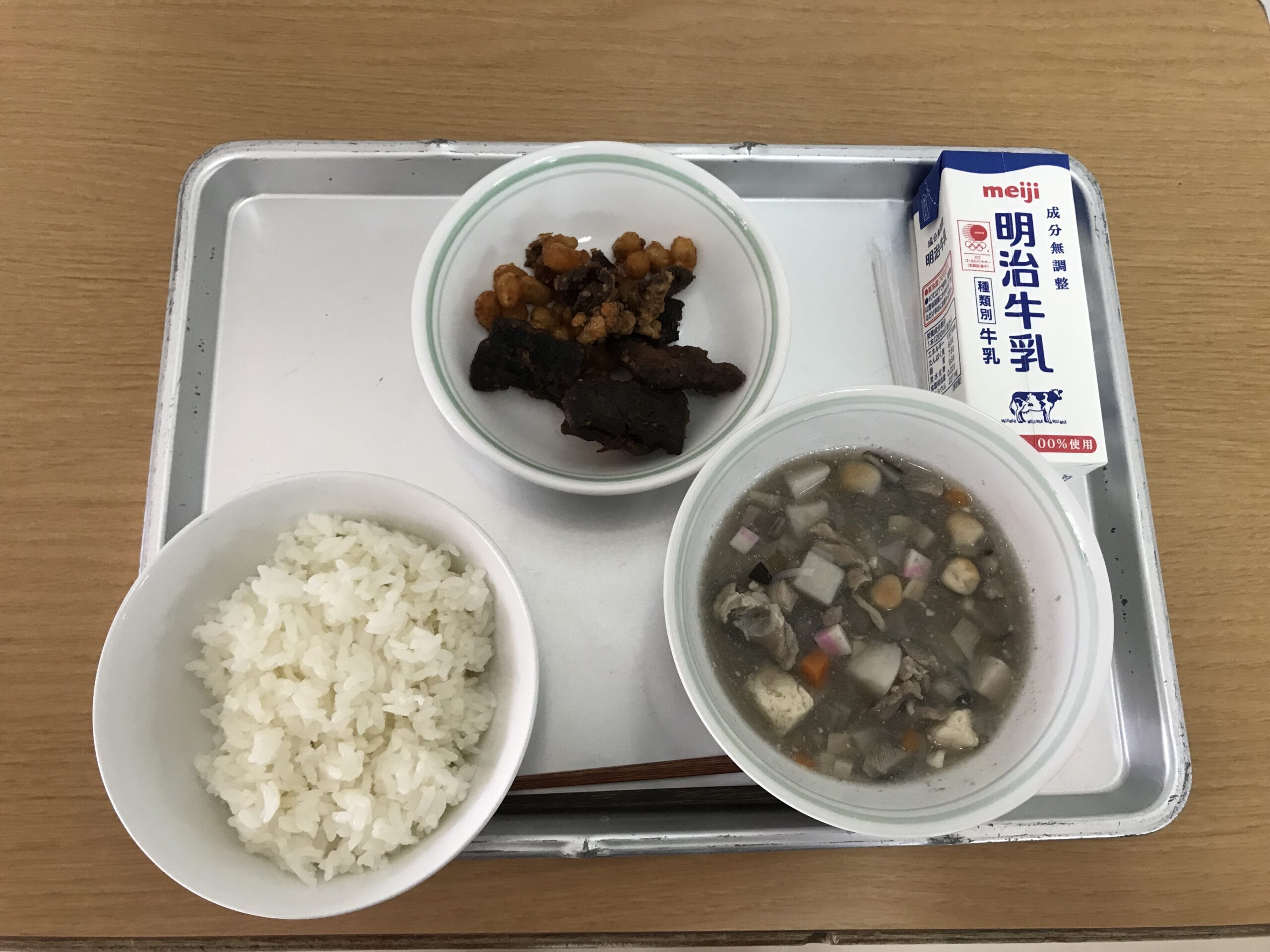
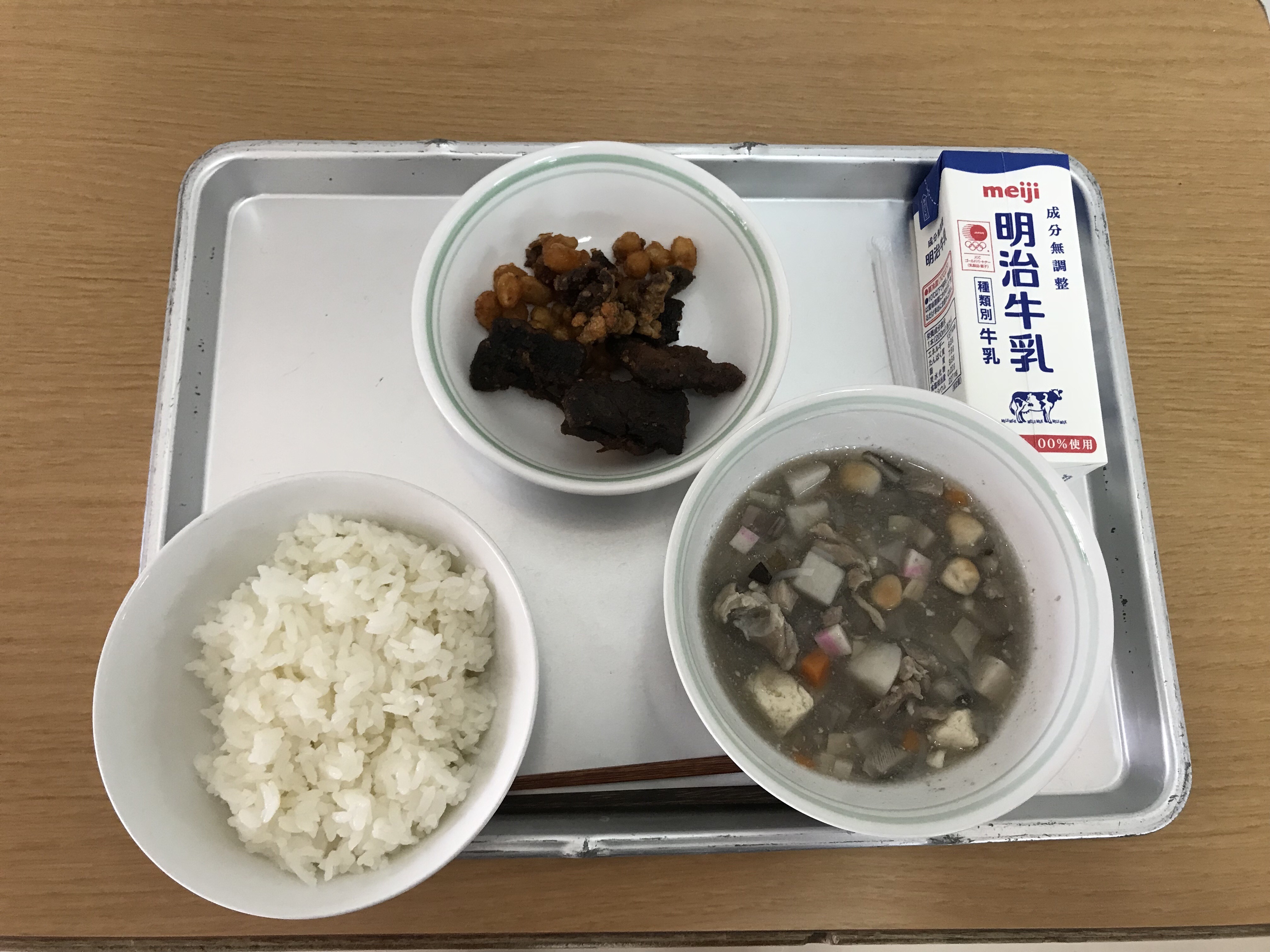
    Yes. I had whale for school lunch! It was a shock for me. I heard the teachers say ‘kyou wa kujira da ne’ (today is whale) during lunch preparation. I help in setting up lunch for non-adviser teachers. And that day, I was the one serving the main dish, which was, yeah, you guessed it right, whale.

    I said ‘hontou desu ka?’ (Is it really?) and they confirmed it, yes. I didn’t know what to do at first. It was in front of me. I don’t know. I’m not a picky person when it comes to food but when I think of whales, I think of Free Willy, the movie, and I consider whales as some sort of pet. And isn`t it they`re considered as endangered now? I know I have to do more research about this but that exact moment I couldn`t imagine myself eating it.

    I found myself in a predicament. I can’t be saying no. I’m in Japan and I’m in school as a teacher. Japanese are very particular about eating what’s on your plate. You have to eat everything on your plate like it is washed and cleaned. Nothing should be wasted.

    One of my co-teachers said ‘If you don’t like it, just put it back, it’s okay’, but no. I’m not doing that. I have to be a Roman since I’m in Rome. So, I said it’s okay. I’ll just think it’s a fish, a big fish.

    And so I went to my assigned classroom to eat lunch with students. Everyone seemed fine and enjoying their lunch. I was scared at first bite but it was not really bad. It was good actually. It tasted almost like chicken. Or something like beef. Something like tuna black meat.

    The next time my school will serve kujira for lunch, my reaction will not be the same for sure. There is always first time for everything and that was mine for whale meat. And the interesting part is that it happened in the school.


    Basashi

    Image result for basashi

    That situation reminded me of the first time I had basashi (horse meat), only that it was a little bit different. I was having a good dinner at my sister`s house and they were serving sashimi of different kinds of fish. And then, they served something they called `special sashimi` on the table and they let me try it. It was good and after a few more bites, I was told it was horse meat. And you can imagine my face like I have a straight mouth that extends up to my ears. I was enjoying the food until I was told what it was. And that was because of the image I had in my head, that horses are pet. They provide some sort of transportation in my father`s hometown, bukid, as we call it in our language. The taste was not bad, it was good, and I never heard of any Japanese died from eating basashi. Basashi is in fact, one of the most expensive kind of sashimi.

    How about in China?

    When I was in a Japanese class of eight students, each of us came from different countries (Philippines, Myanmar, China, Thailand, Laos,  Egypt, Iran, and Malaysia), I learned many things about the differences in food culture. I remember one day when we had the topic `Breakfast in my Country`, my Chinese classmate showed us a map of China showing the different regional specialties. We were surprised to see pictures of animals in the map that we considered pet (cat) or dangerous (scorpion), but for them they consider it is a delicacy. I couldn`t tell if it was a joke or for the sake of fun when she mentioned that they eat anything in their country.

    Lechon

    Image result for lechon

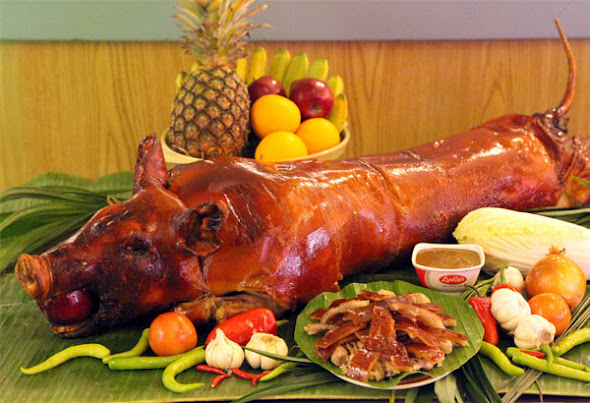
    In the Philippines, the most special food you can serve in any occasion is lechon or roasted pig. For us, a big occasion without lechon is not special. `Happy birthday, walay lechon` as we jokingly sing. `Walay lechon` means `no lechon`. The crispy skin of lechon is the trademark favorite. And it is usually displayed whole with an apple in its mouth. For us, Filipinos, it`s a beautiful view in any dining table. But, when I showed it to my Japanese friend and to my students in school, they were all surprised. They couldn`t believe what a whole pig with an apple in its mouth and sometimes with a knife stuck on it`s body doing on the table.

    Balut

    Image result for balut

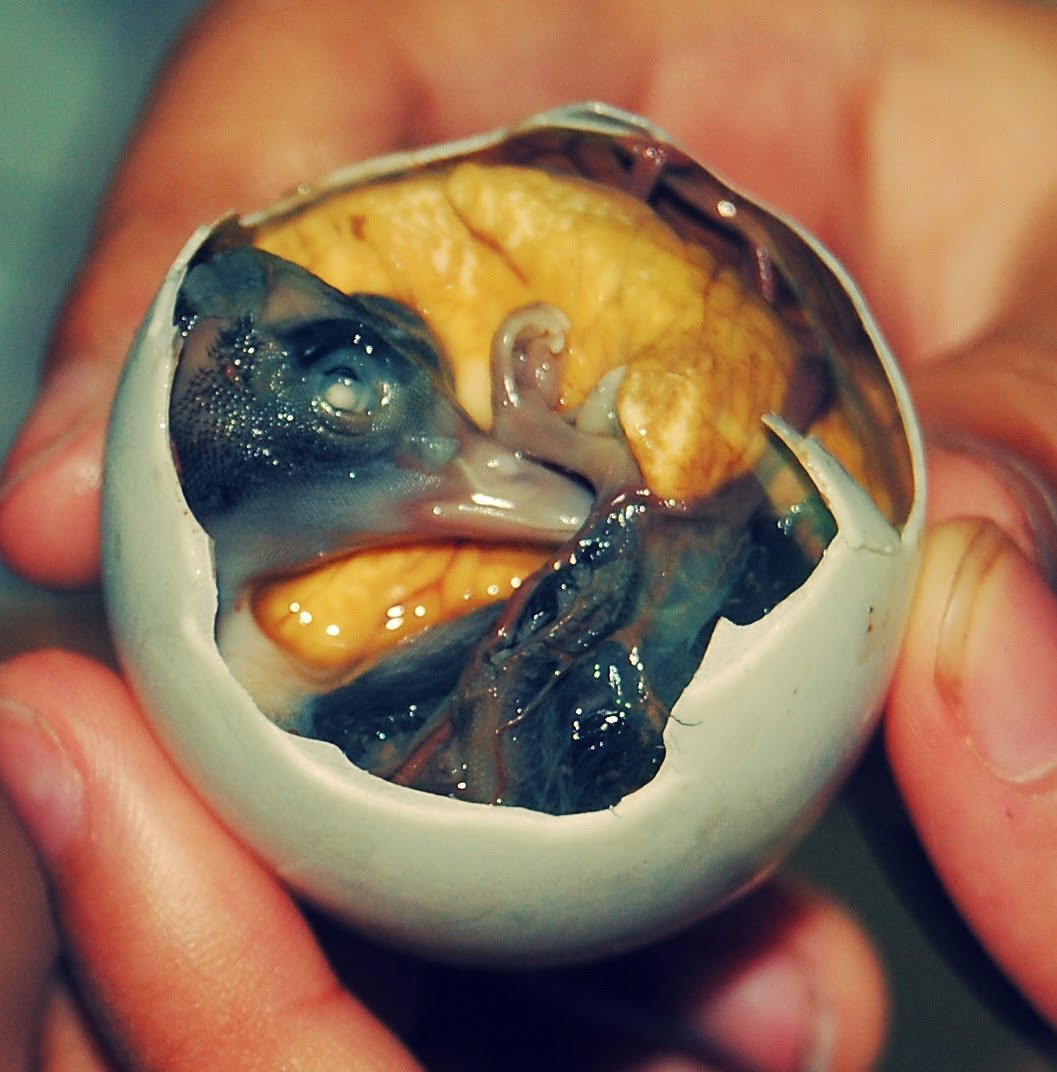
    The same with balut (duck egg with embryo). For most non-Filipinos, eating balut is gross. As in GROSS. Well, not all Filipinos like balut but I have to tell you, I do eat balut and most of us in my family like it. It`s good and nutritious. You should try. 🙂

    It is very interesting to talk about differences in food culture. I will talk about it more in my next article.


  • English Bulletin Boards

    English Bulletin Boards

    One of the not so many tasks of an ALT (Assistant Language Teacher) in Japan is updating the school’s English Bulletin Board.

    In my school where I’m assigned, in fact, the only school I am assigned (normally ALTs are assigned to more than one school), I make sure to update our English Board every month.

    In the first semester (April, May, June, July), I kept the board pretty simple. I put up some world updates, some English greetings and words, and also a daily update of day, date and weather.

    I started changing the board according to the monthly event/theme in the second semester, that is from September, right after summer vacation in August.

    But, unfortunately, I forgot to take a picture of my September board.

    So let’s start with October.


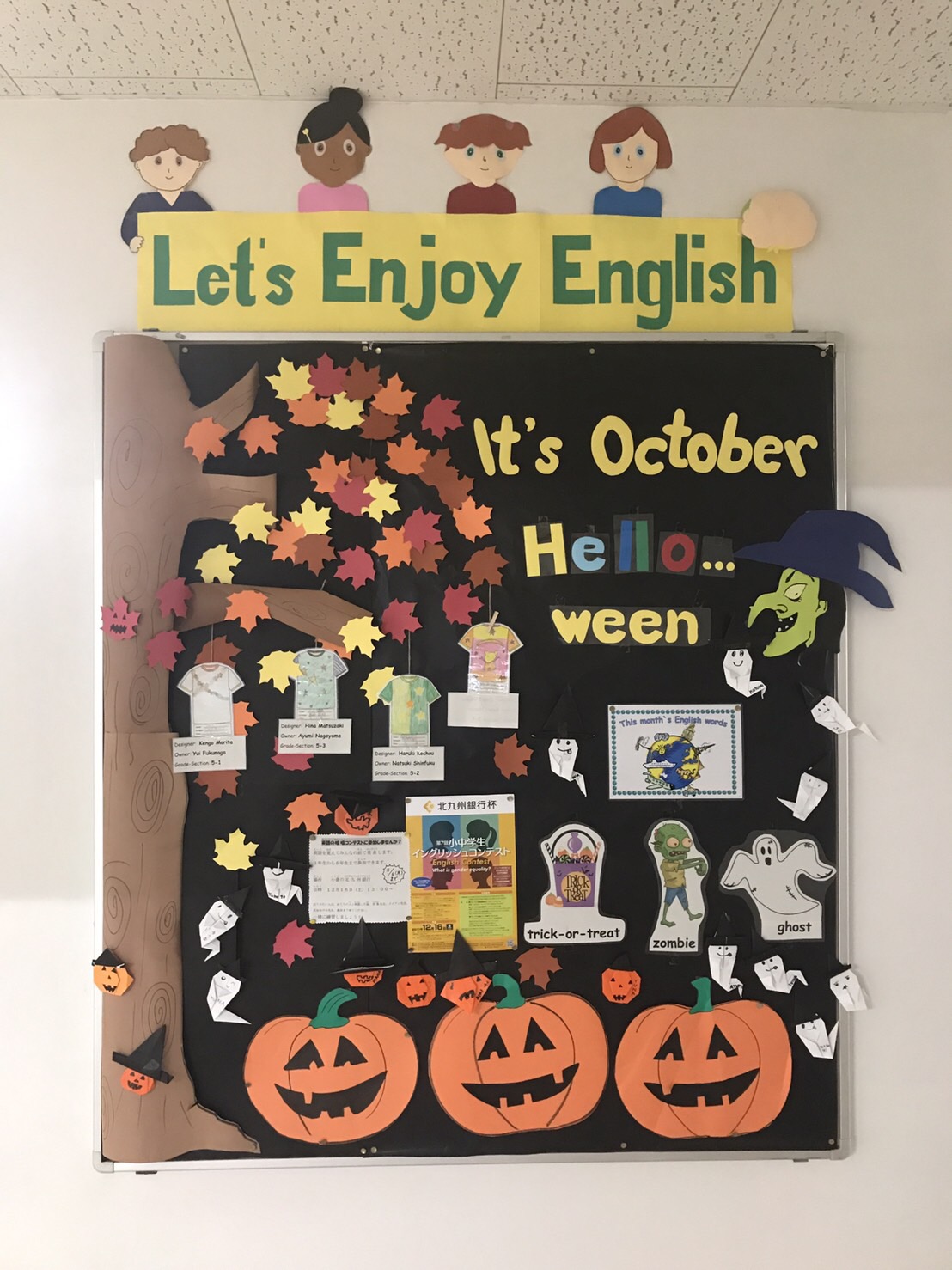
    As you can see, it’s Helloween, I mean, Halloween theme. I just put a little twist to the word to make it more catchy. I made three big jack-o-lanterns and aligned it under a maple tree. I printed one maple leaf and traced it to colored papers, of course autumn colors since it’s autumn and just put it all over the cut out tree. The origamis are made by students during lunch break, when they come to the ‘English Lounge’, well, basically just tables and chairs in front of the English board and we gather there and chat while making origamis.

    Next is November.

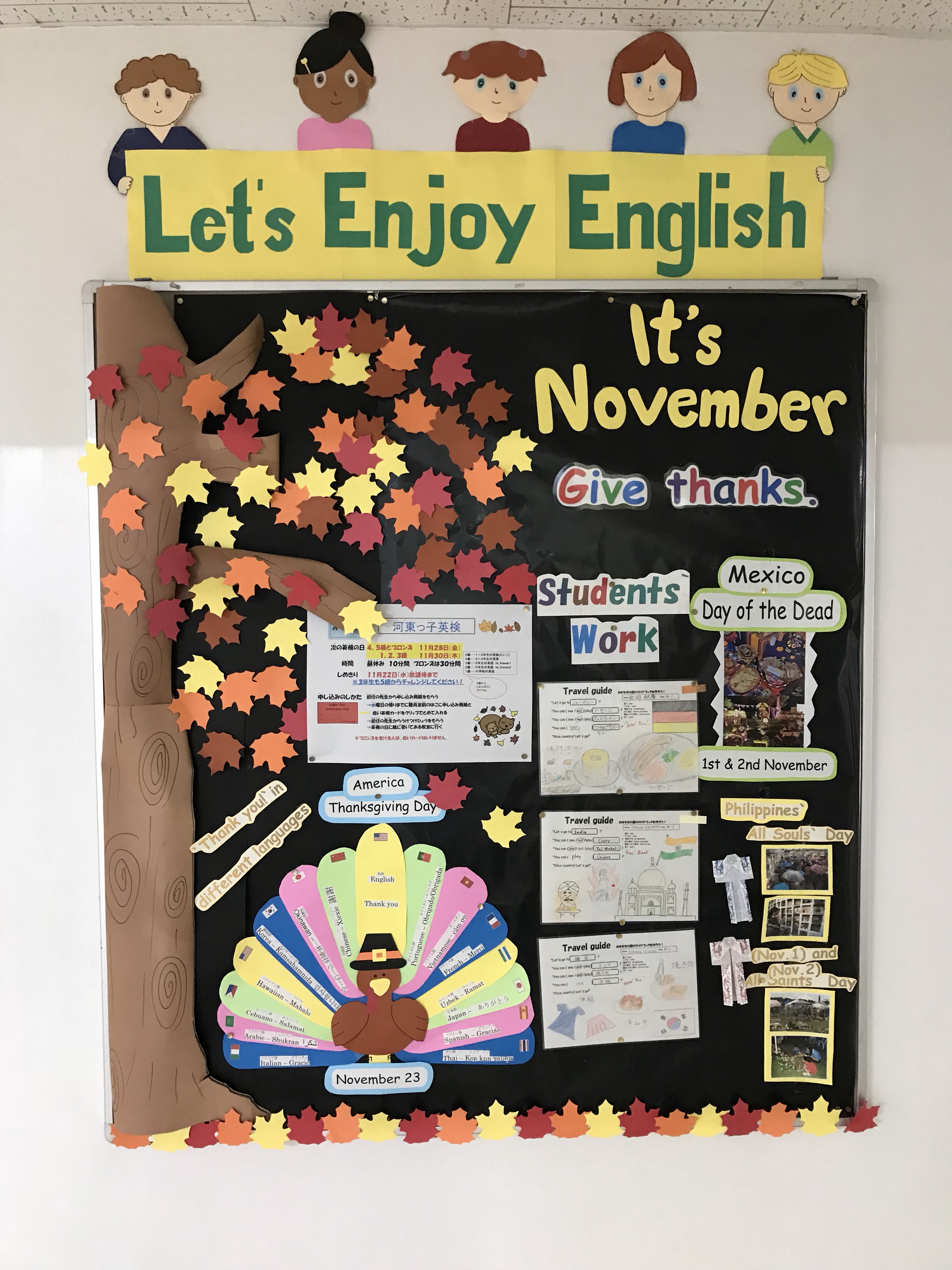
    I kept the maple tree in November board since it still autumn but I removed the jack-o-lanterns and other Halloween things and put a colorful turkey on it. November is Thanksgiving so that explains the ‘Give Thanks’, right? If you look closely, the turkey’s feathers contain ‘Thank you’ in different languages. Some (that Mexico thing) are reused from the previous years’ bulletin board. It’s a waste to throw them away. Why not recycle, right?

    Here comes December.

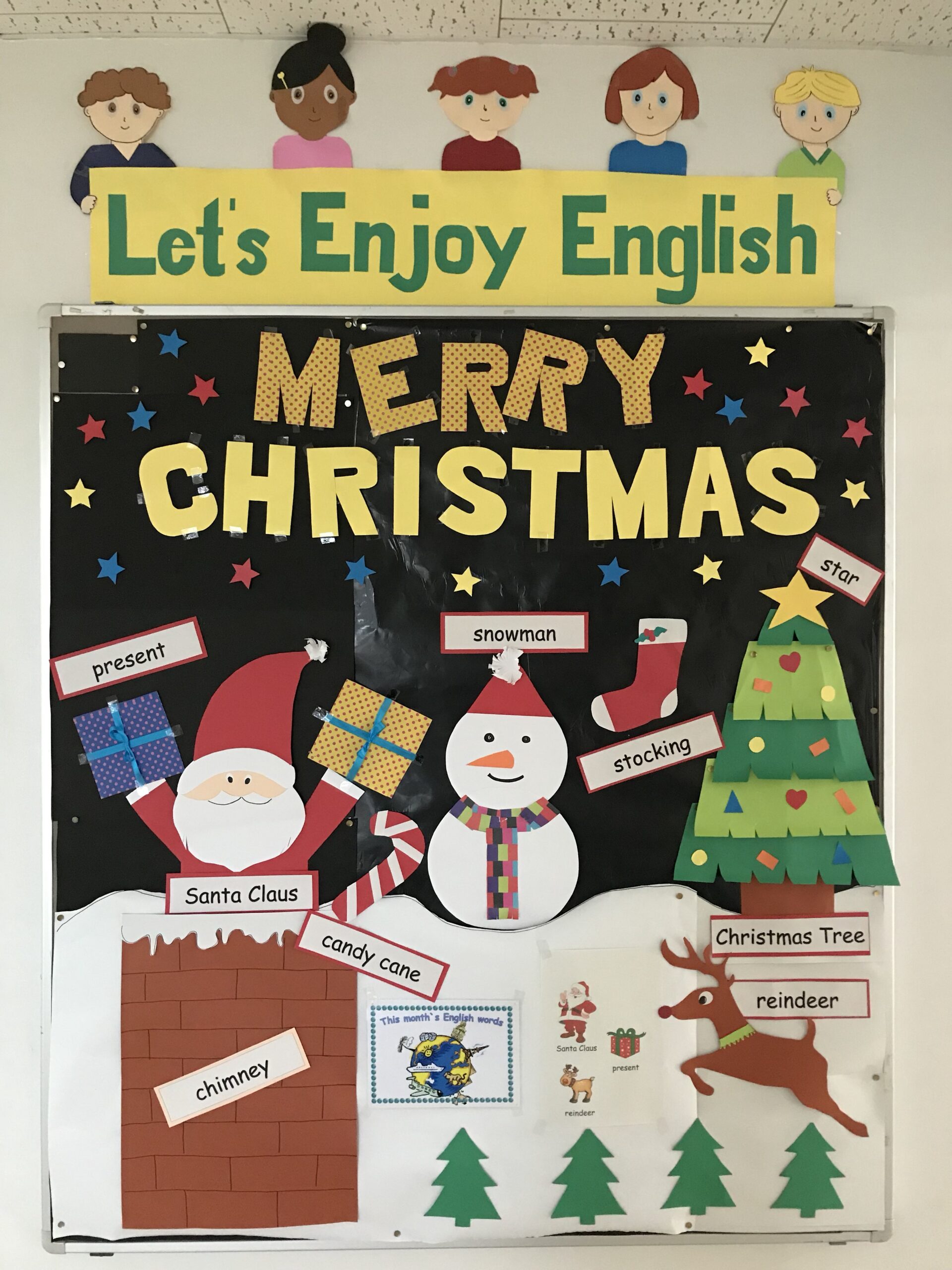
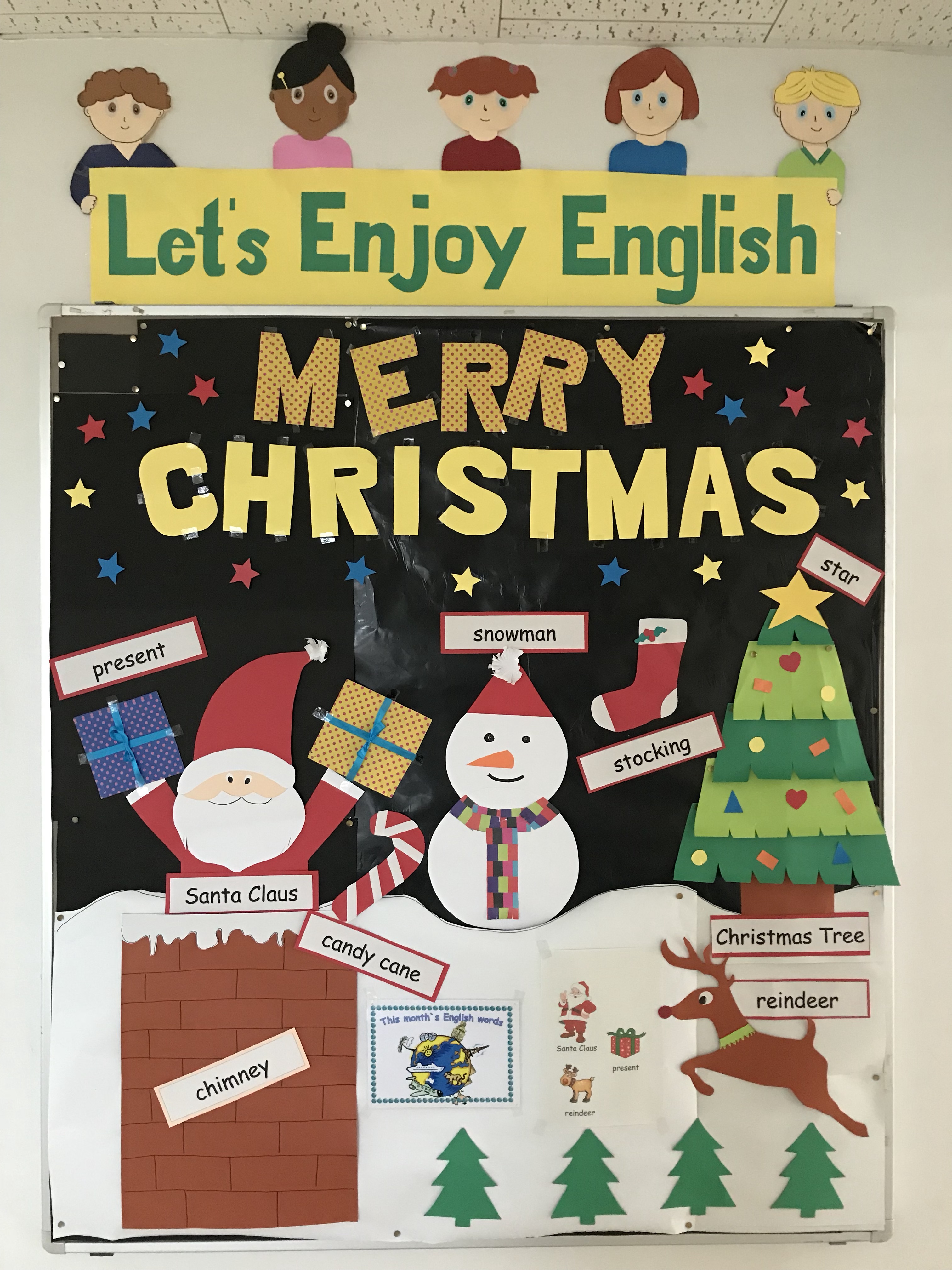
    The black background has been there for three months. I find black background so easy to decorate but I admit, I was getting sick of it, so I added white background below it to represent snow. The students like the snowman but I personally like the reindeer. Those are all cut-outs. Well, I had a plenty of time to make these things. 🙂

    The January board was not really the best but I have to tell you, this is the most, should I say, tedious, to make. I decided to make cut-outs of Snoopy and friends’ characters since it is year of the dog. All the red letters are cut-out too, but when I put a white background into it, it looked like printed words. :-/ The new year greetings in different languages are printed. Nothing complicated. And below is the outcome.

    Next week, I will update the bulletin board for February. I already prepared some heart cut-outs but I still don’t know the final outcome. Nothing in mind. We’ll just see.

  • When its Christmas and it’s not so merry

    It’s a day before Christmas, when usually the spirit is up. But it seems like the other way around. I can feel the sadness in my city.

    Yesterday, December 23rd, the day of our flight coming back to the Philippines, I couldn’t go to bed until around 2 AM. Yes, I was excited (I was excited weeks and even months before that), but more than being excited I was worried trying to monitor my family (and relatives and friends) in the Philippines. There was a flash flood brought about by typhoon Vinta in my hometown and our place, just by Davao River, the largest river in Mindanao, is one of the affected areas. I went to bed after knowing that they were safe and rescued.

    Waking up in the morning was a mix of excitement and sadness. The aftermath of flood is as distressing as the flood itself. I’ve seen pictures and videos of our house and my neighborhood soaked in mud. Everyone was busy cleaning up their houses. Just seeing them doing that made me feel tired as if I was there scraping the mud out, too. I’ve read news of death and missing people. Just bad vibes for the season. Not a good feeling to start our trip scheduled in that afternoon.

    And because of that I blamed the troubles I had in the airport coming to the Philippines. I don’t have my residence card and I lost my laptop along the way of getting through immigration without that very important card for foreigners living in Japan. Bad news after bad news.

    Yet, another bad news was on the way for my fellow Davaoeños. One of the big malls in my city and the nearest to our house, NCCC Mall, is on fire. The fire started around 9:30 in the morning of Saturday, December 23, and as of writing (morning of December 24) the fire is still on, engulfing the entire mall.

    Coming back to the Philippines, my family is excited to do many things in the city and one of them is going to NCCC Mall. We often go there for shopping, dining and just whatever. It’s a big part of us. I think most of us in our neighborhood go to NCCC mall for Christmas shopping or any regular day shopping. It’s not uncommon to see a friend, a neighbor, a teacher, a classmate, an ex in the mall if you go shopping there, especially for us living in that area.

    It’s just sad that around these days, when people usually go shopping for Christmas, they’re cleaning their homes of flood dirt and even if they finished cleaning and they decided to go to the mall they love, it’s not there anymore. It’s turned to ashes. An ugly sight. There’s no more walking distance mall to go to. Of course, there are still other malls in the city, but there’s nothing like NCCC. It’s a sad feeling. Not a very merry Christmas this year for my hometown.