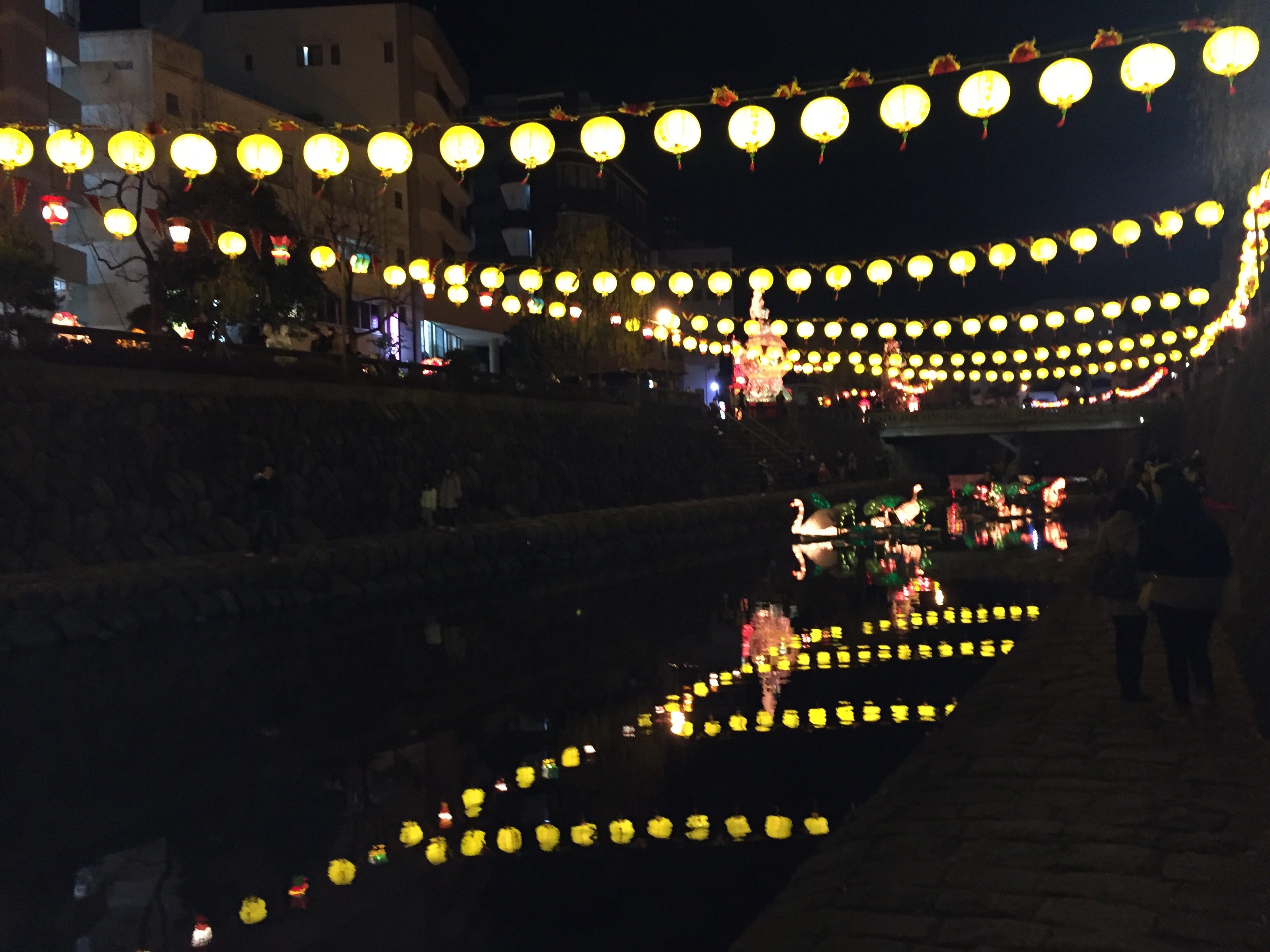
Category: Japan Living

  • Temporary Visitor Visa extension of my mother and sister in Japan

    Temporary Visitor Visa extension of my mother and sister in Japan

    Originally, my mother and sister`s visa is good for only 90 days. They came here last July 20th and scheduled to go back home to the Philippines on October 13th. That would be about two weeks before my due date which is October 30th.

    Upon consideration of many things, we decided to extend them a little bit so they can be with me and help me when I give birth and see baby girl in person. We were worried if they can`t adjust to the weather changes (summer to autumn) since Philippines is always summer and it might be too much for them to brace the cold. Yes, autumn is cold for them just like as spring was. To make the story short, despite that worry, we decided to extend them.

    The first thing I did was  booked another ticket online and deferred the payment for another 24 hours (so I can have time to think it over and find other means). I also googled the requirements for extension and found the downloadable application form.

    The next day, I called the immigration office to know for sure the requirements for extension. The lady who got my call dictated me the following requirements:

    1. Application from (which you can download online)
    2. Personal appearance of the applicants
    3. Passport of the applicants
    4. Reason for Extension (can be written in a separate sheet of paper)
    5. Return ticket (open date is recommended since the approval of extension is not one hundred percent sure and there is a possibility that it will be denied)
    6. Income Tax Certificate (mine and my husband`s) or shotoku kazei shomeisho  in Japanese
    7. Bankbook balance ( optional but will really help to show your capacity to sponsor )

    After that, I called the airline (Cebu Pacific) US hotline thru Skype so and I found out I can just re-book the original ticket and save some good thousand yen than buying a new ticket. I ignored the return ticket I booked yesterday (automatically forfeited after 24 hours of booking without payment  settlement) and processed the re-booking. It took me about 40 minutes to re-book but thank goodness Skype calls are free of charge.

    I changed their return ticket from October 13th to November 23rd. I know the immigration lady told me to get an open ticket but the airline said it is not possible. I just trusted that their visa application will be approved no matter what.

    After that, I filled up the application forms and went to bank then to the city hall to gather the rest of the requirements.

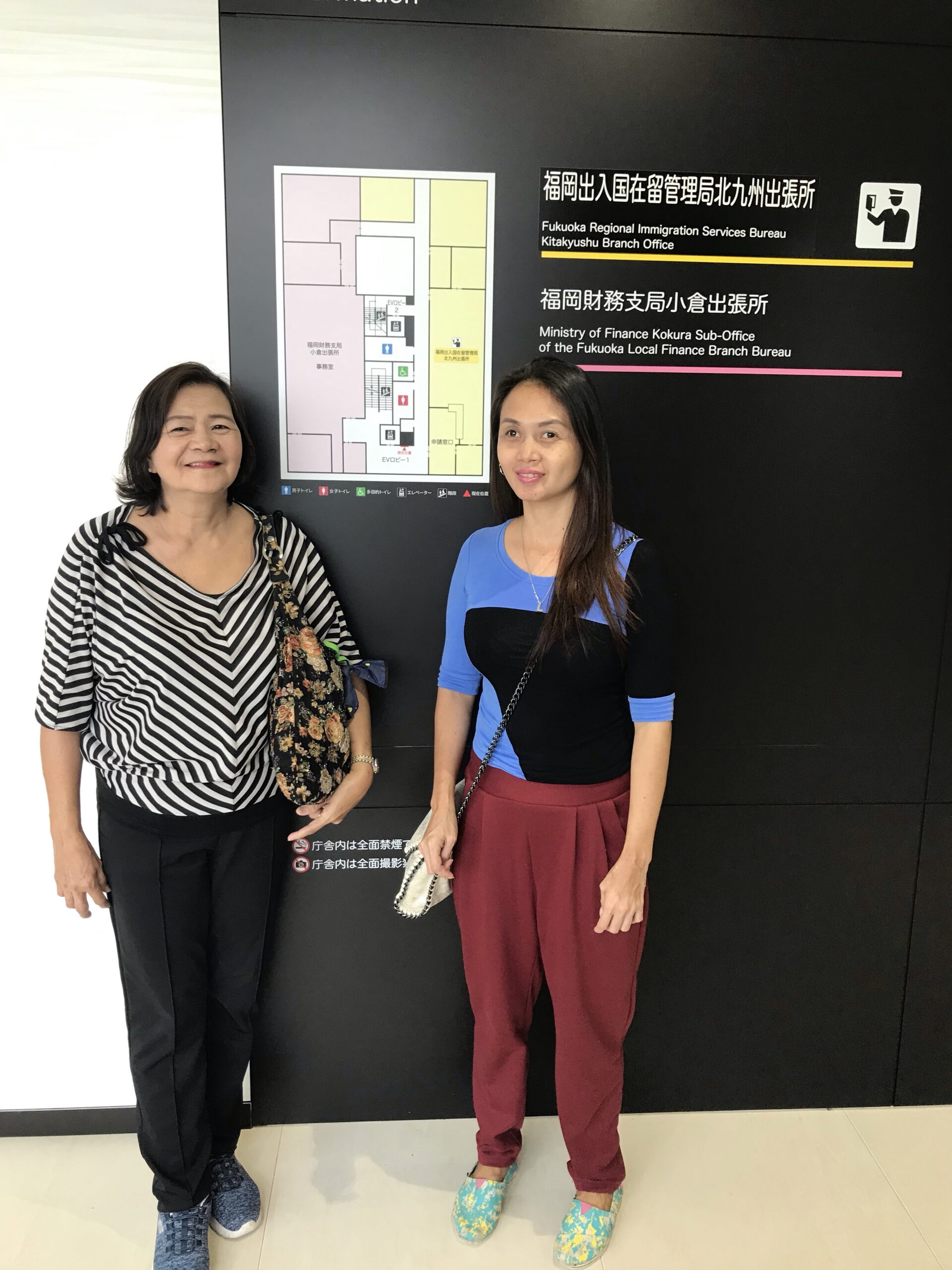
    On that same day, a very rainy day, I took my mother and my sister to the immigration in Kitakyushu to file for the extension.
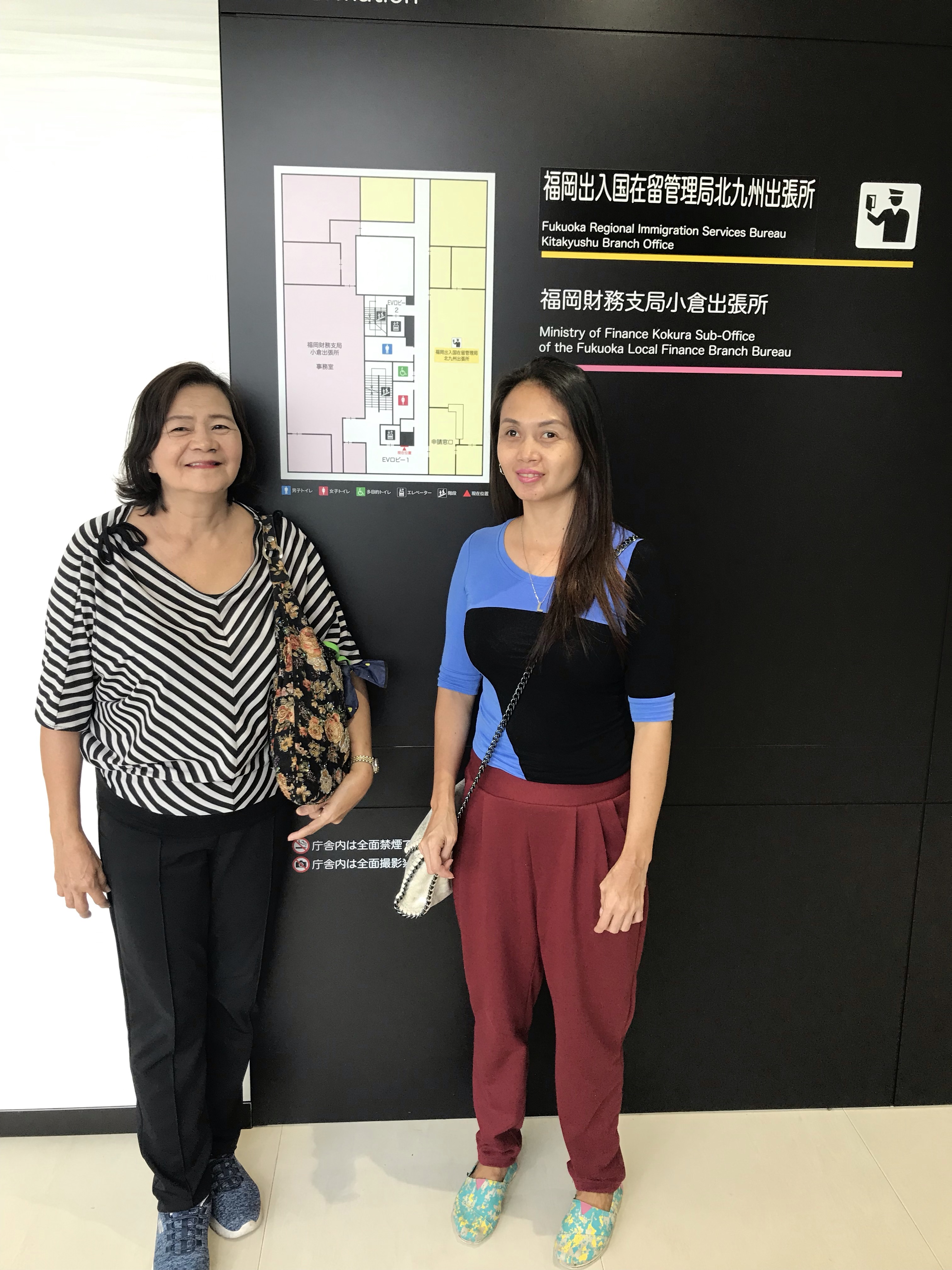
    The lady behind the counter checked the documents and asked me for my Juuminhyou (Residence Certificate) but I don`t have it and told her it was not mentioned when I called that morning to verify the requirements. So, instead, she asked for my Residence card and that was sufficient. She also asked my mother and sister to sign the application and checked the forms again. There were some items I missed to fill-up and she guided me to write them down.

    While waiting for her to process the documents, she asked me to write my address down on a small piece of paper. One tip guys. If there is one thing you need to master in writing Japanese, it should be your address and your name of course. You will write these in any Japanese forms. Again, NAME AND ADDRESS.

    After that, it was done. We were told to come back if we receive some postcard.
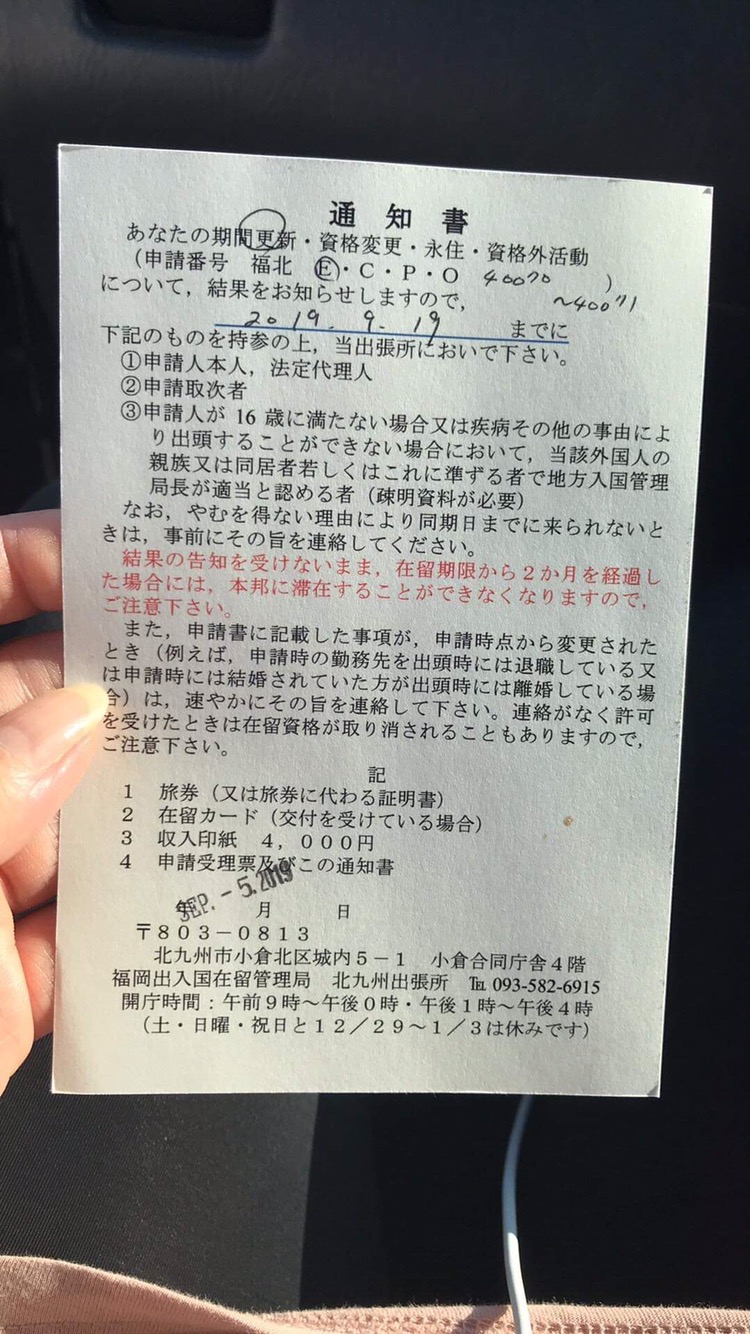
    That was Wednesday, September 3rd when we filed the extension and the postcard came Sunday, September 8 although the postcard was stamped September 5th, meaning, it was released two days later upon application. That was FAST!. It was actually the fastest transaction I have ever made with the immigration. It usually takes three weeks to two months to process renewal or changing status. when I filed for permanent residency, it took almost three months. I guess they hurried knowing that I`m pregnant and could give birth anytime soon.

    A week after we filed the extension, we were back to claim the result. We brought  the postcard (通知書)or written notification and their passports. We also needed to buy two ¥4,000. revenue stamp. My mother and sister signed a document (each for one of them) and I attached the revenue stamp on it and that was it. The lady called me and handed me back the passports showing the new visa which expires in January 16th. They actually extended for another 90 days. That was great to know. We could buy another return ticket later in January if we want but it`s not a very good idea because of the winter cold. And the budget. Lol.

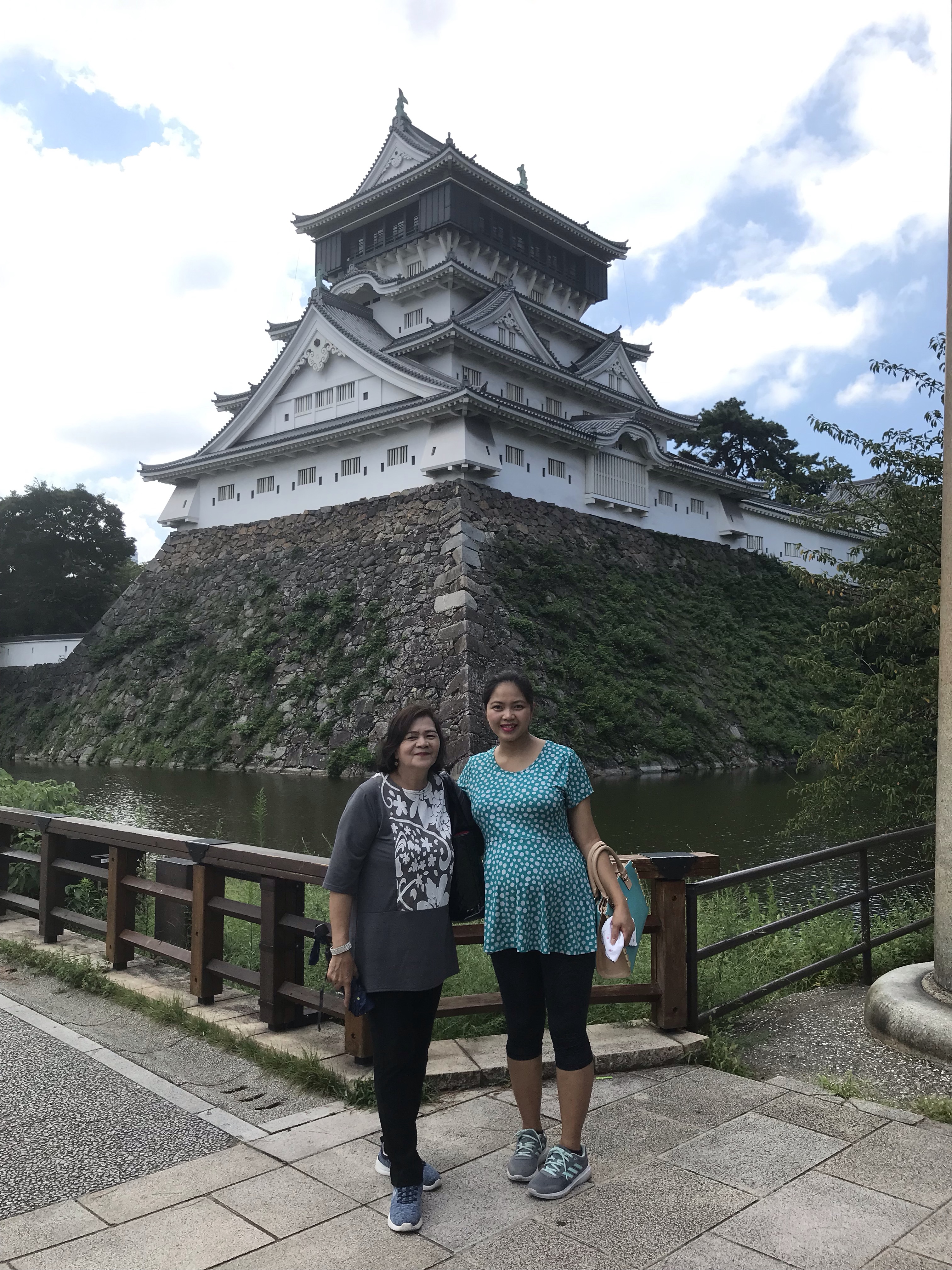
    Before heading back home, we went to the nearby Kokura castle, took some pictures, had lunch at the Riverwalk, enjoyed shopping at Can Do (a very nice hyakuen shop), got tired and went home.
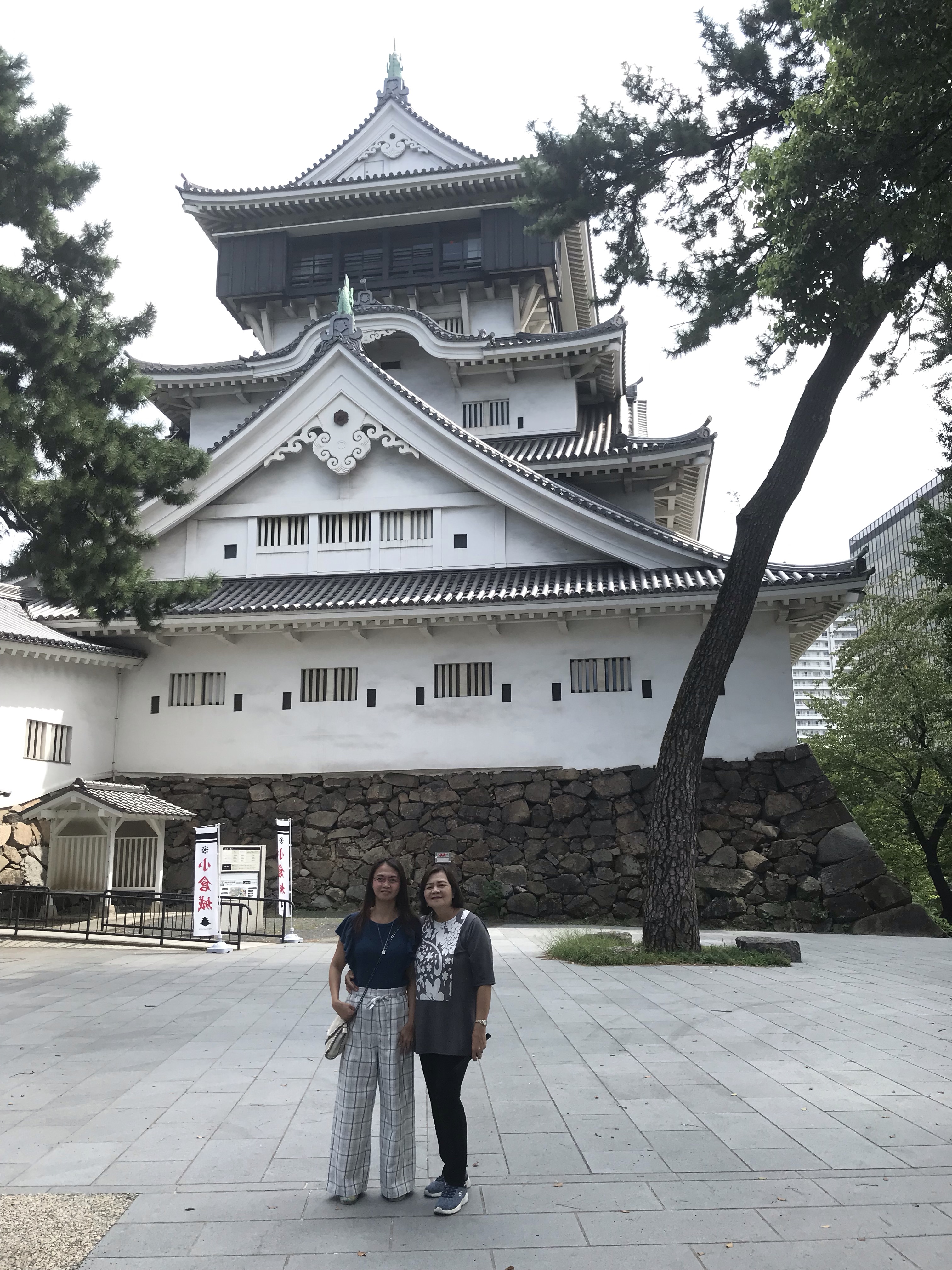
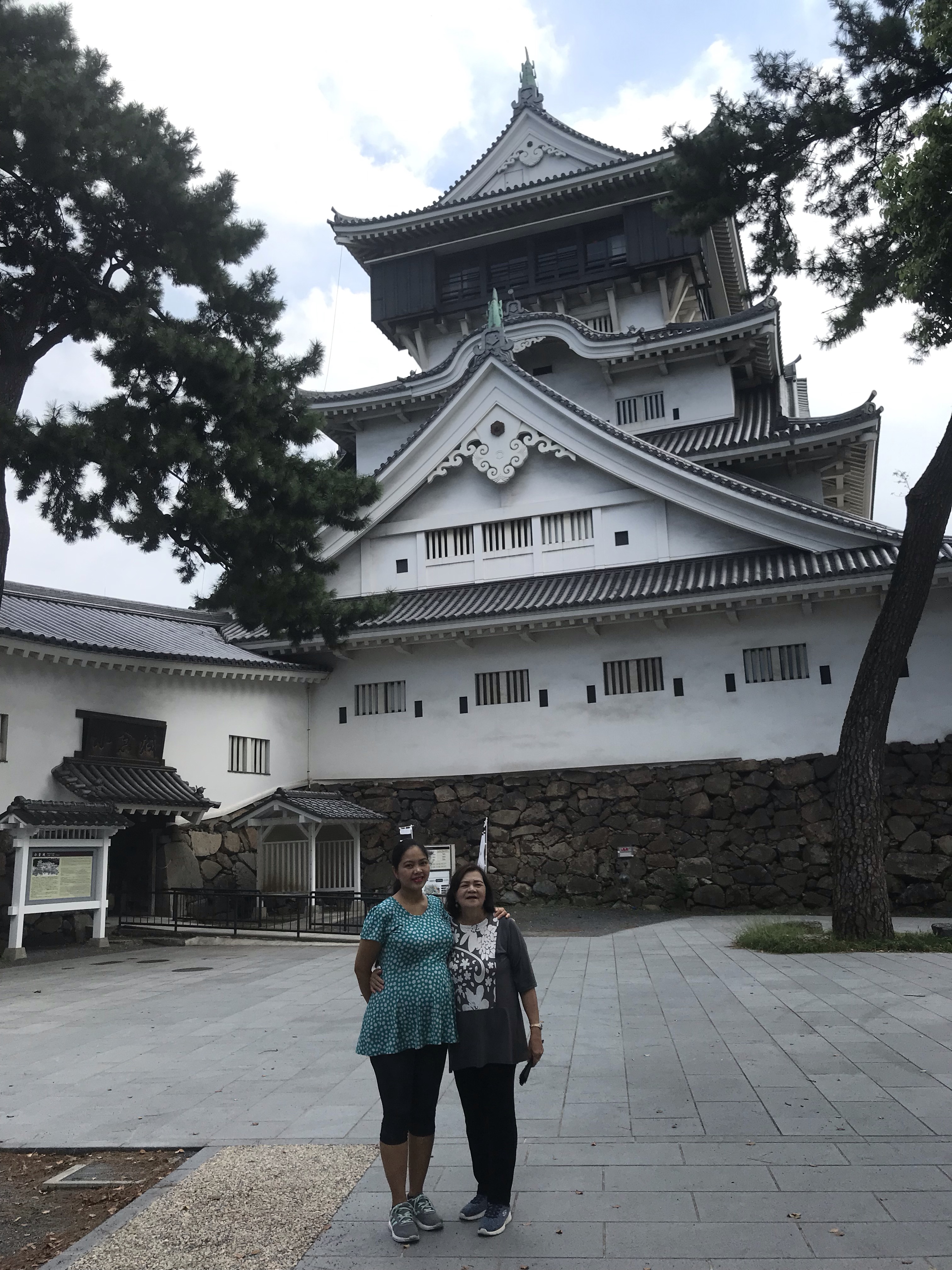
    I hope this article entertained you somehow and more importantly help some readers in their plans of extending their family`s temporary visitor visa.

    Below is the link where you can download the application form and read about the requirements.

    http://www.immi-moj.go.jp/english/tetuduki/kanri/shyorui/03.html

    That`s the website of Immigration Services Agency of Japan.

    This link  (http://www.immi-moj.go.jp/soshiki/kikou/fukuoka.html) will help you locate Fukuoka Immigration Bureau.

    I chose Kitakyushu because that is where I am comfortable at and it is not as busy compared to the one in Fukuoka City. Fukuoka City used to have it in the airport but since they changed the location to somewhere in Hakata, I have`t been there.  Even the immigration officer wondered whether my place is closer to Kitakyushu than to Fukuoka. I am actually residing in between these two cities. I preferred Kitakyushu. Not so many people and you can finish your transaction fast.

  • Look at This Public Restroom in Japan

    Look at This Public Restroom in Japan

    One of the many things I love about Japan is their toilets. You will be amazed at how sophisticated the technology is in this part of the planet. With all the buttons there are to press, you will be lost if you can’t read Japanese. And it is not just about the toilet bowl. It is everything about the restroom.

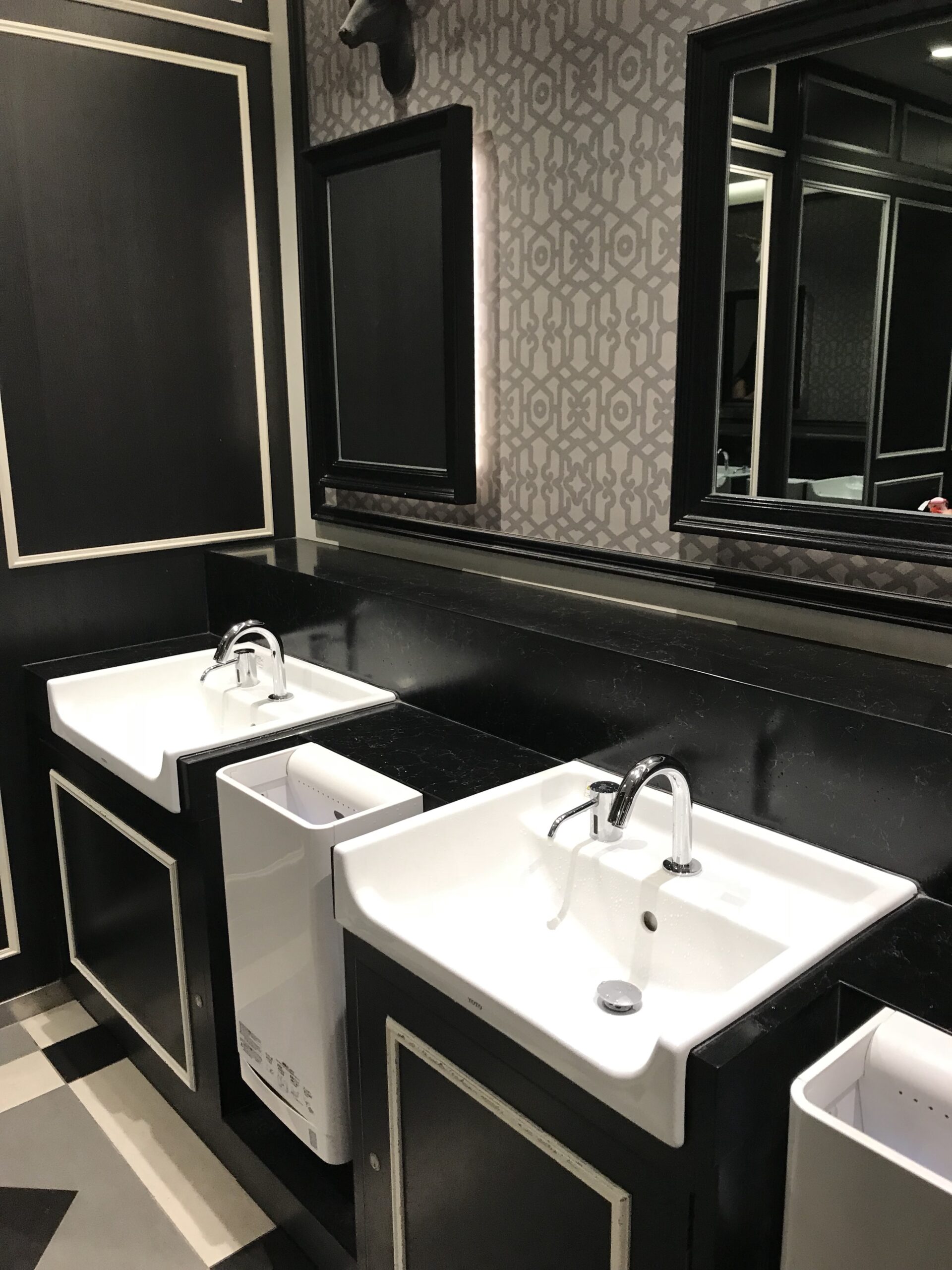
    Here is one of the many elegant public restrooms in Japan. This one is located in Tenjin Chikagai in Fukuoka. Chikagai means undergound shopping center.

    I discovered this beautiful restroom last Saturday when I went to Tenjin to bond with my cousins and my sister.

    I am one of the many female who go to the toilet many times a day. As I was trying to figure out how to get to the meeting place from the chikagai, the call of nature brought me here.

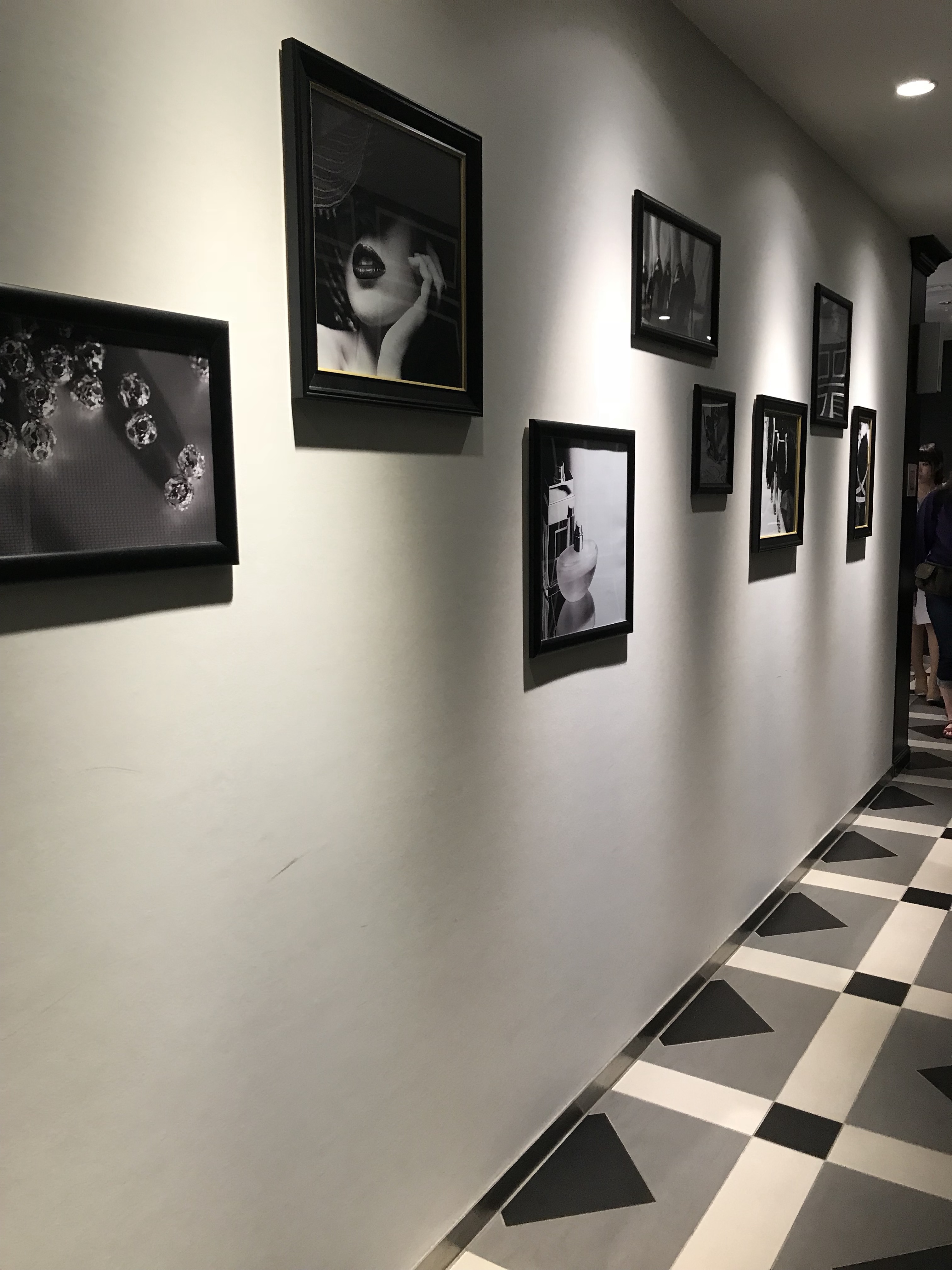
    The entrance is very sophisticated in black and white theme. And even the female and male symbols are nice. I think the best part is the floor. I like the pattern of squares and triangles. Very simple but very nice.

    The hallway wall is decorated with picture frames also in black and white. Unity – one important factors of design is very evident here.

    Everything was either black or white. The mirror frame and the cabinets are black. The sink and the hand dryer are white. The wallpaper add texture and pattern to the room.

    There is also this big cabinet displaying silver and gold items. It gives the feel of luxury.

    And last but not the least, of course, my toilet selfie. The big whole wall mirror is so inviting you can`t resist for a snap.

  • My first apartment as an ALT in Japan

    My first apartment as an ALT in Japan

    When I got a job in Japan as an Assistant Language Teacher (ALT), my company helped me find an accommodation. The company that I worked with had a contract with this apartment chain that I am not gonna name….okay, I changed my mind. I`m just going to tell you. It is Leo Palace. Here you go. Now, you know. Well, if you are planning to work in Japan as an ALT or something else, you might come across with this apartment. Many ALTs are familiar with Leo Palace since most first-timers have lived in one.

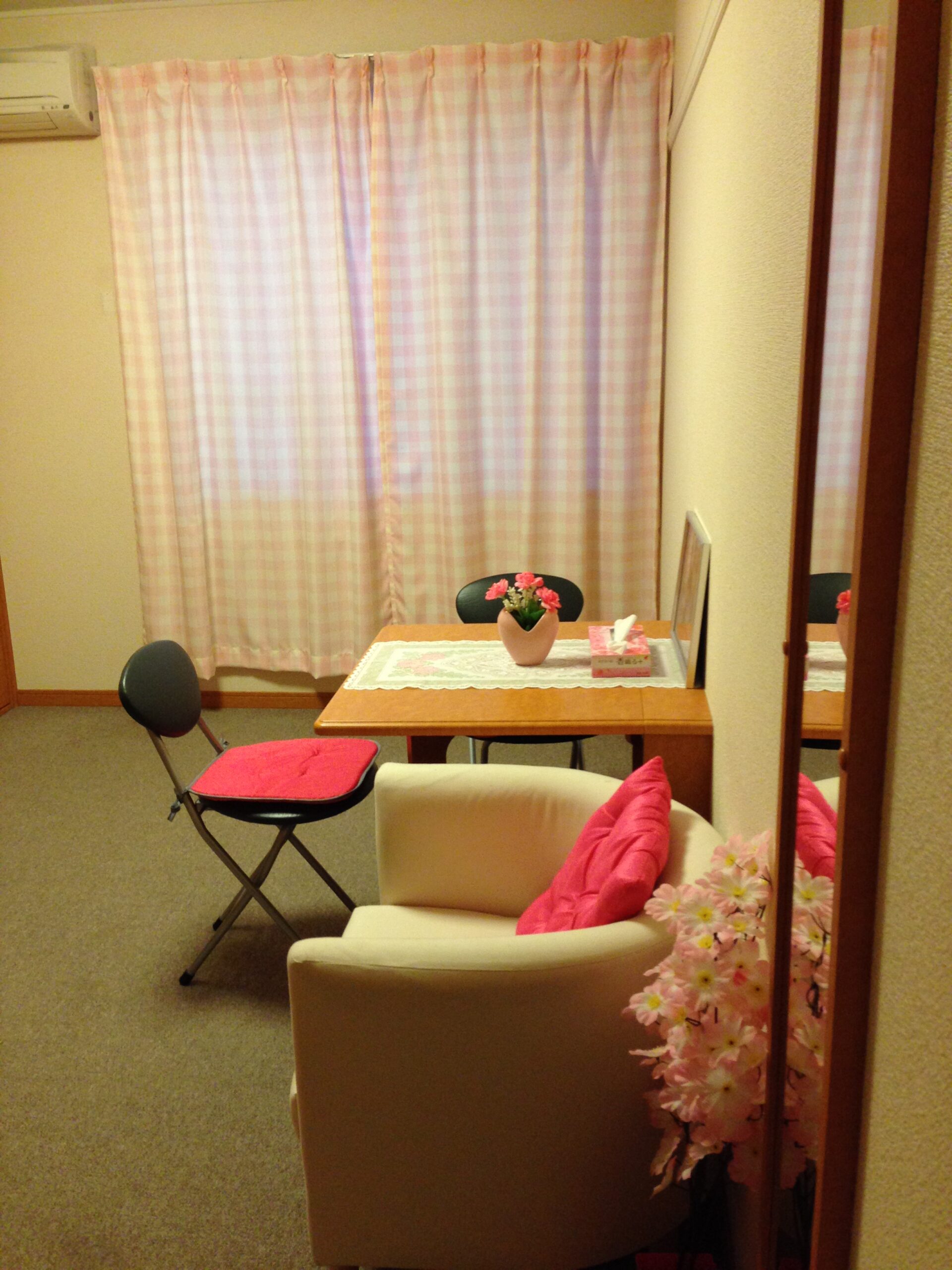
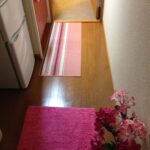
    Here are the pictures of my apartment.

    Pink is not my favorite color if that is what you think but it just happened that I had a pink blanket and curtains from my old apartment when i was still a student and so I decided to just match everything to create harmony, and peace, Amen. 🙂

    The rent was about ¥50,000 which is about 20,000 Philippine peso and about $500 US dollars. When you moved in, you have to prepare like ¥200,000 as first payment. I know. It`s crazy. This first payment includes two months advance, plus thank you money, plus this and plus that and that and so on. I was lucky (or maybe just a victim of  business opportunist) because my company provided loan and it covered my first payment, which in turn they had to deduct from my salary for a couple of months.

    This apartment is good for first-timers since it is a furnished apartment. You don`t need to buy a refrigerator, gas stove, air conditioner and microwave. They even provide curtains and it is internet ready. It is good for one person or 一人暮らし read as hitorigurashi meaning living alone by yourself.

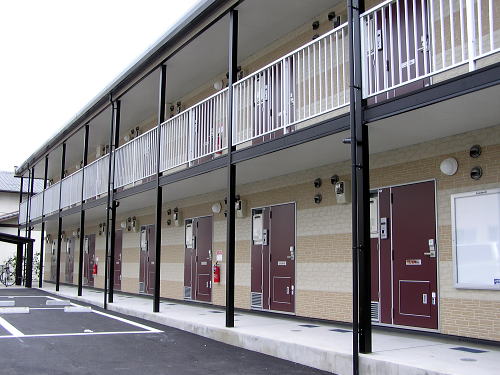
    Below is a common exterior of Leo Palace.

    Image result for leo palace room floor plan

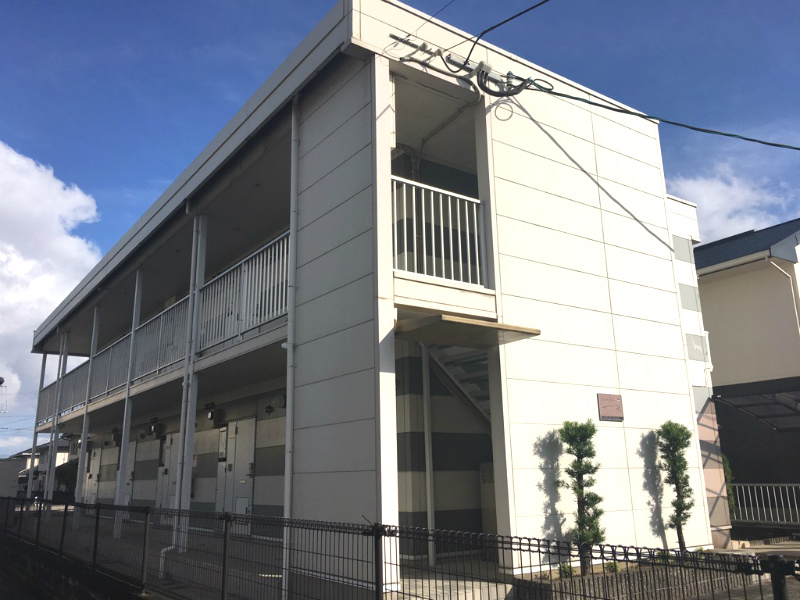
    My apartment was like this in the outside

    Image result for leo palace 宿町鳥栖市

    Image result for レオパレス 21宿町鳥栖市

  • How to distinguish Japanese from Korean and Chinese

    How to distinguish Japanese from Korean and Chinese

    Can you tell if a person comes from a specific country? Before coming to Japan, I had no idea how to distinguish Japanese, Korean and Chinese from one another. I had quite a few experience (when I was in the university as an international student) of trying to speak Japanese to a fellow student who I thought is Japanese, but after all, turned out to be Korean or Chinese (who is new to Japan and cannot speak Japanese). To avoid future embarrassment of assuming someone is not, let me discuss their similarities and differences. This is according to my observations and the opinions of my friends with who I discussed the subject.

    twitter.com

    Similarities

    1. Skin.

    preview.ph

    Japanese, Korean and Chinese, generally, have the same skin characteristics. It is popular that their skin is more resistant to aging and that they have fair, light porcelain-like skin. It is due to extreme sensitivity to environmental factors and chemical effects of some products, which can disrupt the pH balance. For this reason, advertising about skin beauty care in Asian countries is very economical as Japanese, Korean and Chinese (especially girls) have to be more careful with products and treatments they use on their skin. It is even impressive to see the number of skin care products build on the myth that Asian skin would look amazing and healthy for a long time. so, it is hard to tell who is who if you only look at their skin. 


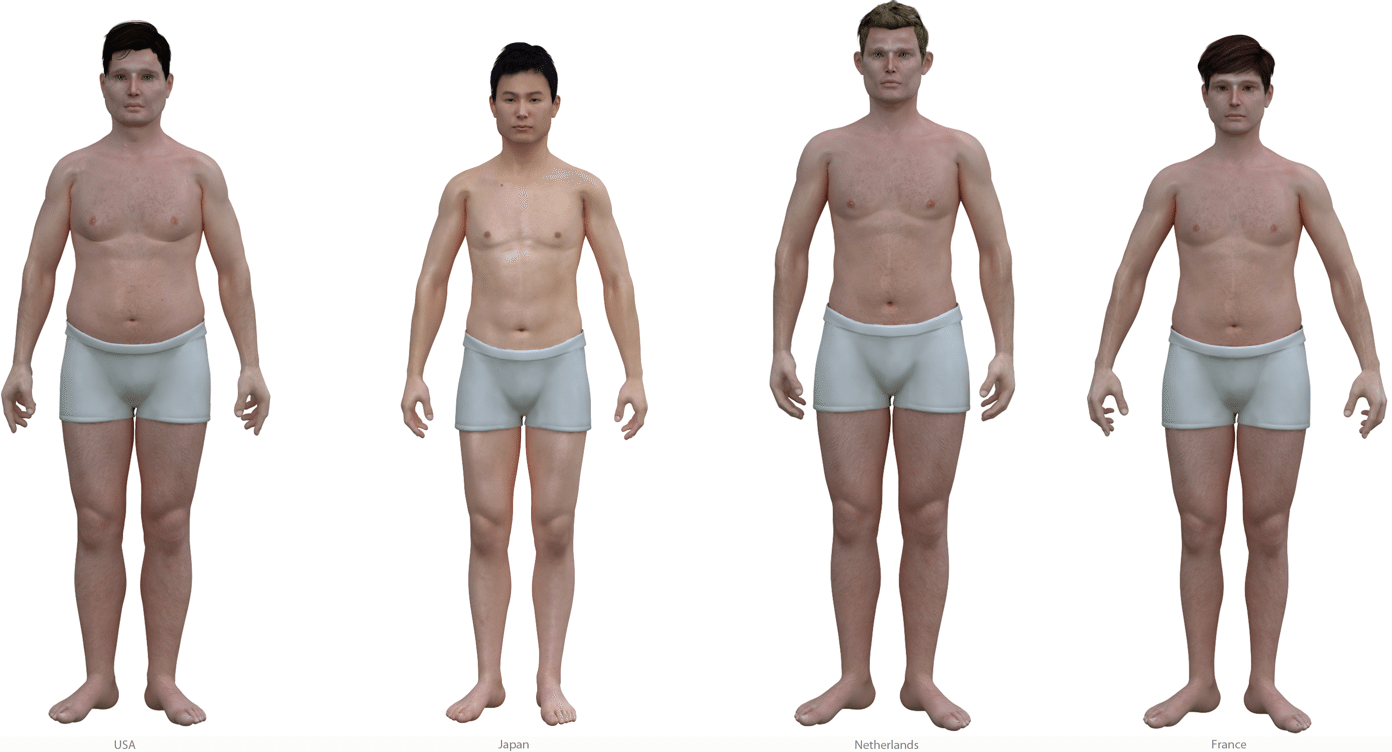
    2. Body built


    theatlantic.com

    There are of course differences in body built among Japanese, Korean and Chinese people.  As human as we are, we can be fat, thin, big or small. It all depends on our individual diet and consumption, not to mention our genes. Although we have a general impression as to how, for example, an American body tend to be (tall and big). Asians, specifically Japanese, Korean and Chinese, are typically of slim body built and kind of short in terms of height. But be careful not to label all of them slim and short, because, as I have said, everyone is different. Some can still be tall, big and fat.


    Differences

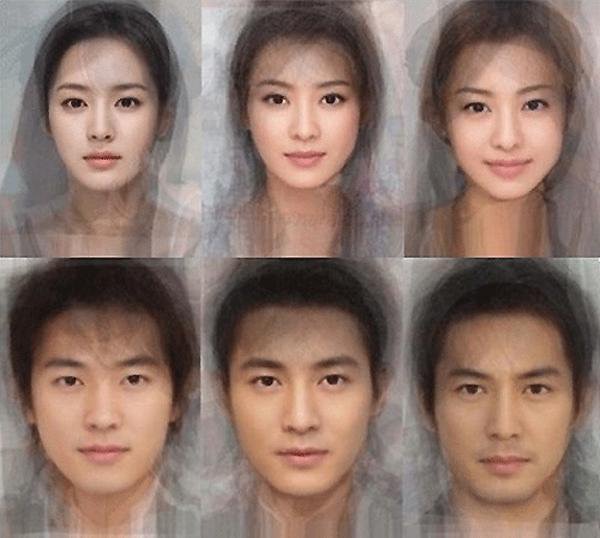
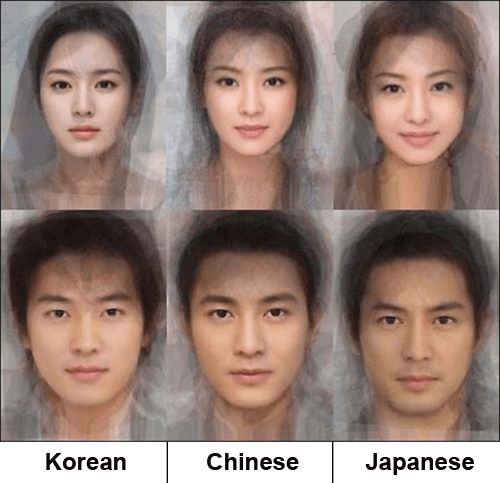
     1. Facial Features.

    onehallyu.com

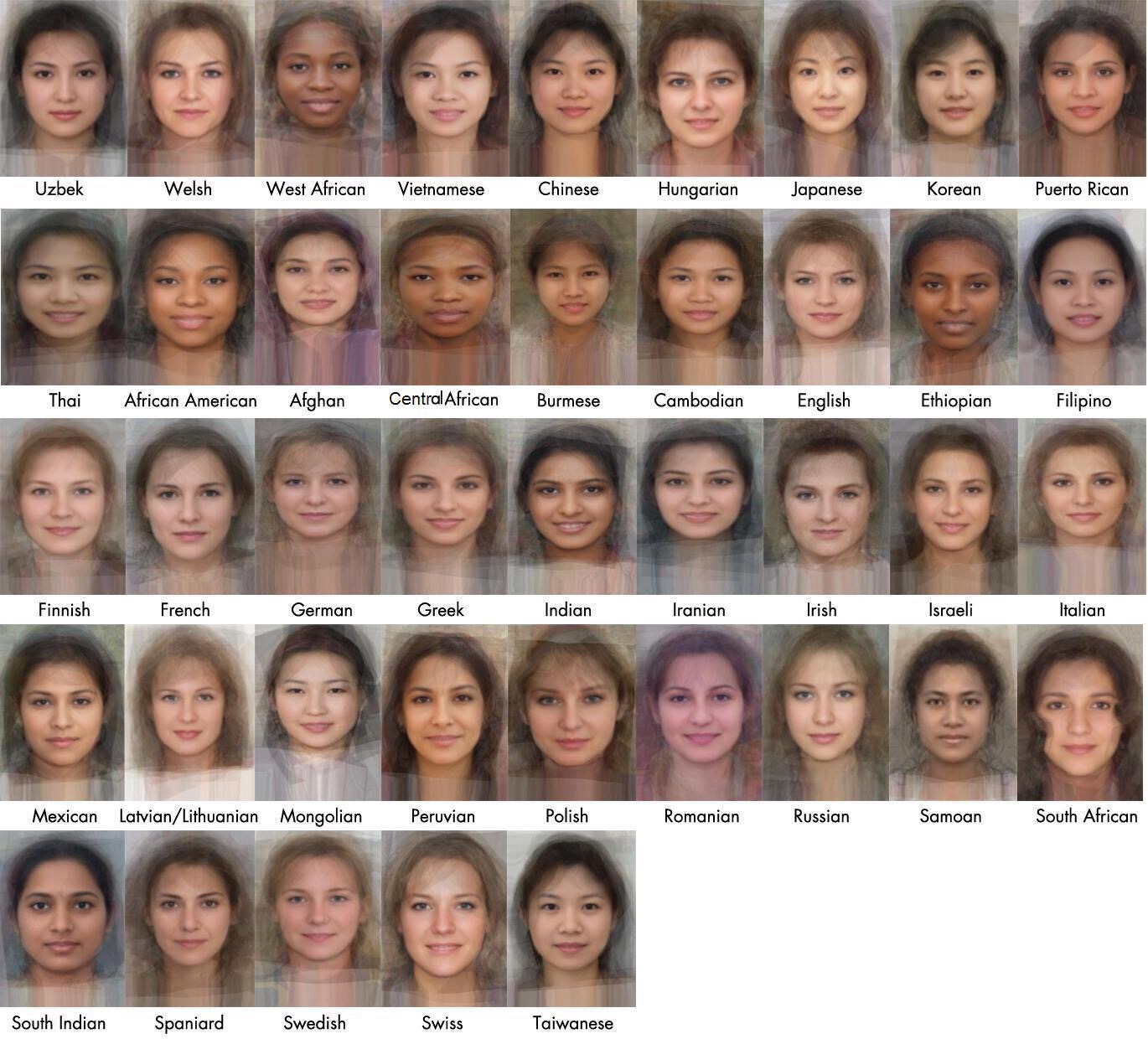
    They may look the same, but if you are a keen observer, there are a few distinguishing characteristics. The Japanese face is generally longer and wider, while the Korean face often has a more prominent jaw and high cheekbones. The Chinese face is typically round in shape. When it comes to the windows of the soul, the Japanese eyes are often described as angled upwards, contrary to the Chinese eyes which are usually angled downwards. Koreans often have smaller eyes.


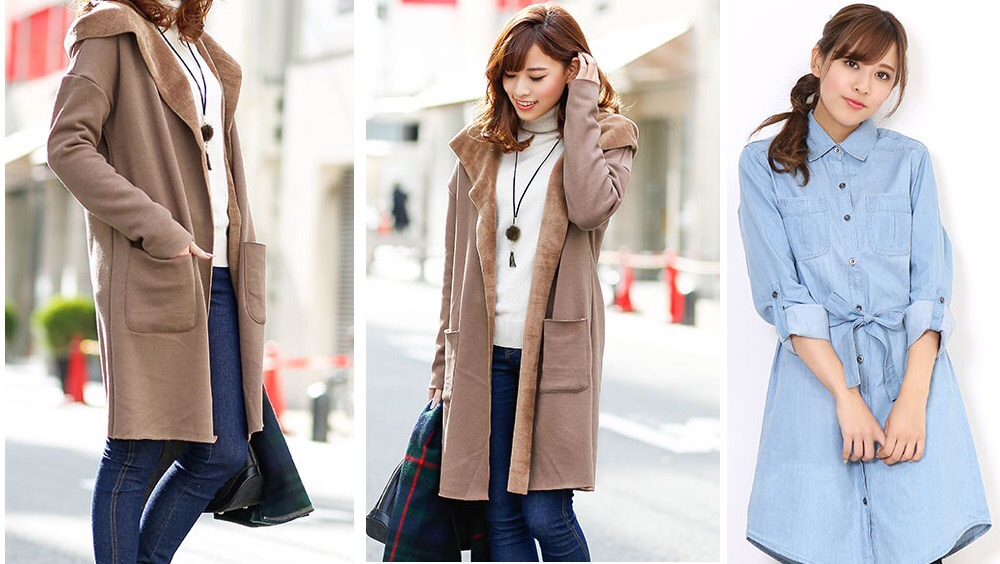
    2. Dressing style

    Japanese street fashion


    thetokyogirl.com

    My Japanese friend told me it is easy to tell whether a person is Japanese or Korean. Just look at how they dress. Japanese people value harmony and uniformity, hence, when they dress up, it is something aimed to blend with the majority. Plain, simple and subtle colors are the key to typical Japanese attire. Nothing that stands out. I observed that wearing suit is very common in Japan. May it be a final (research) presentation in school, a job internship, a job interview, graduation; Japanese usually wear suits, in black and white (inner). Very seldom you can see a coloured inner. 

    kore.am

    Contrary to Japanese, most Koreans wear bright and more colourful attire. I remember my Korean friend said in her culture presentation in school, that, unlike in Japan, they can wear nice colourful dresses when they do their internship and especially during job interview. Chinese, on the other hand, due to its high cultural diversity is difficult to distinguish


    Even up to now, after living for quite some time in Japan, it is still challenging for me to tell which is what, and who is who. Even people of the same race can look different. It is hard to generalize. We can never actually generalize. As the saying goes “Everyone is unique”.

  • What makes kanji difficult and challenging and what are the ways to overcome it?

    What makes kanji difficult and challenging and what are the ways to overcome it?

    Many Japanese language learners express difficulty about the language and most of them say that learning kanji is what makes it hard.

    Kanji is one of the three set of characters, together with Katakana and Hiragana, which make up the Japanese language. While Katakana and Hiragana symbolize sounds, Kanji symbolizes meaning.

    So, what makes kanji difficult and challenging? The answer is simple -it’s the way they are written and read. Let’s discuss them one by one.

    A. Writing

     The way to write kanji is based on strokes – number of strokes, stroke pattern. For example, the kanji for number one 一 read as ichi consist of only one stroke. That is from left to right. More complicated kanji, for example the kanji for difficult, 難しい read as muzukashii, 難 itself consists of eighteen strokes.

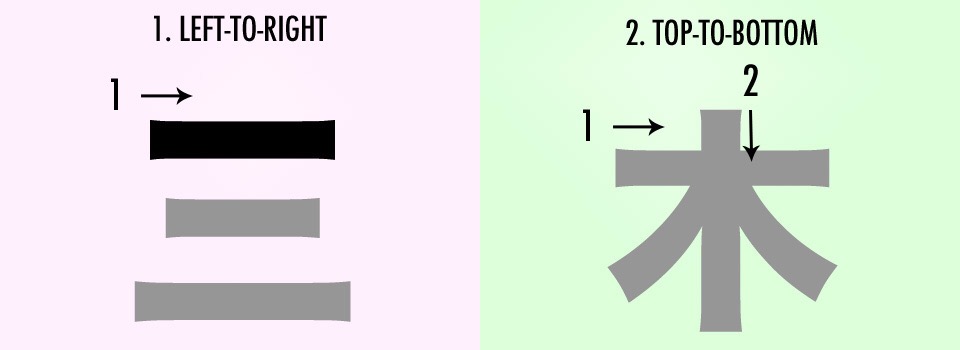
    When writing a kanji, the stroke should follow the following order:

    1. Left to right

    2. Top to bottom

    I was always amazed by how our Kanji teacher always could tell how I wrote the kanji in the wrong order. How could she know the order just by looking at the lines? Isn’t it amazing?

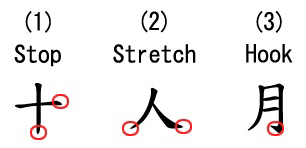
    Moreover, the way to end a stroke is categorized into three.

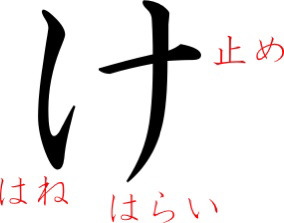
    1. Stop. Stop stoke is done by completely stopping your writing tool at the end and lifting it to start on to the next stroke. To make it simple, it looks like a straight line.

    2. Stretch. Stretch stroke is done by lifting your writing tool as you end the stroke. It looks like a curvy line.

    3. Hook. Hook is done when you make a small hook at the end of the stroke.

    If you fail to follow this rule, the meaning can completely change. The kanji for thousand 千 read sen, chi and dry 干 read as ho(su), kan for example look alike but they are, of course, different. The first stroke for千 is a slash stroke from right to left while干 is a stop stroke from left to right.

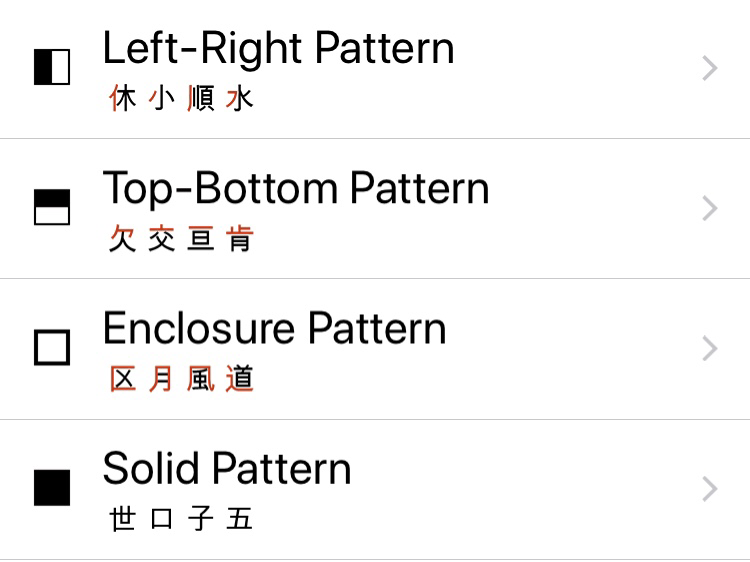
    Kanji characters are categorized into four patterns

    1. Left-Right

    2. Top-Bottom

    3. Enclosure

    4. Solid

    B. Reading

    Reading kanji is the most challenging part. This is where your memorization skill is tested and harnessed. Kanji has two basic kinds of reading, onyomi and konyomi.

    a. Onyomi 音読み, the Chinese reading. From the word itself, this reading is derived from the Chinese reading, although many of my Chinese friends say that they read kanji completely different from Japanese way of reading.

    A kanji character can have one on’yomi or more. It can have only on’yomi without kun’yomi or it can have both. On’yomi is used when two or more kanjis are put together to form a word. Say for example the word for teacher 先生 read as sensei. That is to say the on’yomi for the first kanji 先 is sen and the second kanji 生 which has two on’yomi sei and shou, uses sei in this case. But, it is not always the case. The kanji for birthday which is 誕生日 does not use on’yomi for each kanji character. There is only one reading for the kanji 誕, that is the on’yomi tan and no kunyomi. The kanji 生, this time uses shou which is changed to jou (and that is another way of switching sound), and the last kanji 日, uses not the on’yomi nichi or jitsu but the kun’yomi bi.

    b. Kun’yomi 訓読み, the Japanese reading, on the other hand, can be single or multiple. It is commonly used for reading a word with one kanji alone or kanji and hiragana combined. Let’s go back to our example word sensei 先生 (teacher). If 先 is used alone, this is read as saki or masu. 生, is one of the many kanji characters which has many kun’yomi. It can be read as the following:

    生きる ikiru (to live)

    生かすikasu ( to make use of)

    生けるikeru (to arrange, to plant)

    生まれる umareru (to be born)

    生れるumareru (to be born)

    生まれ umare (birthplace)

    生む umo (to give birth, to deliver, to produce)

    生える haeru (to grow, to spring, to sprout)

    生やす hayasu (to grow, to cultivate, to wear a beard)

    生 ki (pure, undiluted, raw, crude)

    生る naru (to bear fruit)

    生す nasu (to build up, to establish)

    生す musu (to grow of moss, etc.)

    Most words made up of multiple kanji use on’yomi and kanji-hiragana combinations use kun’yomi, but not in all cases. Say for example the word for Sunday, nichiyoubi 日曜日, where the first 日 uses the on’yomi nichi while the second 日 uses the kun’yomi bi.

    C. Meaning

    Since kanji are pictograph, each kanji represents a particular meaning. Can you tell why the following basic kanji carries each meaning?:

    人 person

    大 big

    山 mountain

    川 river

    口 mouth

    木 tree

    火 fire

    Most of the kanji above look like the object they represent, aren’t they? Some even has stories about how they come up to such meaning. Like the kanji for rest 休 (yasu-mi). the left part represents a person while the right part represents a tree. In short, a man “resting” under a tree. But, wait! It’s not that easy. Not all kanji can be explained by how it looks like. Most kanji are irrelevant to their meaning, that even Japanese cannot explain and the only thing you can do is memorize them. Look at the following examples and see if you can explain why such kanji carries the following meaning:

    瓶 bottle

    飲む drink

    蛙 frog

    色 color

    別 separate

    These are only a few. There are thousands of kanji that you have to learn. Don’t get discourage. Even Japanese don’t memorize all kanji there are. We only need to learn a few (like three thousand) to survive Japan

    Tips in learning kanji

    1. Write them down. That’s the only way to learn how to write it right. You have to learn the strokes. And you need to write it many times. Many many times. That’s how the Japanese learn kanji, too. Elementary kids have Japanese writing homework everyday where they have to write a set of kanji many times. And not only the single kanji itself but the word it forms. And not only the word, you have to write the sentence it is used. That way, it will stick in to your head.

    2. Find a meaningful connection of a kanji character to something that makes it easy for you to memorize. Imagine a story out of a character. For example, 低い hikui (low, short). The first stroke on the left is a person and the strokes on the right represents two legs stepping on something to be equal the height of the person because she is ‘short’.

    3. Read stories with audio background so you can listen while reading silently. After that, try reading it aloud. I found a website that has many Japanese stories with audio files. I like it very much because it shows me the kanji of the words I already know but never seen the kanji before. It helps a lot.

    4. Watch Japanese TV whether it’s news or drama. Don’t watch with English subtitles. Watch it with Japanese subtitles. Most Japanese news and some programs have Japanese subtitles.

    5. Read labels and packaging and try to understand some words you don’t know. Research. Research. Research. I tell you. One of the words that came out in JLPT N2 Vocabulary section is a word always seen from food packaging. And I regretted why I didn’t try to learn it before the test.
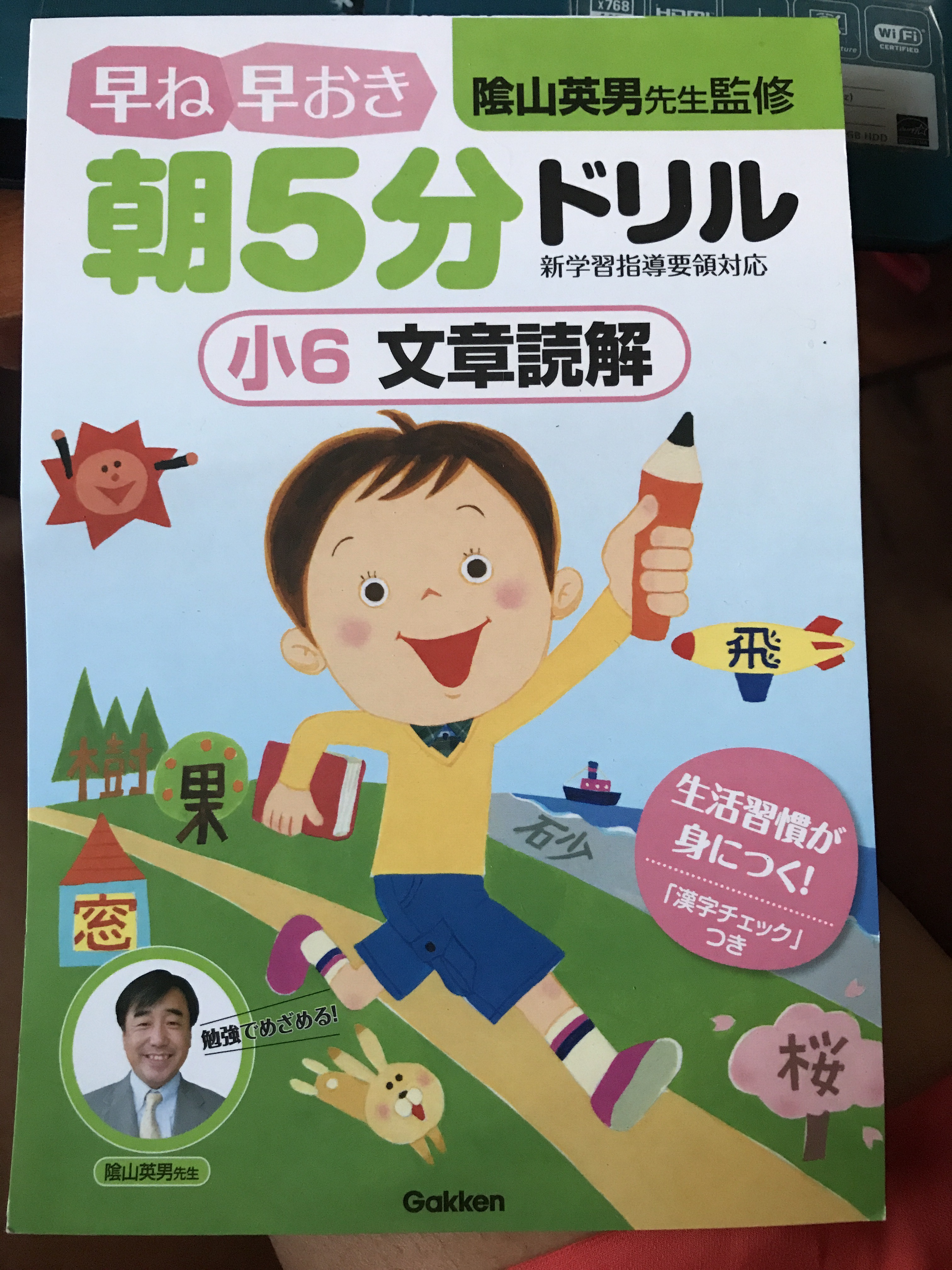
    6. Love it. If you hate kanji then you’ll never learn. You have to find the passion to learn each stroke, it’s meaning, it’s reading. You have to learn to appreciate how wonderful it is that a single character can mean many things when combined with many other characters. If you say you can’t, then you won’t. Our mind is so powerful. If you set your mind to refuse to learn then it will shut down and will never understand. It will only see the negative side of learning. Train your mind to open up to new things and new knowledge like learning a new kanji everyday and one day you’ll see the fruits of your labor.
    That’s all for now.

    If you want to say anything about this article, just leave your comments below.

  • English Bulletin Boards

    English Bulletin Boards

    One of the not so many tasks of an ALT (Assistant Language Teacher) in Japan is updating the school’s English Bulletin Board.

    In my school where I’m assigned, in fact, the only school I am assigned (normally ALTs are assigned to more than one school), I make sure to update our English Board every month.

    In the first semester (April, May, June, July), I kept the board pretty simple. I put up some world updates, some English greetings and words, and also a daily update of day, date and weather.

    I started changing the board according to the monthly event/theme in the second semester, that is from September, right after summer vacation in August.

    But, unfortunately, I forgot to take a picture of my September board.

    So let’s start with October.


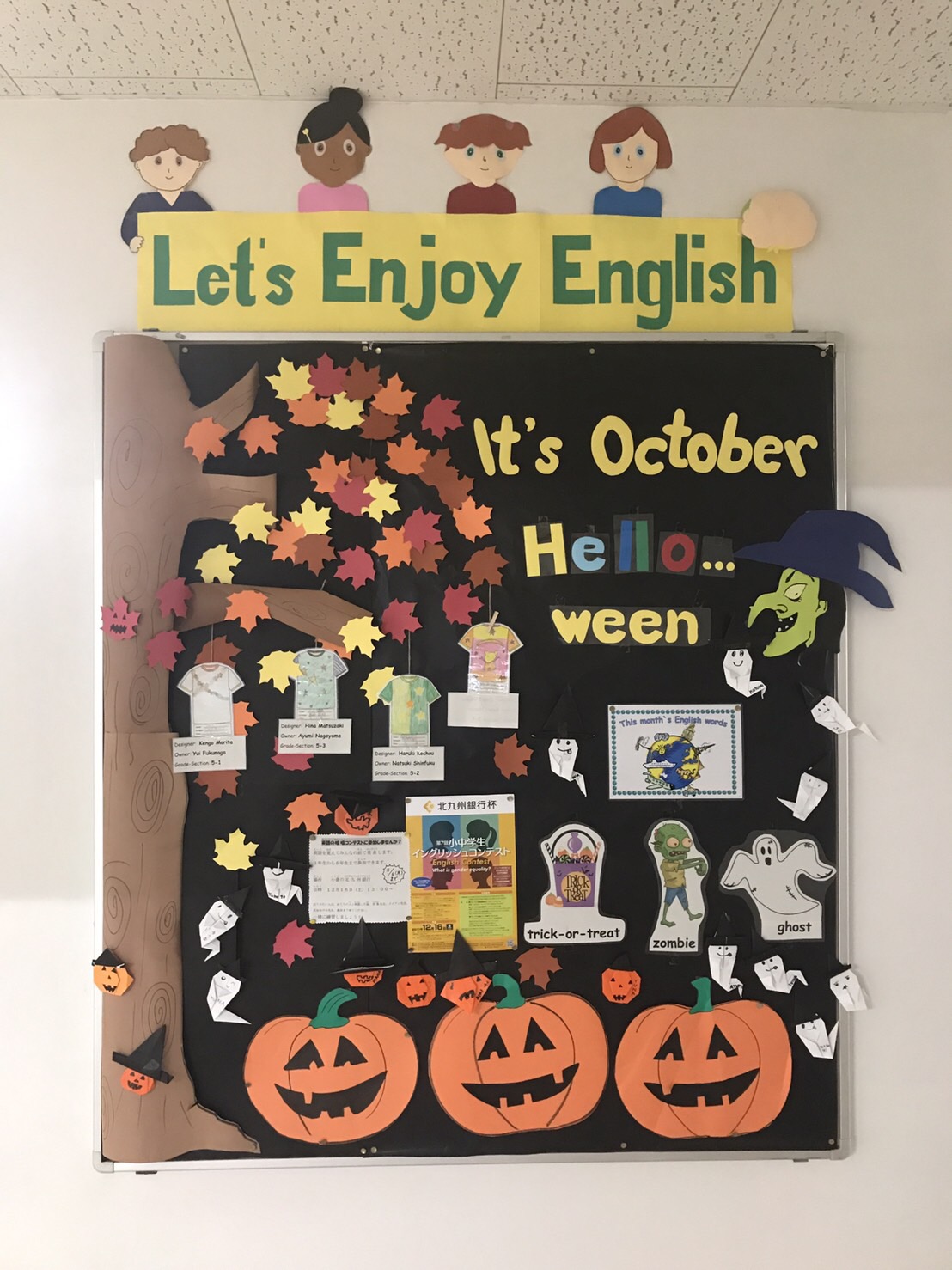
    As you can see, it’s Helloween, I mean, Halloween theme. I just put a little twist to the word to make it more catchy. I made three big jack-o-lanterns and aligned it under a maple tree. I printed one maple leaf and traced it to colored papers, of course autumn colors since it’s autumn and just put it all over the cut out tree. The origamis are made by students during lunch break, when they come to the ‘English Lounge’, well, basically just tables and chairs in front of the English board and we gather there and chat while making origamis.

    Next is November.

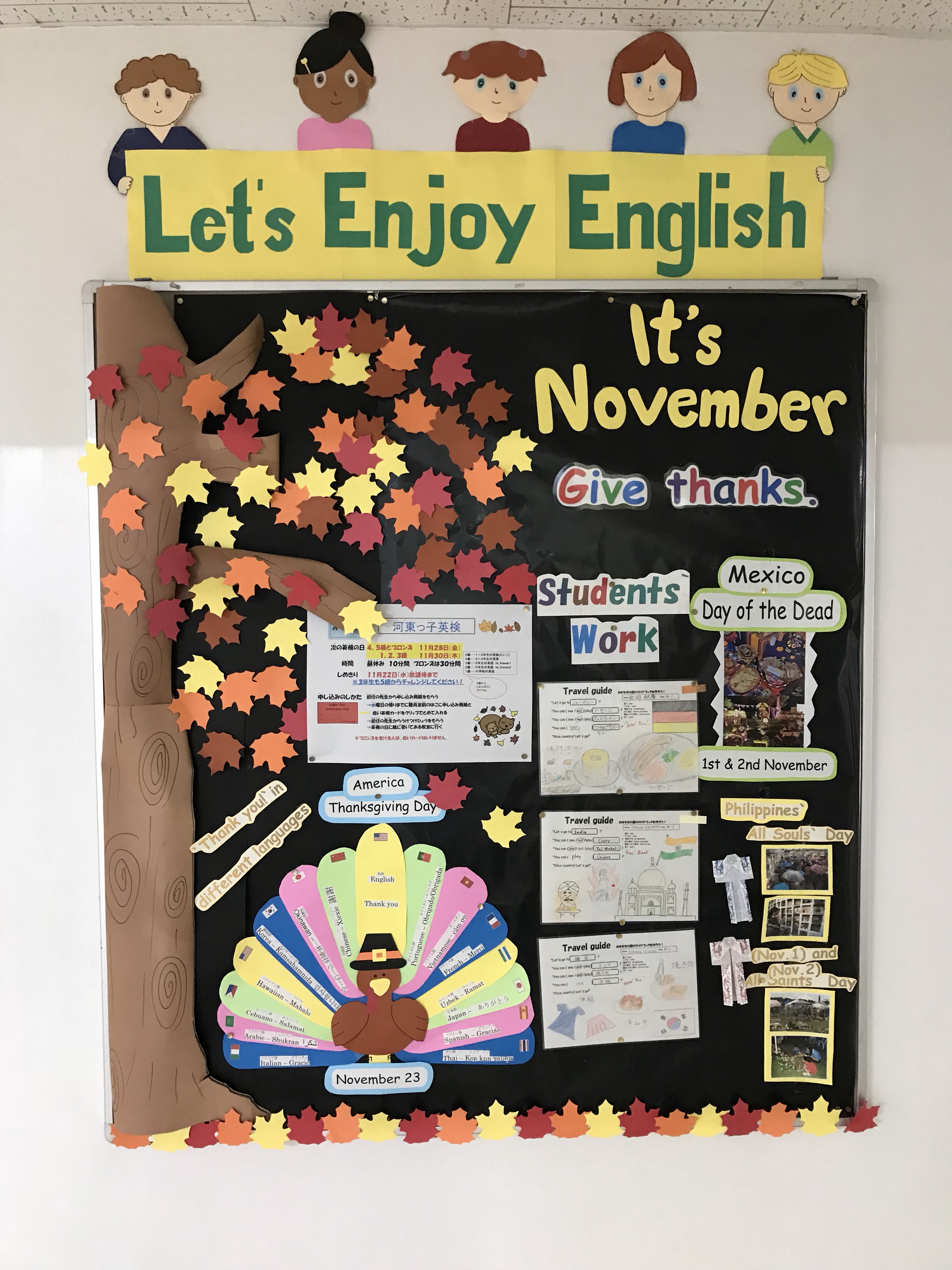
    I kept the maple tree in November board since it still autumn but I removed the jack-o-lanterns and other Halloween things and put a colorful turkey on it. November is Thanksgiving so that explains the ‘Give Thanks’, right? If you look closely, the turkey’s feathers contain ‘Thank you’ in different languages. Some (that Mexico thing) are reused from the previous years’ bulletin board. It’s a waste to throw them away. Why not recycle, right?

    Here comes December.

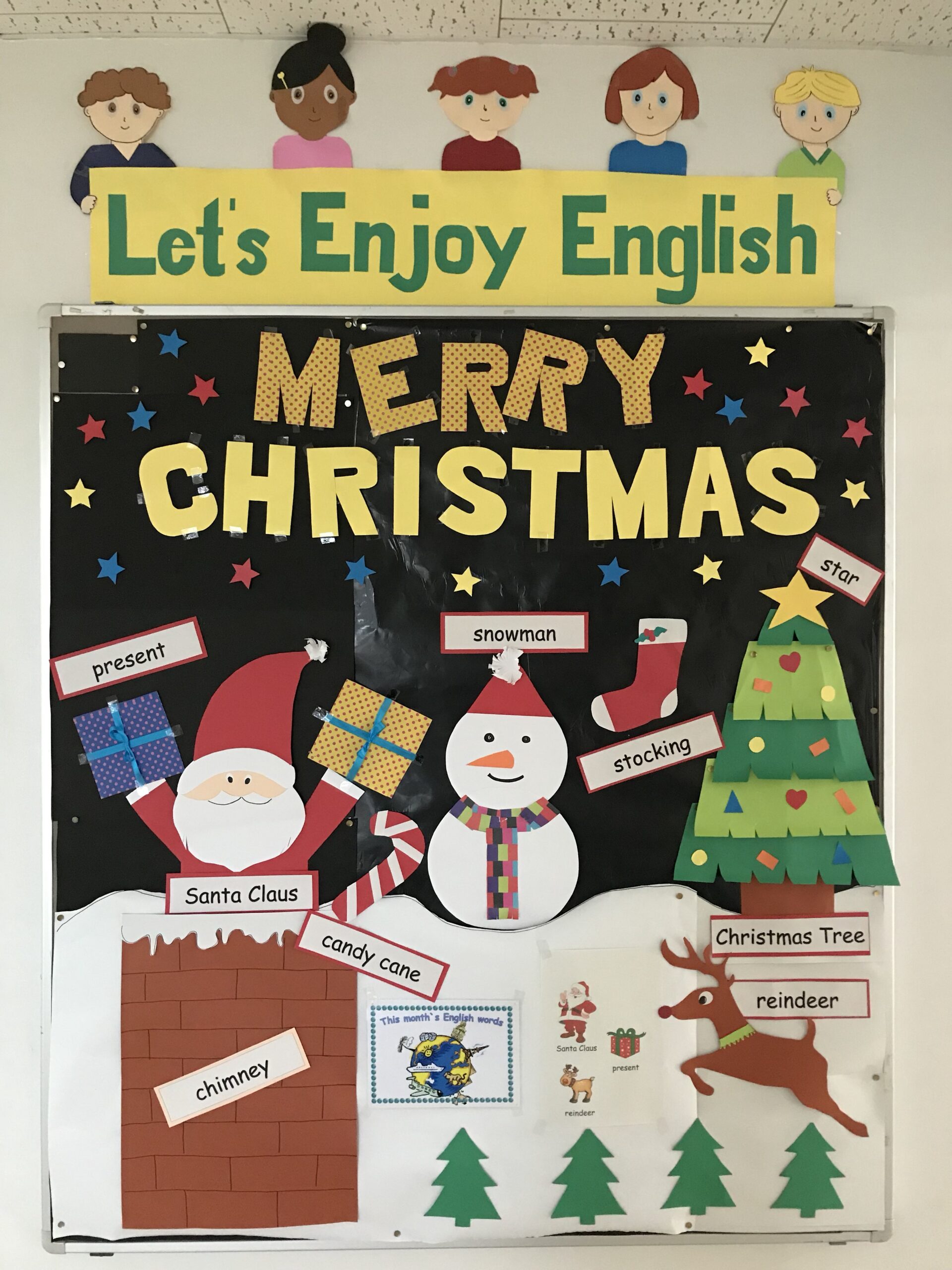
    The black background has been there for three months. I find black background so easy to decorate but I admit, I was getting sick of it, so I added white background below it to represent snow. The students like the snowman but I personally like the reindeer. Those are all cut-outs. Well, I had a plenty of time to make these things. 🙂

    The January board was not really the best but I have to tell you, this is the most, should I say, tedious, to make. I decided to make cut-outs of Snoopy and friends’ characters since it is year of the dog. All the red letters are cut-out too, but when I put a white background into it, it looked like printed words. :-/ The new year greetings in different languages are printed. Nothing complicated. And below is the outcome.

    Next week, I will update the bulletin board for February. I already prepared some heart cut-outs but I still don’t know the final outcome. Nothing in mind. We’ll just see.

  • Why is summer vacation in Japan not a vacation for students at all

    Why is summer vacation in Japan not a vacation for students at all

    Most kids around the world look forward to summer vacation. For most of them, it is the best time of the year. Free from the tiring things in school, listening to the teachers sermon, doing projects and endless homework.

    But, not in Japan. Although summer is fun in Japan with so many festivals that you can go and you can even watch fireworks while wearing your yukata (summer kimono), eating kakigori or shave ice, most kids, elementary and junior high school somewhat hate summer.

    Why? For one reason. Homework.


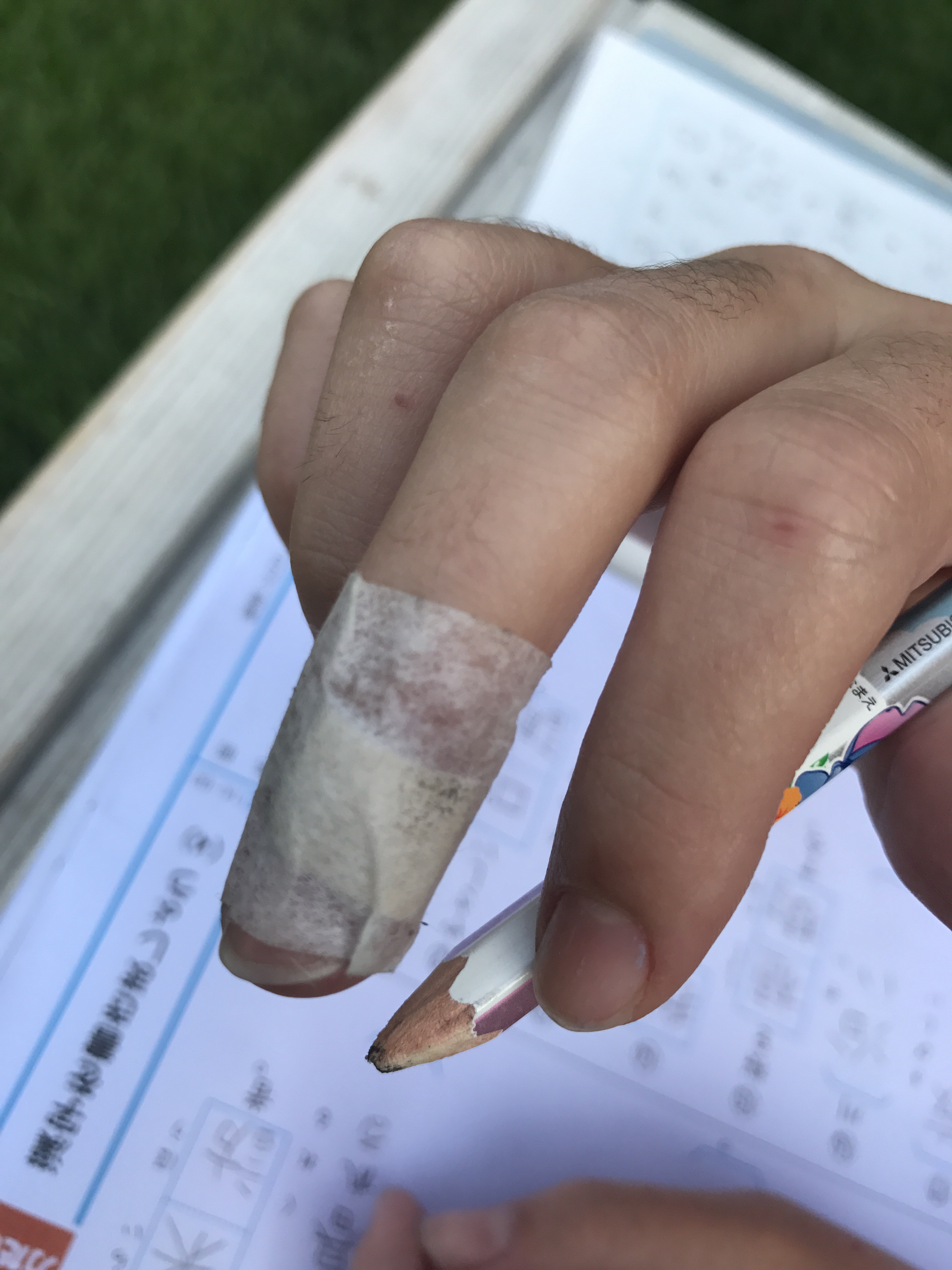
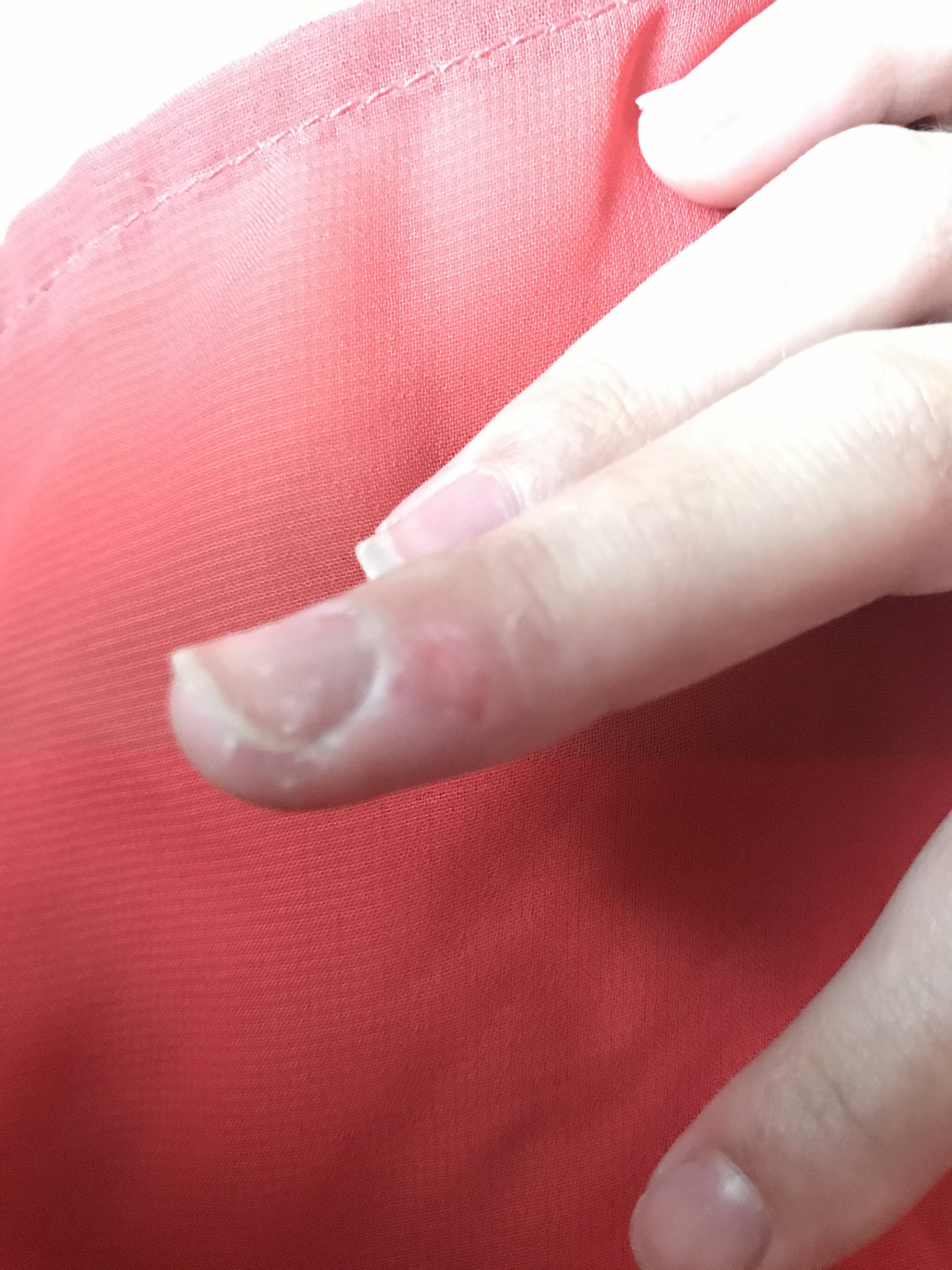
    And it’s not just a piece of paper with few mathematical problems to solve. It is a set of three to five book/booklets, some of them are inch-thick and most are half-inch thick. It can literally hurt a child’s finger because of doing too much  homework.

    Japan doesn’t consider summer break a vacation for students. They consider it a time for independent study. For students to study on their own in the convenience of their homes.


    Unlike the US and the Philippines, summer vacation in Japan is during school year, not between school year. April is when classes starts and mid-July to August is summer break. Classes resume in September and close in March. Between March and April, they have like  a two-week spring break, and that is between grades, when kids don’t get tons of homework like in summer break.

    Its not only the students who don’t like summer homework. Somehow, it becomes tedious for parents, too, who, during summer, becomes the “teacher substitute”, reminding their children to keep track of their homework. Parents are also the ones who check their children’s homework. Some parents make the schedule, how many pages a day and how many hours a day should their children dedicate for doing homework.

    The most stressful part of summer is the last week, when both parents and children realize that they only have few days to finish a bunch of unfinished homework , including the daily summer diary.

    Both Japanese and non-Japanese often discuss about whether this practice of summer homework is good or not. Some say that it’s a good way for training children to become independent and responsible. Some say that it’s too much in a way that it deprives children to enjoy their childhood.

    How about you? What’s your take on this?

    How do you spend your summer vacation?

  • Setsubun and Risshun: Say Goodbye to Winter and Hello to Spring

    Setsubun and Risshun: Say Goodbye to Winter and Hello to Spring

    The freezing cold of winter makes people long for spring. Spring, the time when flowers bloom. It is when the temperature goes up gradually. It is when people start going outdoors again. The weather is not too cold. Just “choudo ii”, as the Japanese say, meaning just right. The cold turns to cool. Everything turns bright and gay with flowers blooming and weather warming up. Adios to the dark and gloomy winter. But, when exactly is spring? In Japan, they have a celebration that marks the end of winter.

    What is Setsubun?

    Setsubun (節分) means seasonal divison. The kanji 節 means ‘season’ and the kanji 分means ‘part’. Setsubun’s original meaning is the last day of any season. Spring Setsubun, usually February third or fourth,is the last day of winter in the traditional Japanese calendar. Setsubun is said to be the old New Year’s Eve celebration basing on the Lunar New Year.

    How is Setsubun celebrated?


    On this day, Japanese people hold the mamemaki 豆まきor bean throwing ceremony for driving away bad luck and attracting good luck. It is a ceremony where they throw beans at the ‘devil’ and chant “Oni wa soto. Fuku wa uchi”, which means “Demons out. Blessings in.” Other translation says “Demons out. Happiness in.” Demons in this case represent bad luck. The chant is said to drive away all the bad things out, and bringing the good things in. People visit shrines and temples to pray. Big shrines sometimes hold a big throwing ceremony and lots of people come to attend. Shrines are beautifully decorated and somebody who is assigned as demons wear elaborate whole body costumes. Shrine priests also wear their special clothes. Sometimes, the city or town’s leaders come to attend to. When you go to supermarkets and grocery stores and even convenience stores, setsubun decorations are displayed. You can see the fuku or happy face and demon masks. Demons are usually in color red and color blue. Normally, Japanese people do their own ceremony at their homes. The demon is usually played by the father. After work, fathers wear a devil’s mask and come home to surprise the kids. The kids together with their moms throw beans at the ‘devil’ and chant.  Families with kids celebrate this ceremony more than those families without kids. Maybe, it’s because kids really believe that devils are real, while adults, they know it is just a pretend.

    What to eat


    goinjapanesque.com

    After having fun throwing beans at the devil, each family member picks up the beans and eats them with the number according to their age. That is to be said, five year-olds for example get to eat five beans and eighty-year olds get to eat eighty beans. It must be hard for grandpa and grandma to eat all those beans, I guess.
    Recently, about three to four years ago, my Japanese friend said that on Setsubun, Japanese eat ehoumaki (恵方巻き). Ehoumaki is a long sushi roll. It is said that eating ehoumaki attracts good luck. There are various kinds of ehoumaki. The one I had in school lunch consists of cucumber and crab stick. I saw in the television news that one shrine in Japan celebrated Setsubun by distributing ehoumaki to about a thousand shrine vsitors and they eat them altogether for good luck and happiness.

    My Experience


    I love festivals and I love learning Japanese culture. I have learned about Setsubun in the university where I studied Japanese. We did a short bean-throwing ceremony in the class and we chose our male classmate to act as the demon. It was fun but it was short and we wanted more. Upon hearing that there was a big bean-throwing ceremony in town, my friend and I decided to attend. We went to Kushida Shrine in Hakata, Fukuoka. 〒812-0026 Fukuoka Prefecture, Fukuoka, Hakata-ku, Kamikawabatamachi, 1, 博多区上川端町1−41

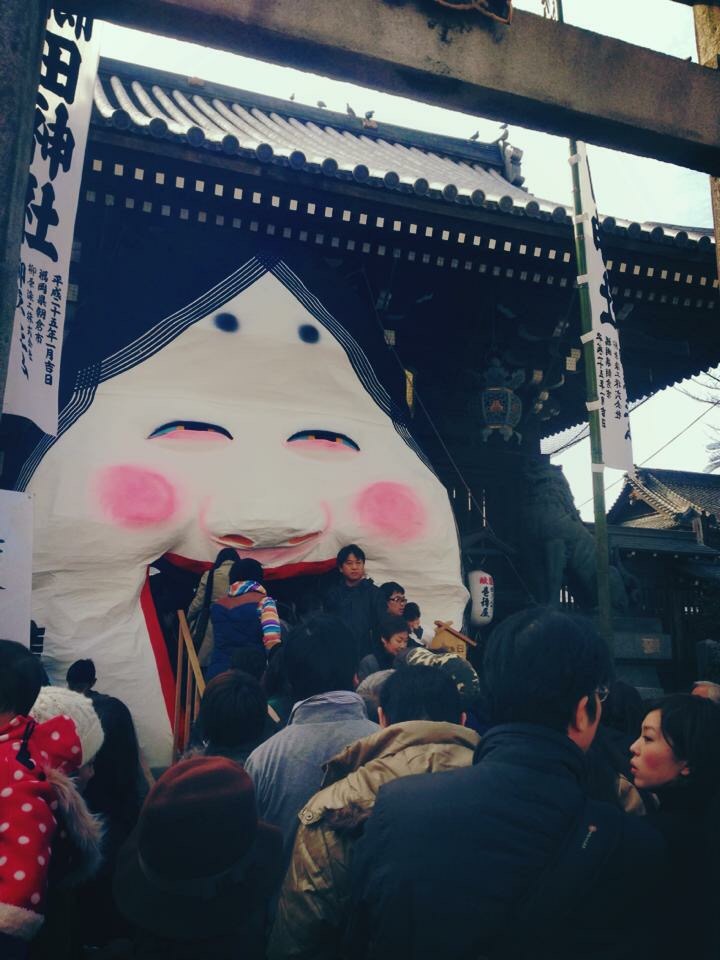
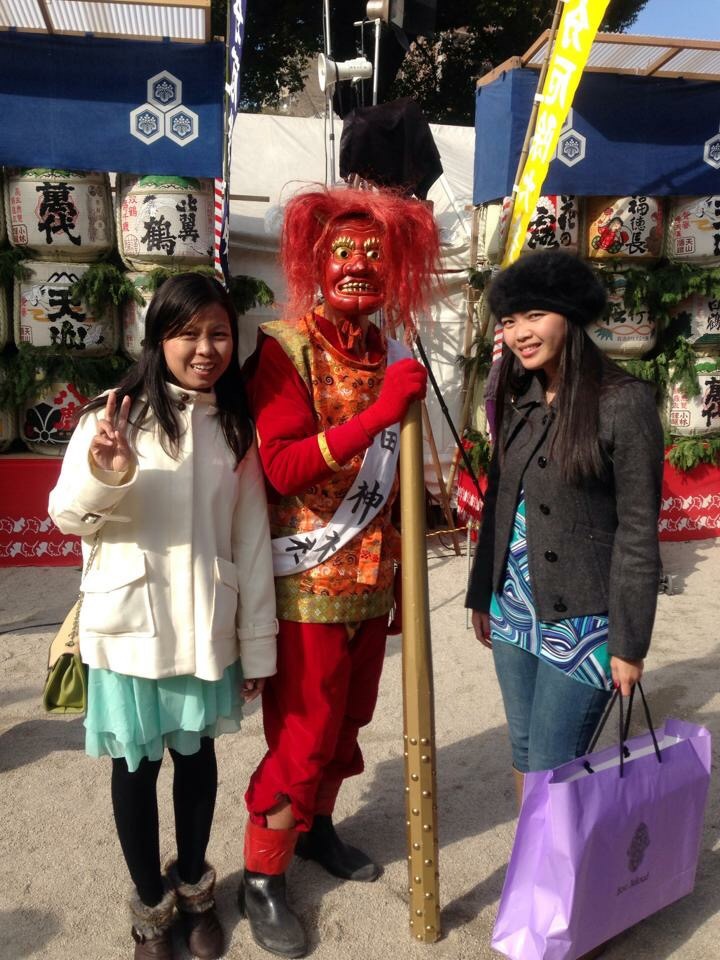
    In the entrance of the shrine was a big face of Fuku or the happy face. You can enter the shrine only through the mouth of the Fuku. The lines were long but my friend and I waited for our turn. Just waiting in line made us feel so excited. We could feel the energy around. The shrine was so full of people. Everybody was excited to get inside and join the ceremony. Inside, the shrine was so beautifully decorated. We saw Japanese priests in costumes and we saw some demons, too. The red demon was kind of cute so my friend had our picture taken with him.


    During the highlight of the ceremony, the guests and priests on the stage throw the beans while saying the chant and the people on the ground tried to catch the beans. We tried to catch some beans, too. We had so much fun. It was a very good experience for me and my friend. Now that she left Japan back to her country for good, while I stayed here and work, we always look back to those times we went to Kushida Shrine every Setsubun.


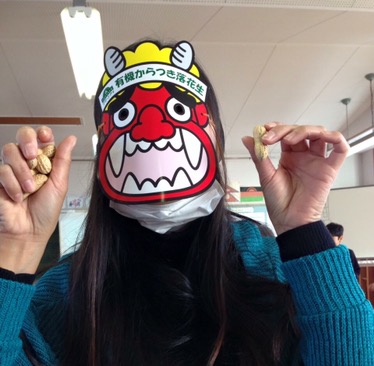
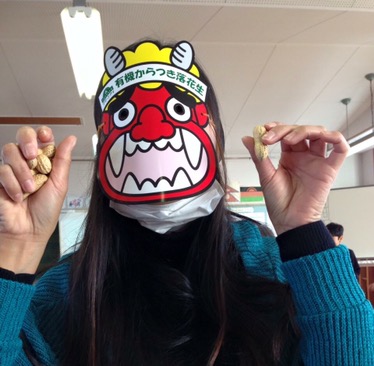
    As a teacher here in Japan, I myself experienced becoming the demon. I wore the demon mask and my students throw peanuts at me. I ran around trying to avoid there throw but, you know, kids are very energetic; of course, and I got hit many times. I lost, as it should be. It was so much fun. We picked up the peanuts after and ate according to our age. Well, I had lots of peanuts as you guess. In my school this year, we had ehoumaki for lunch and everyone got a pack of fukumame. Everybody was happy.

    Risshun (立春)


    Comes the next day, February fourth, is the risshun, or the first day of spring according to the traditional lunisolar calendar. Even though it is still cold around the month of February, even though many people still wear all their winter clothes, with their necks still wrap with thick scarves, it is not as cold compared with the previous months of January and December. Around the month of February, plums start to blossom. Plum blossom is the early sign of spring. And this time, we can say, “Indeed, spring has come.”

  • Trending Na Miss U Sa Pinas, Trending Pud Ba Sa Japan?

    Trending Na Miss U Sa Pinas, Trending Pud Ba Sa Japan?

    Malingaw ko magscan sa akong timeline kay makita nko kalahian sa Pinoy ug Hapon when it comes to beauty pageants. Trending kaayo sa Fb sa Pinoy ang Miss Universe (Ms. U). Halos tanan akong mkita sa timeline puro about Ms. U. Halos tanan nakatutuk gyud. Ma pa-TV, streaming, etc.

    Ang uban gani, bisan naa sa trabaho, muundang ky mutan-aw gyud. Ang uban nga tigdugay mangmata nagmilagro ug mata sayo kay mutan aw lagi ug Ms. U.

    On the other hand, ang mga Hapon, wa koy nakita o nadungog about aning butanga. Busy sa ila work ug skwela. Bisan sa balita, wa koy nakita nga ginews kinsa nakadaog. Wala bisan isa ka commercial about sa pageant. Kung naa man ug wala lng nko nakita, dili gyud ana ka-big deal sa ila ang beauty pageant. Wa silay paki kung kinsa mga bayhana nangapil ug kung kinsay makoronahan. Dili sila hilig ug pagwapahay ug pa sexy-hay. Ang ilaha – trabaho ug responsibilidad ug realidad.

    Dili parehas sa kadaghanan sa mga Pinoy. 🙂

    O basi kami ra. Hehe.

    Maremeber lng nko sa una dugay na. Bata pa ko. Manan-aw pud gyud mi sa among balay ug mga pageant sama sa Miss Universe, Miss World ug unsa pa ng mga beauty pageant. Bisan gabii na kaayo, pulawan gyud makita lng kinsay makoronahan. Ganahan pud kaayo mi magtan aw sa mga sexy na kandidata nga nka swimsuit ug mga nagkalain-laing gown. Mag-iyahay pud mig pili ug kinsay mudaog. Mura pug judge hehe. Murag tradition na gyud sa mga Pinoy. Nka embed na sa kultura. Mao siguro, ang uban, ginatudluan nag rampa ug modeling (selfie etc) ila mga anak na babae sugod sa gagmay pa. Hehe. Cute tan awon. Bisan sa skul, beauty contest dili mawala. Ms. Nutrition, Lakambini, Ms. United Nation, Queen of Hearts. Bisan gani teacher naay beauty contest. Lol. Dala pa kwartahay. Funding para sa school. Hehe. Sa Purok, sa Barangay, sa Siyudad, tanan naay “Miss”. Kung lokal na lengwahe usahay tawagon ug “Mutya” o “Binibini”.

    Ug inig gani dili makadaog ang pambato, ang kasagaran rasun “giluto” lol. Ug kung dili maayo ang tubag, mag-andam nlng ang kandidata ug mga isa ka semana hantud isa ka bulan na pagpanaway sa iyang abilidad. “Bugua pud ui!”
    “Ngano kana gipili?”
    “Di kabalo mutubag”.
    “Paluma-luma!”
    “Maypag si kuan nlng tu..”

    Ug uban pa hehe..

    Bitaw no…unsa may benepisyo nato anang kahilig natu sa pageant?

    Maasenso ba gyud ta ana?  O makasamot ka pobre?

    Ikaw..unsa sa imo tan-aw?

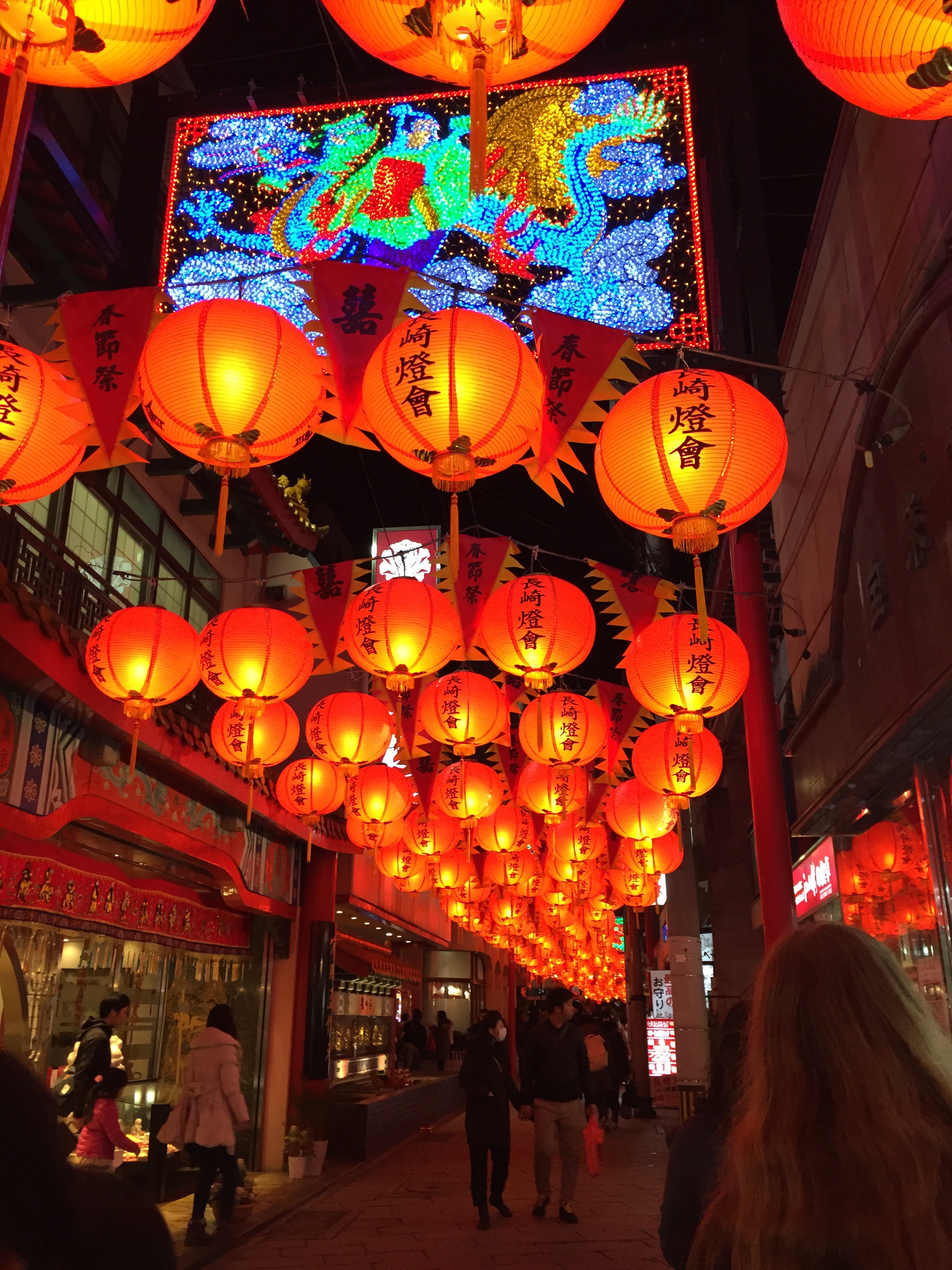
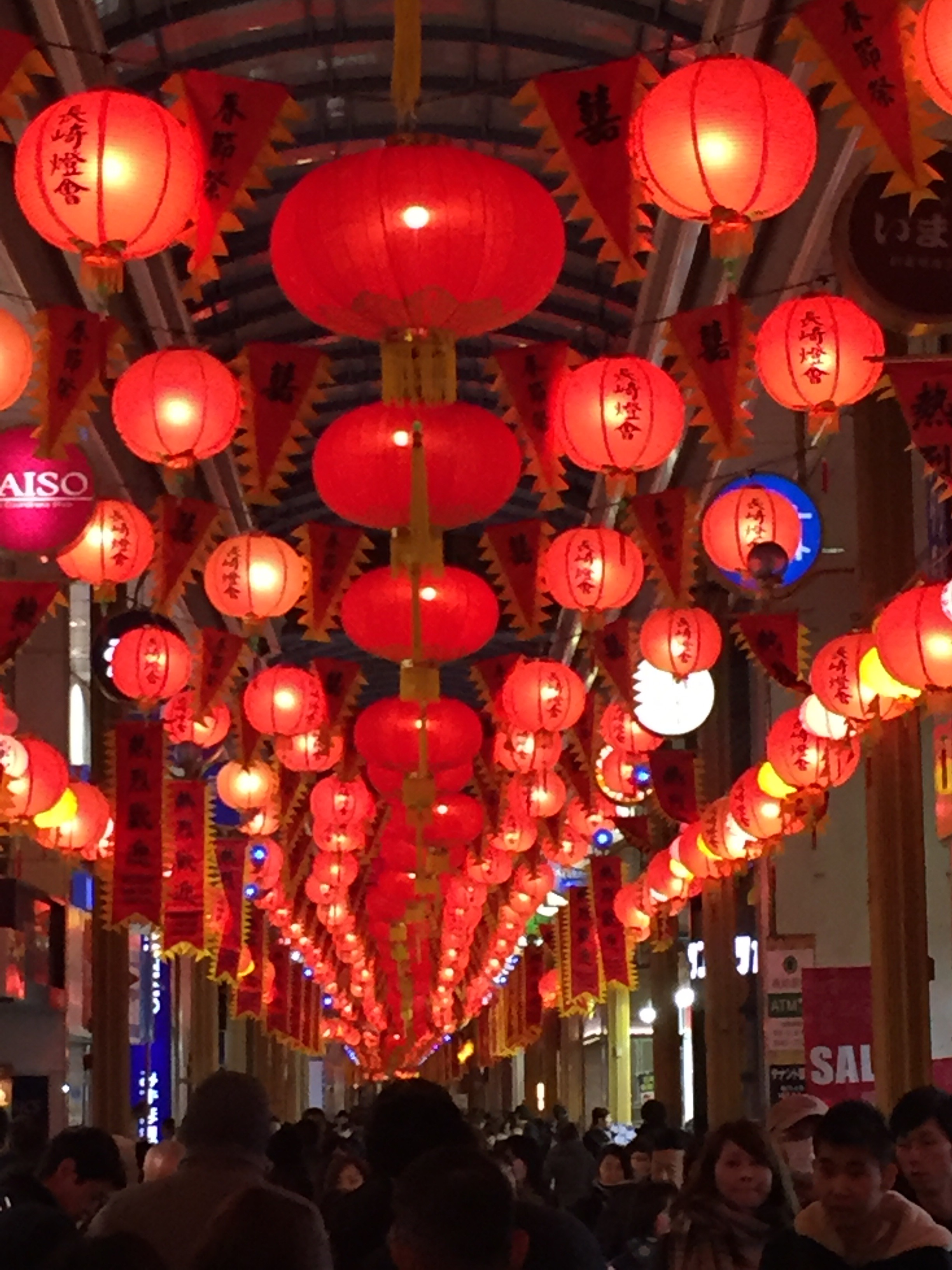
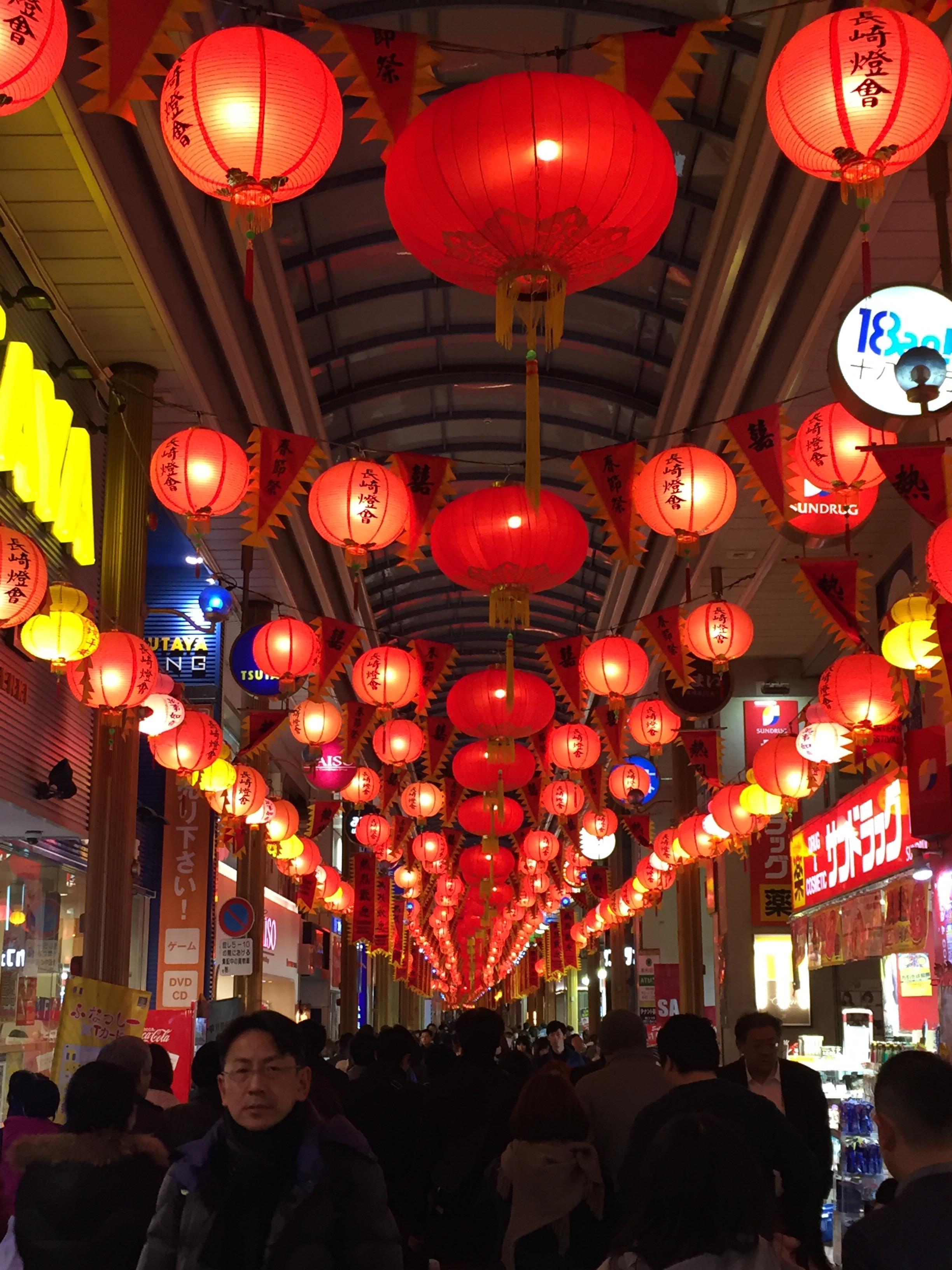
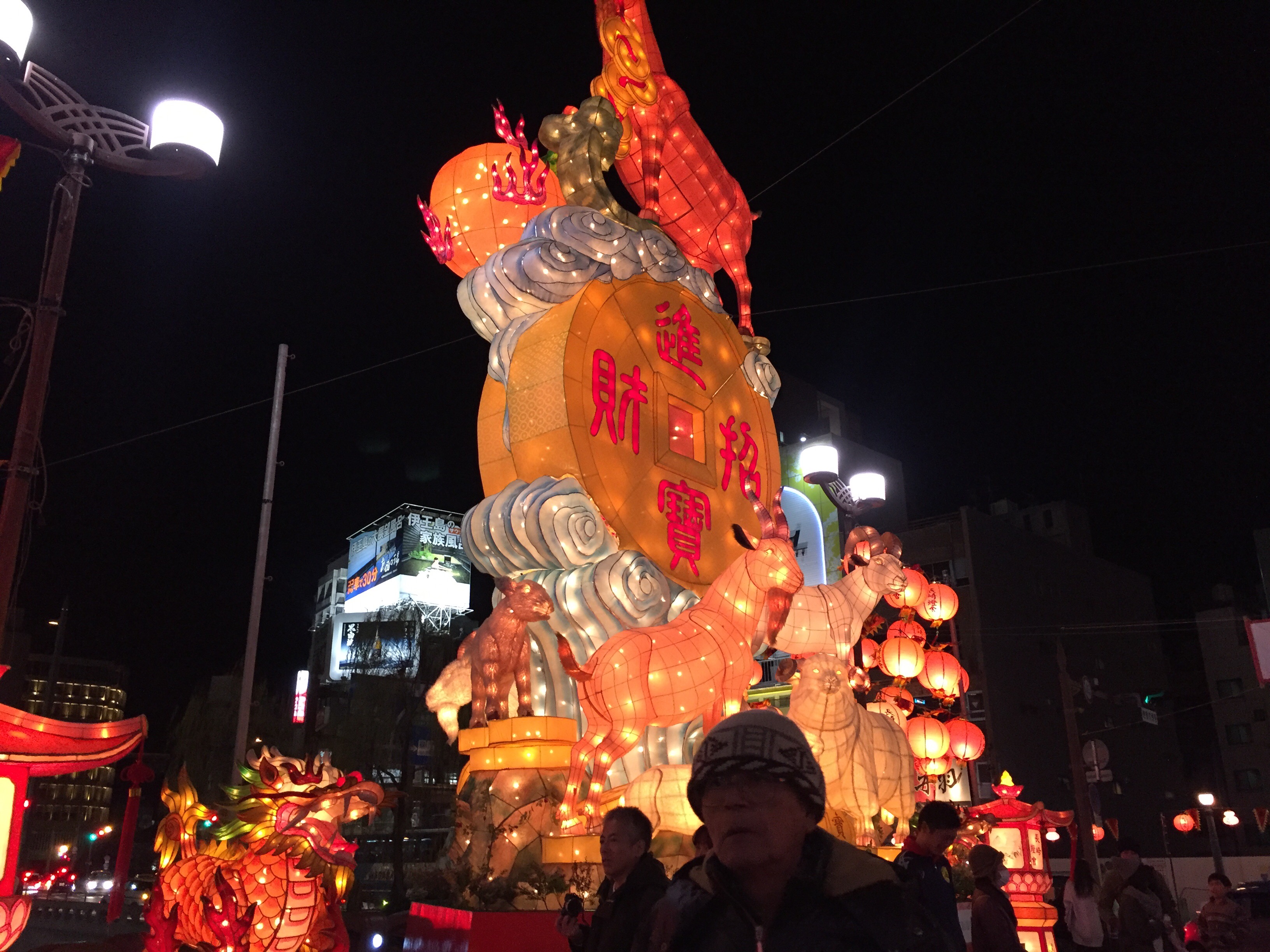
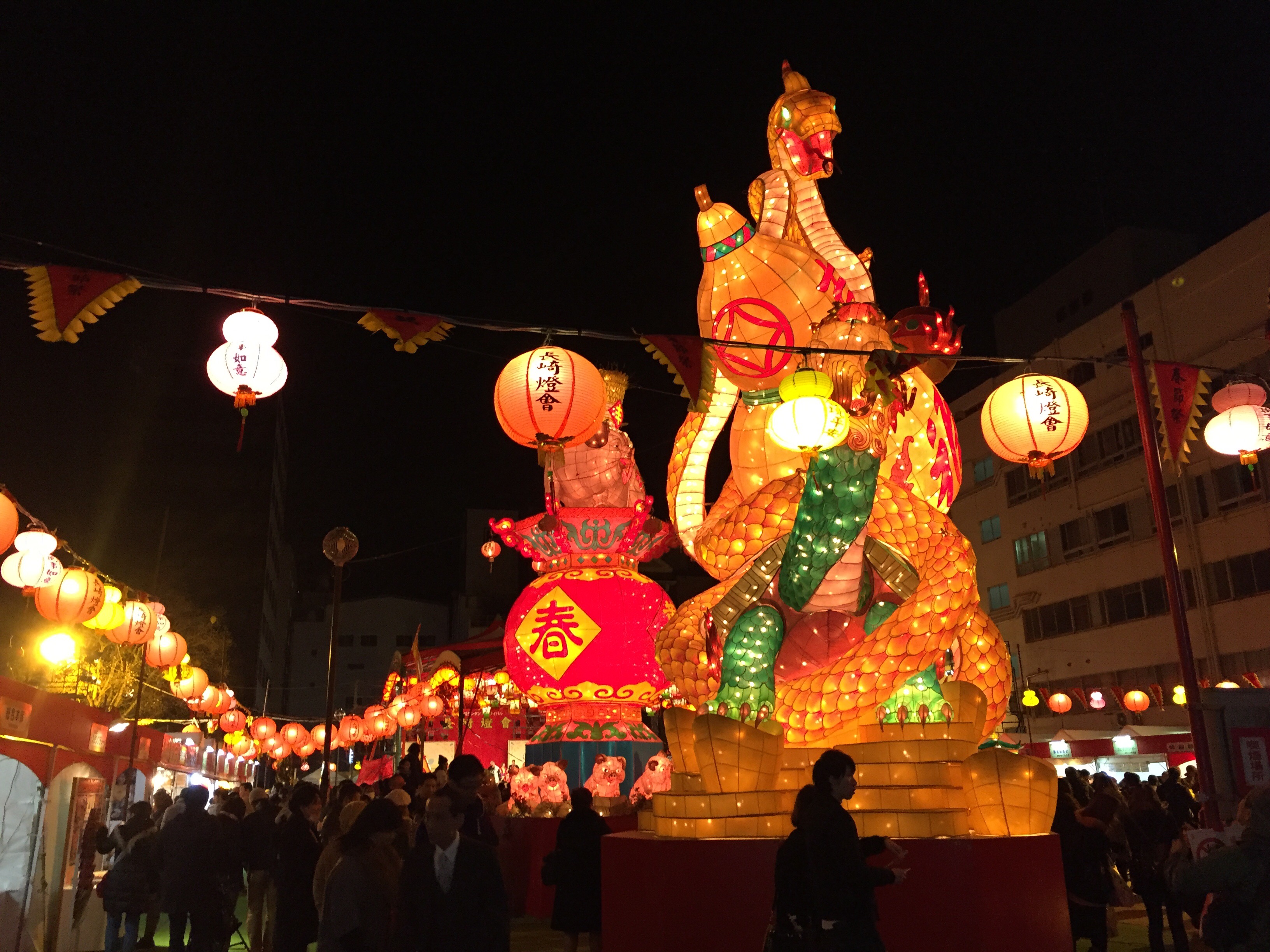
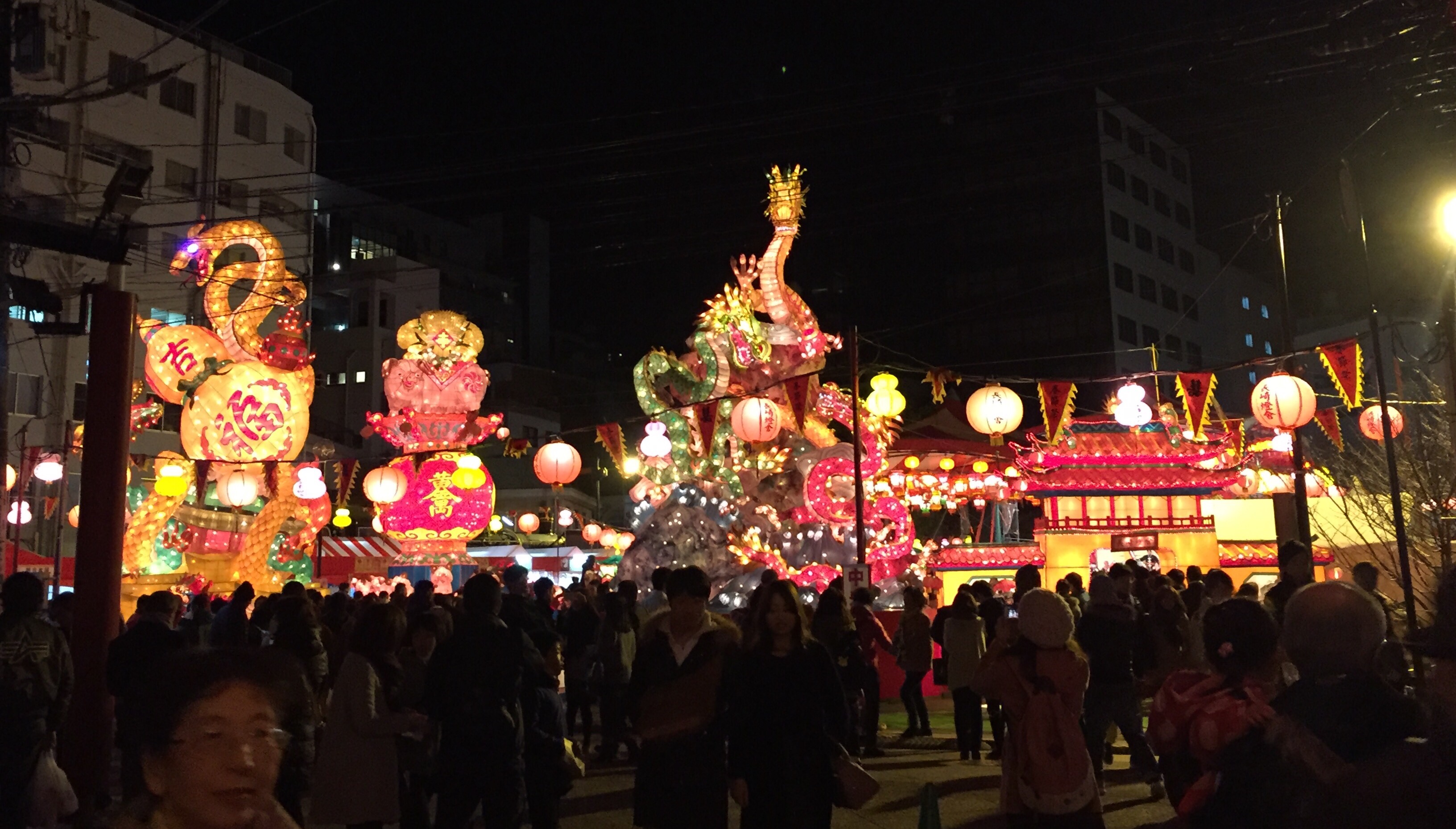
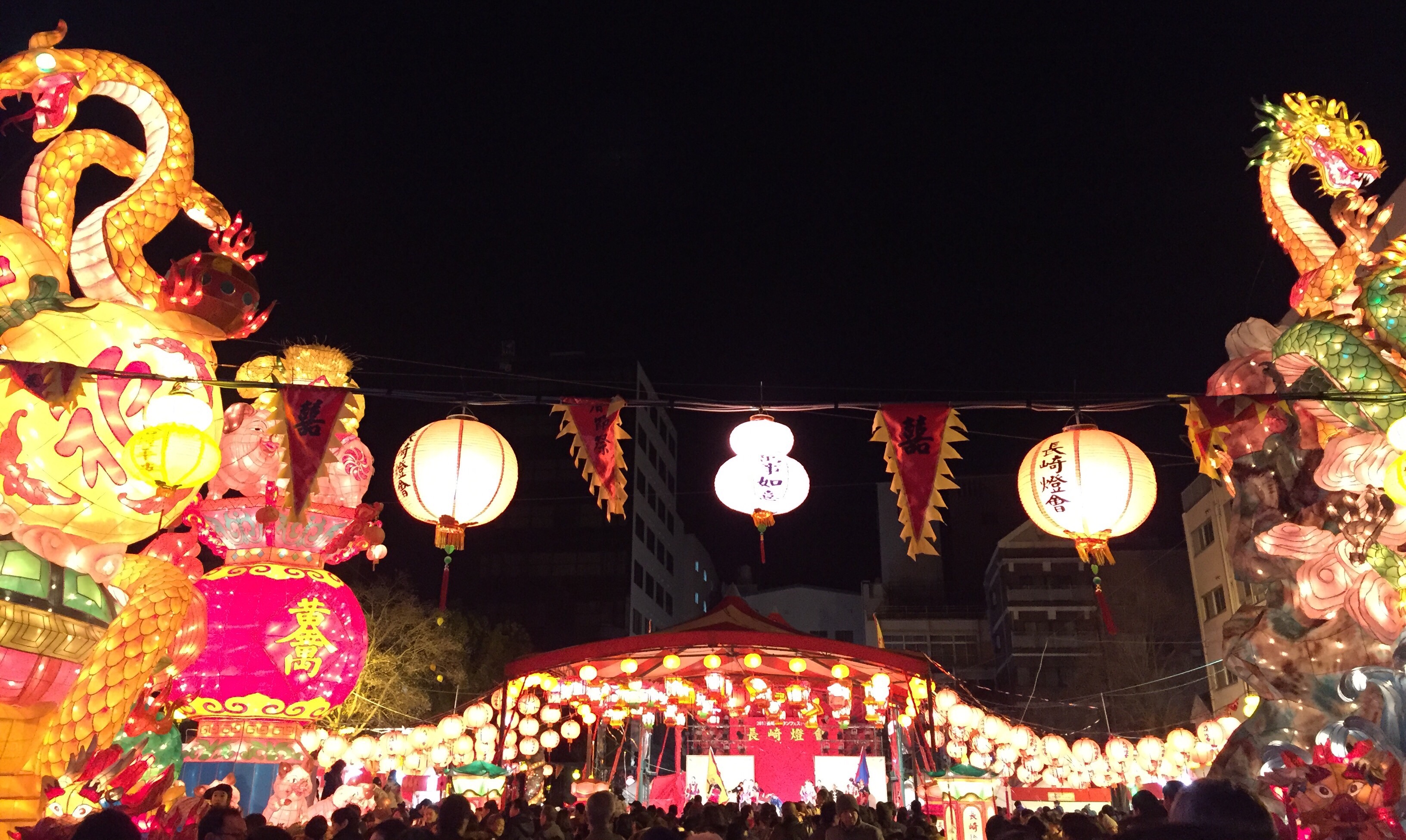
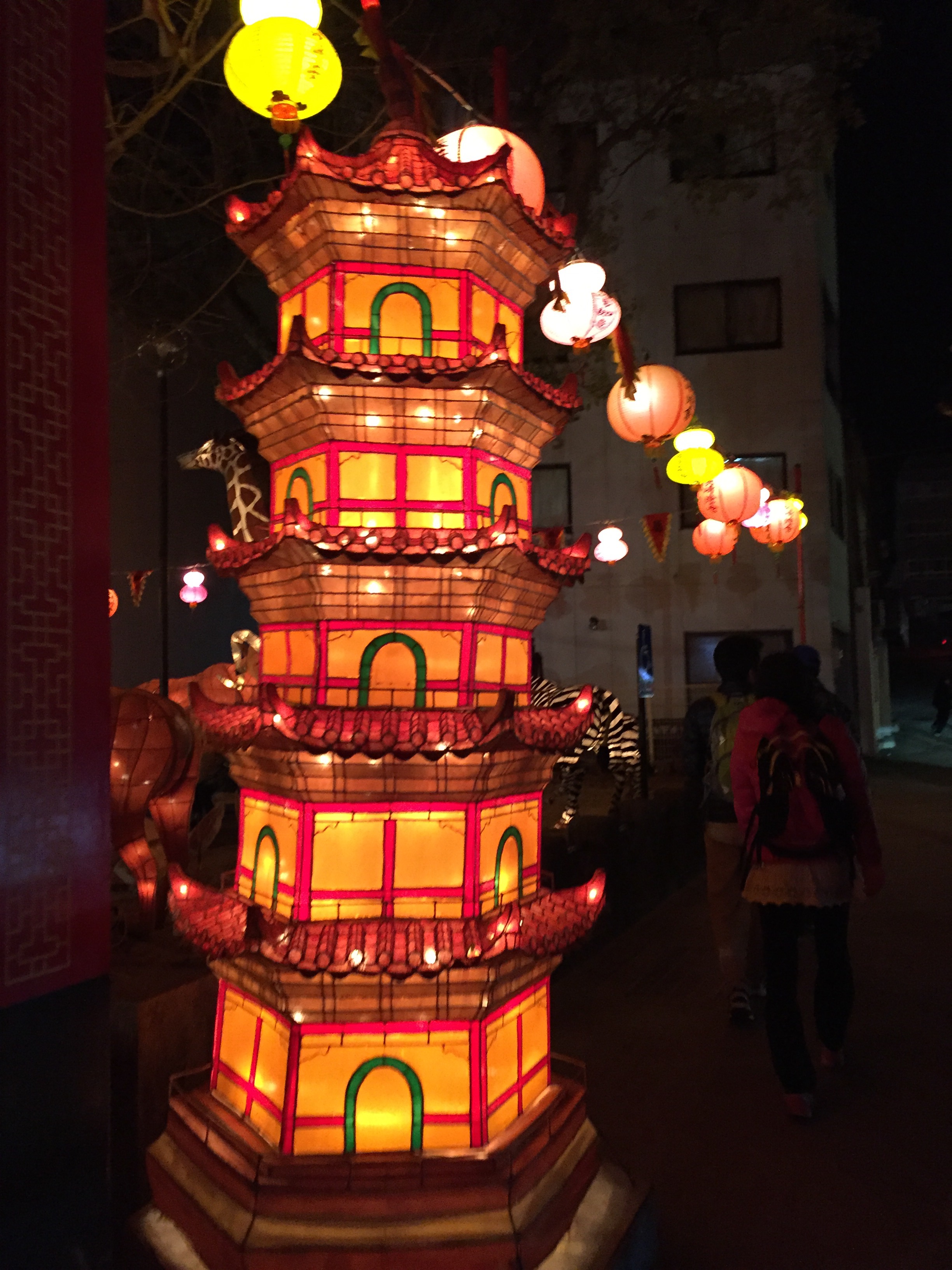
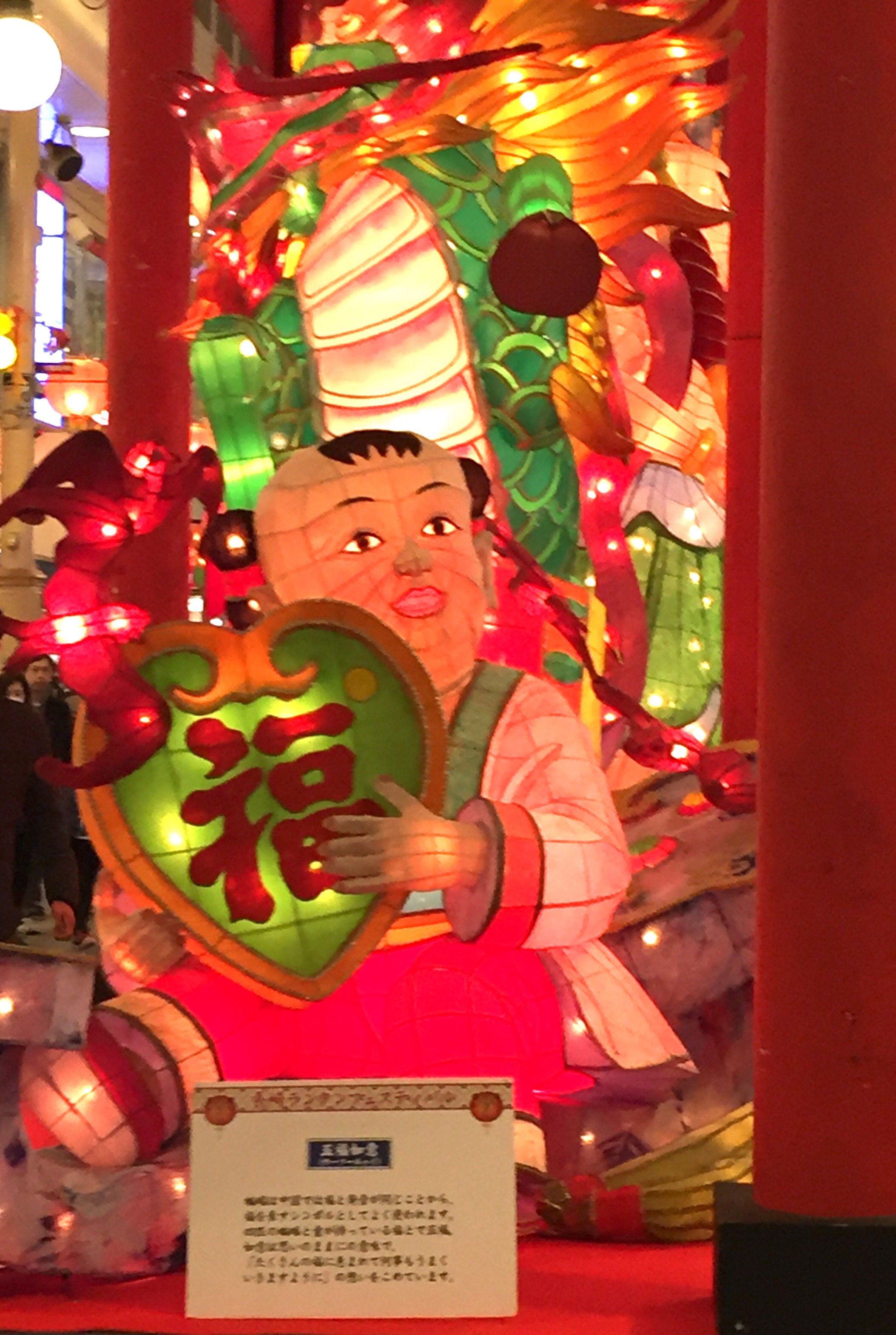
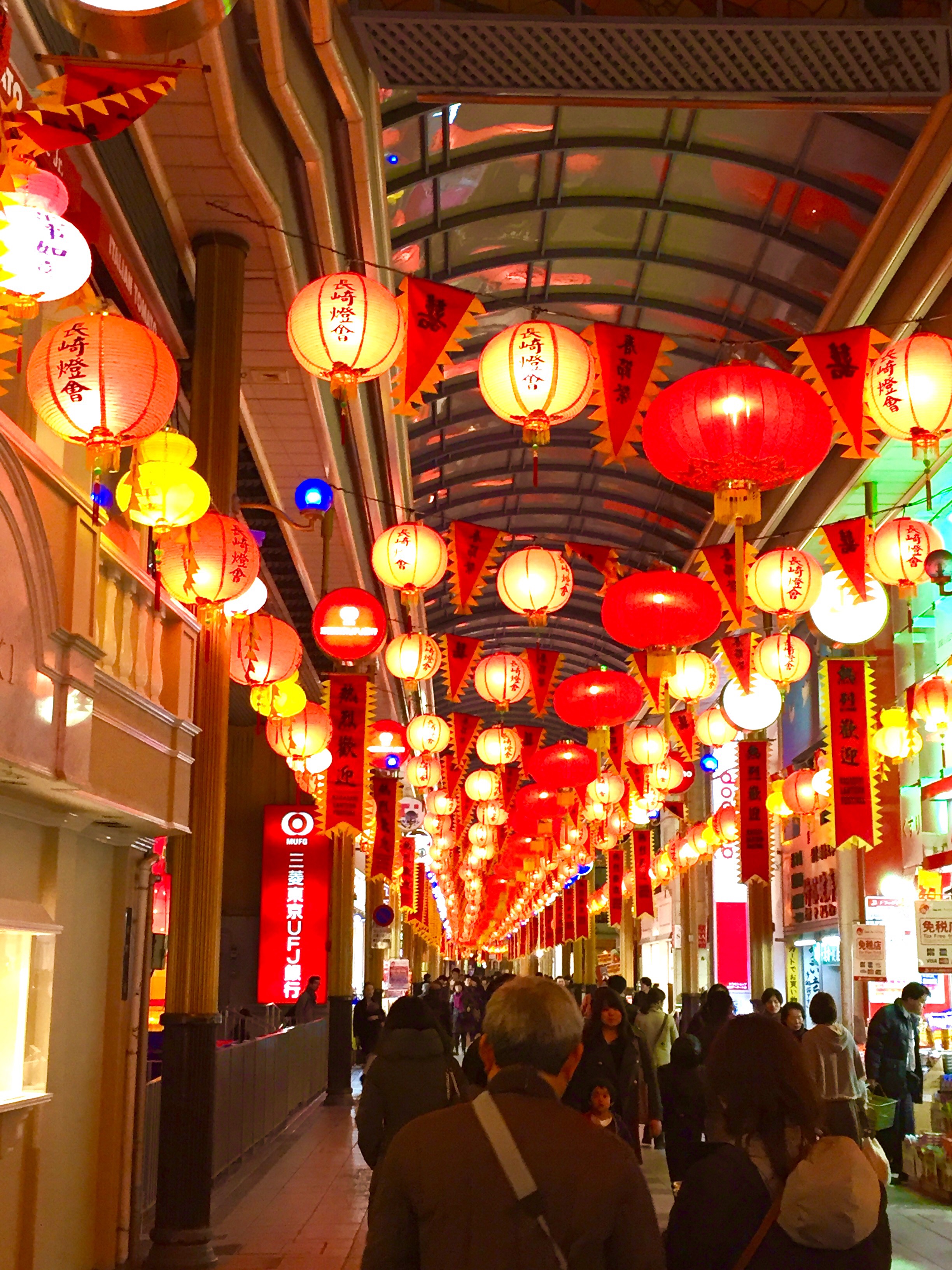
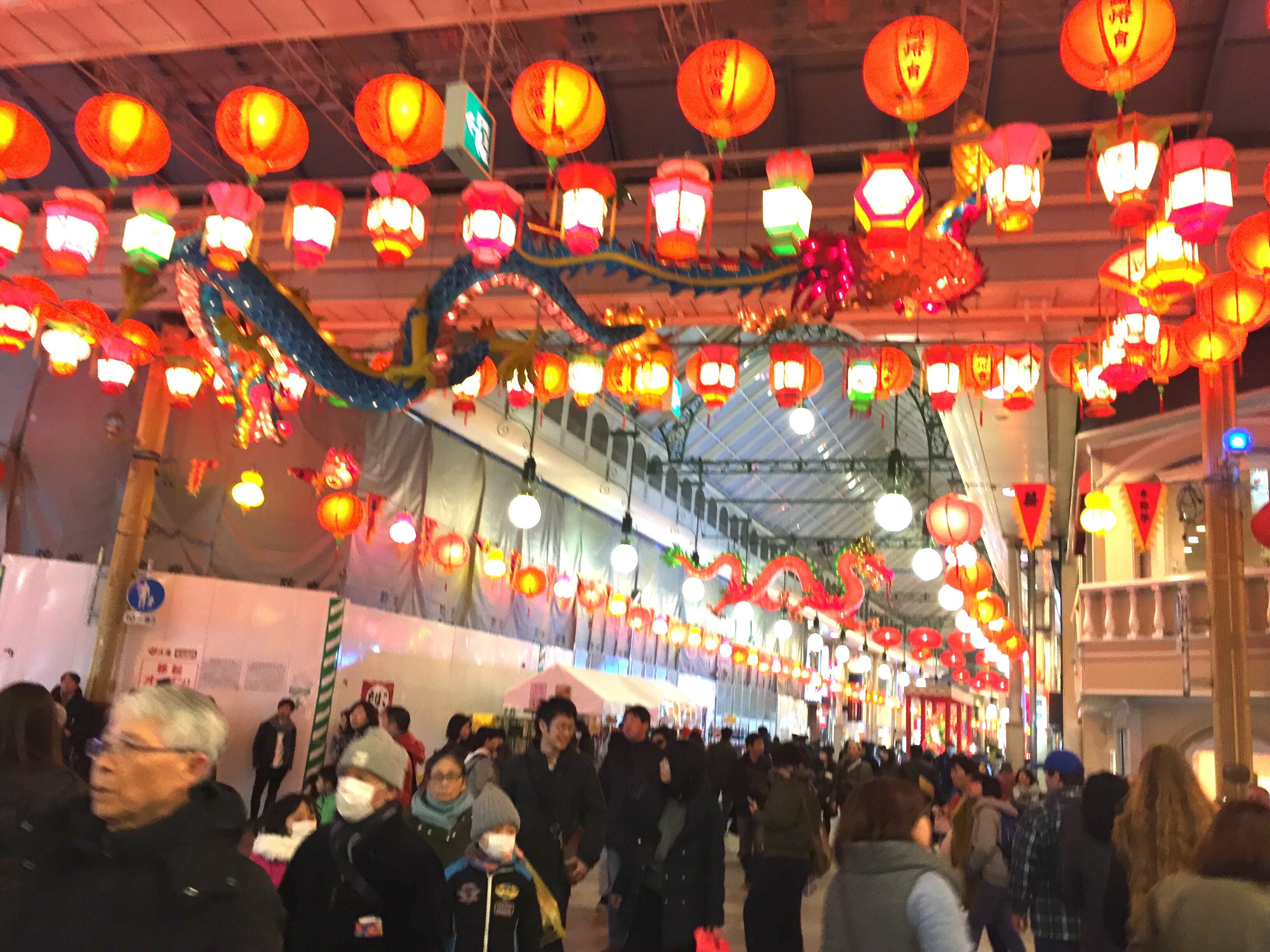
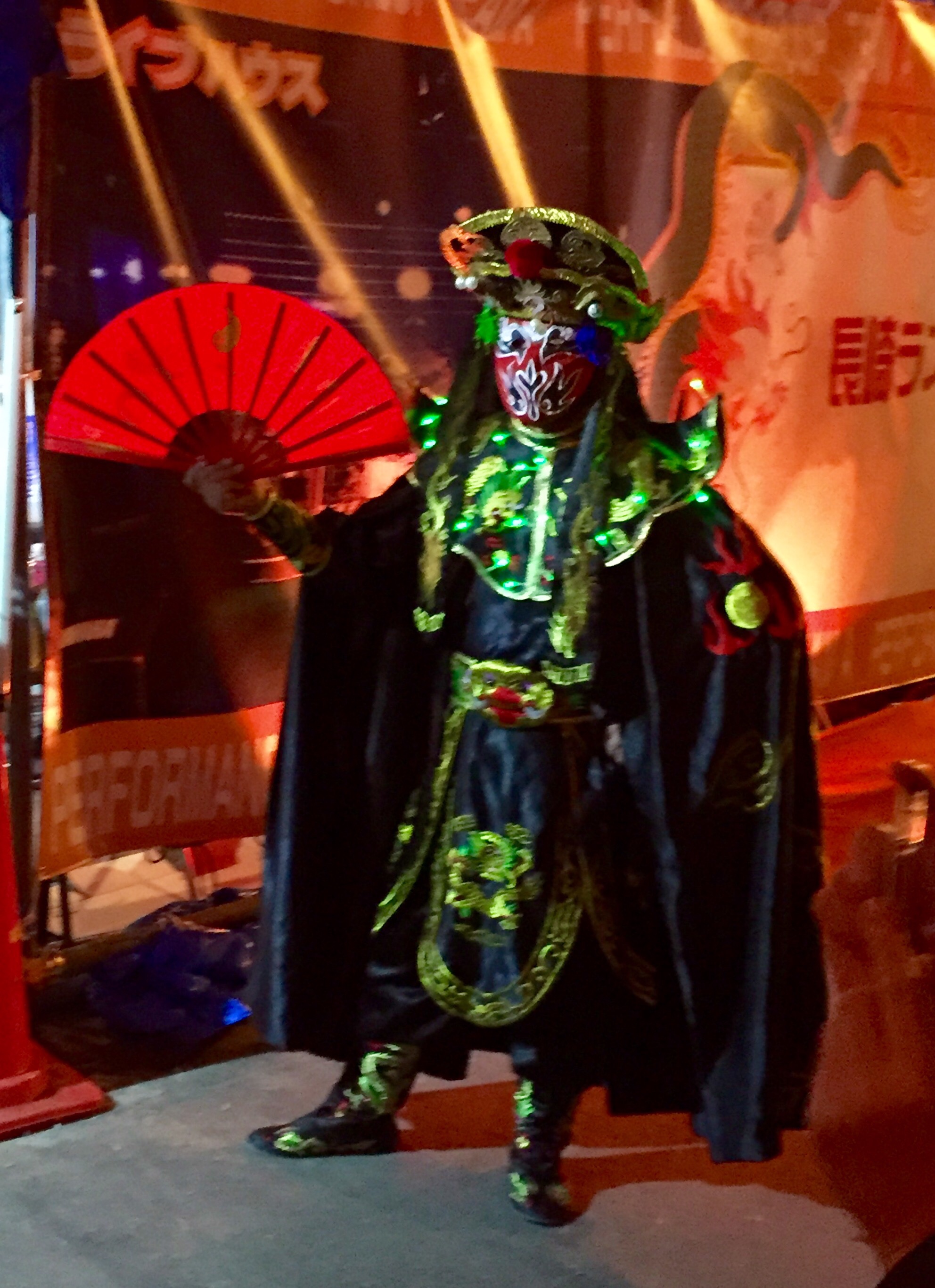
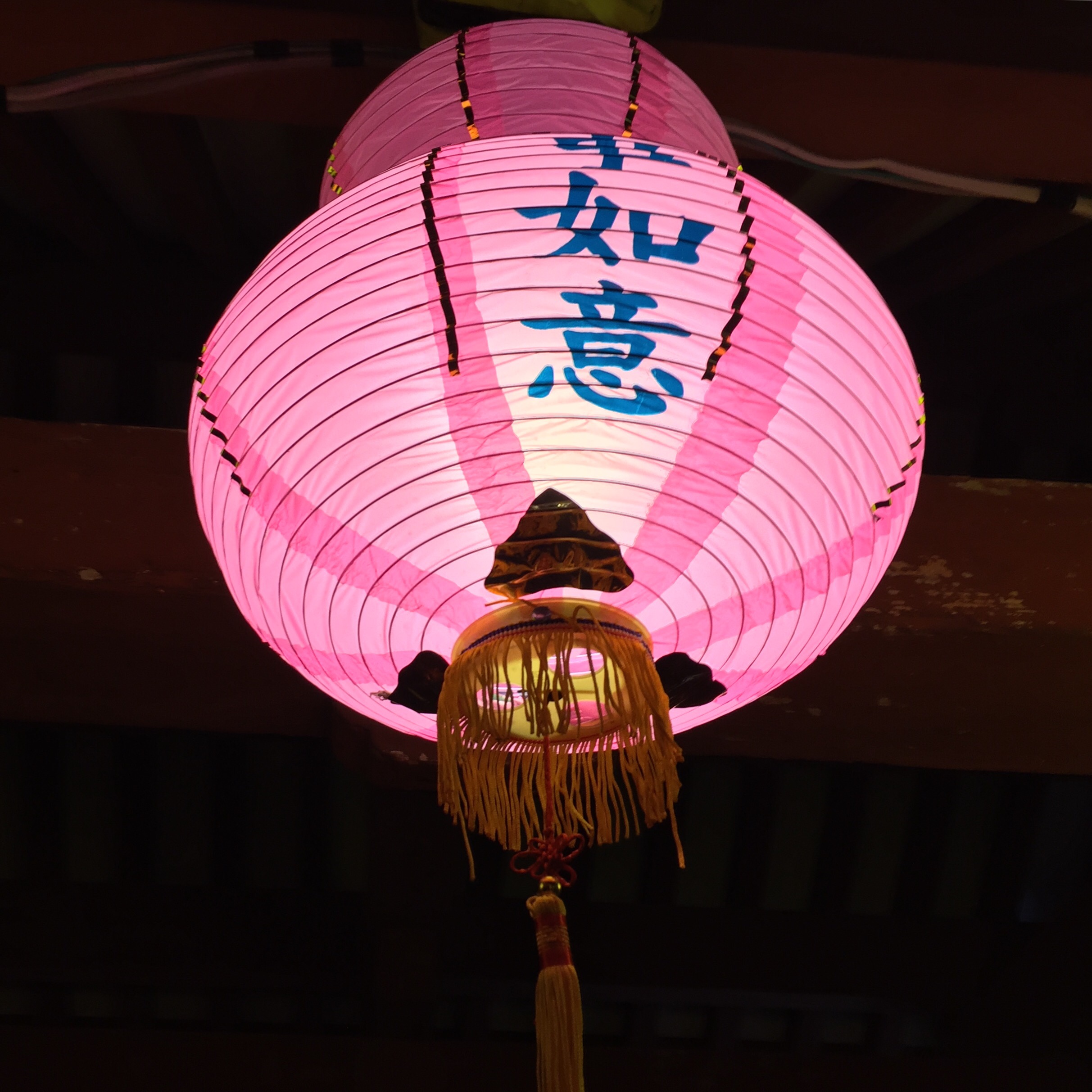
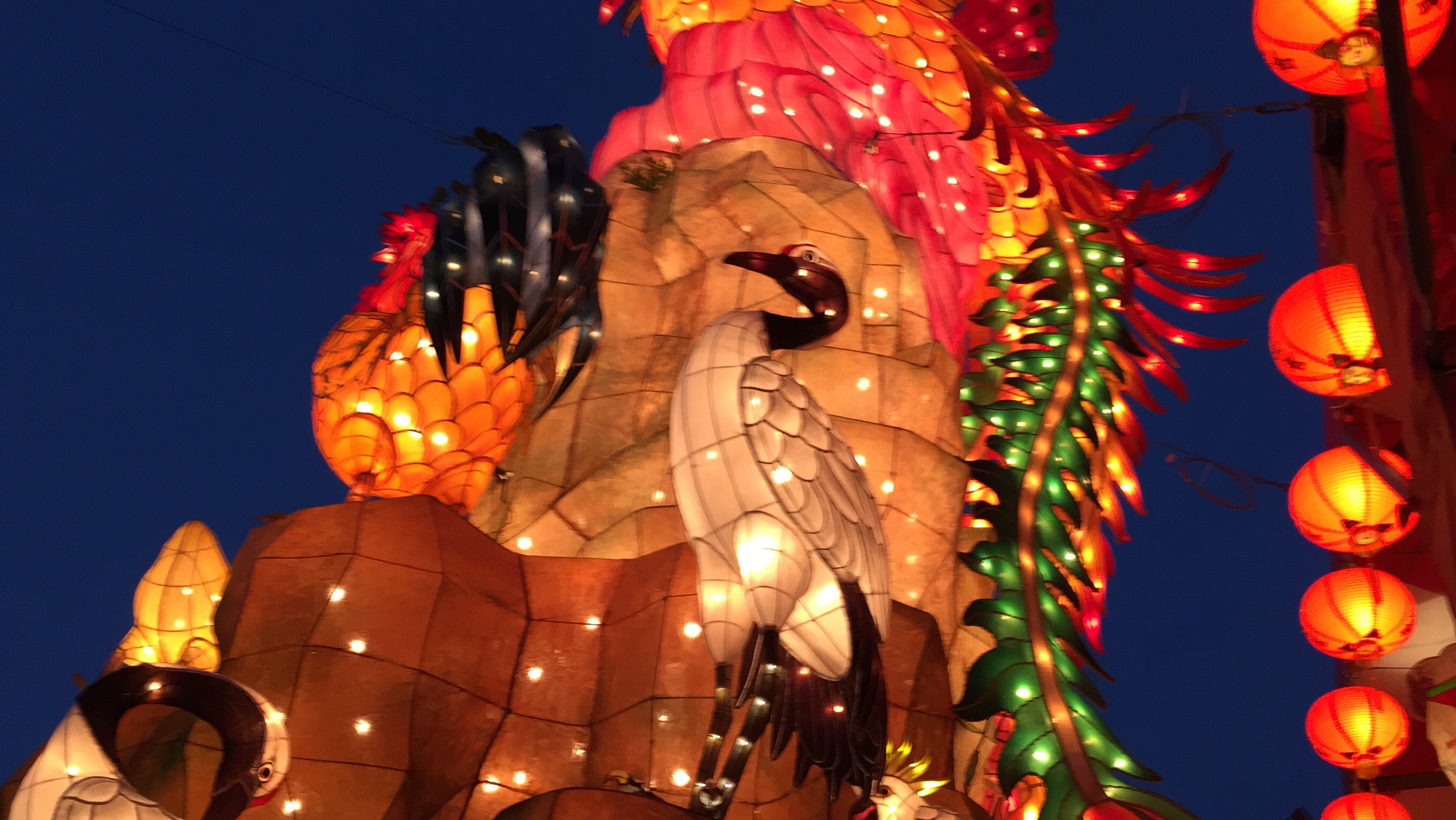
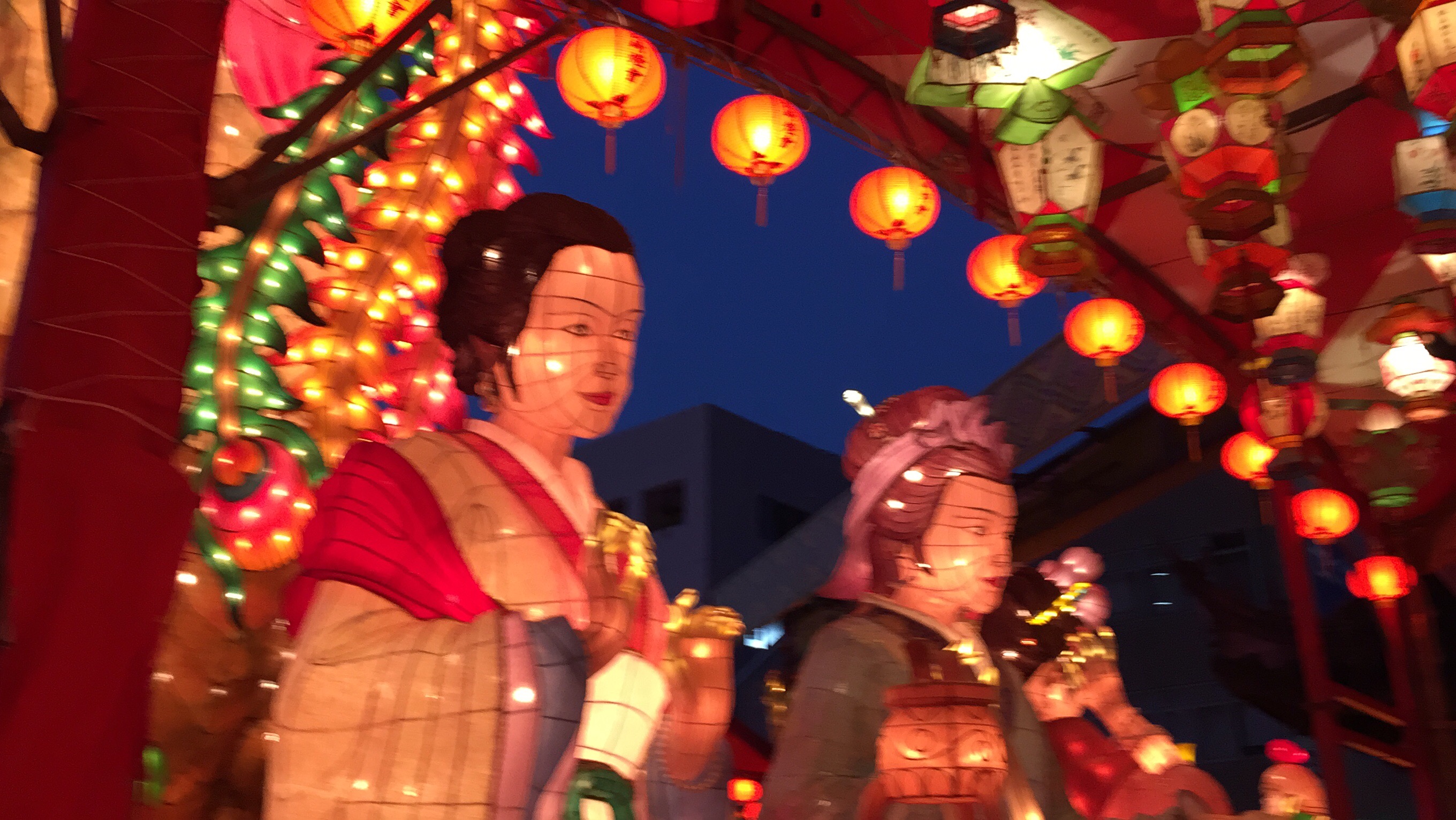
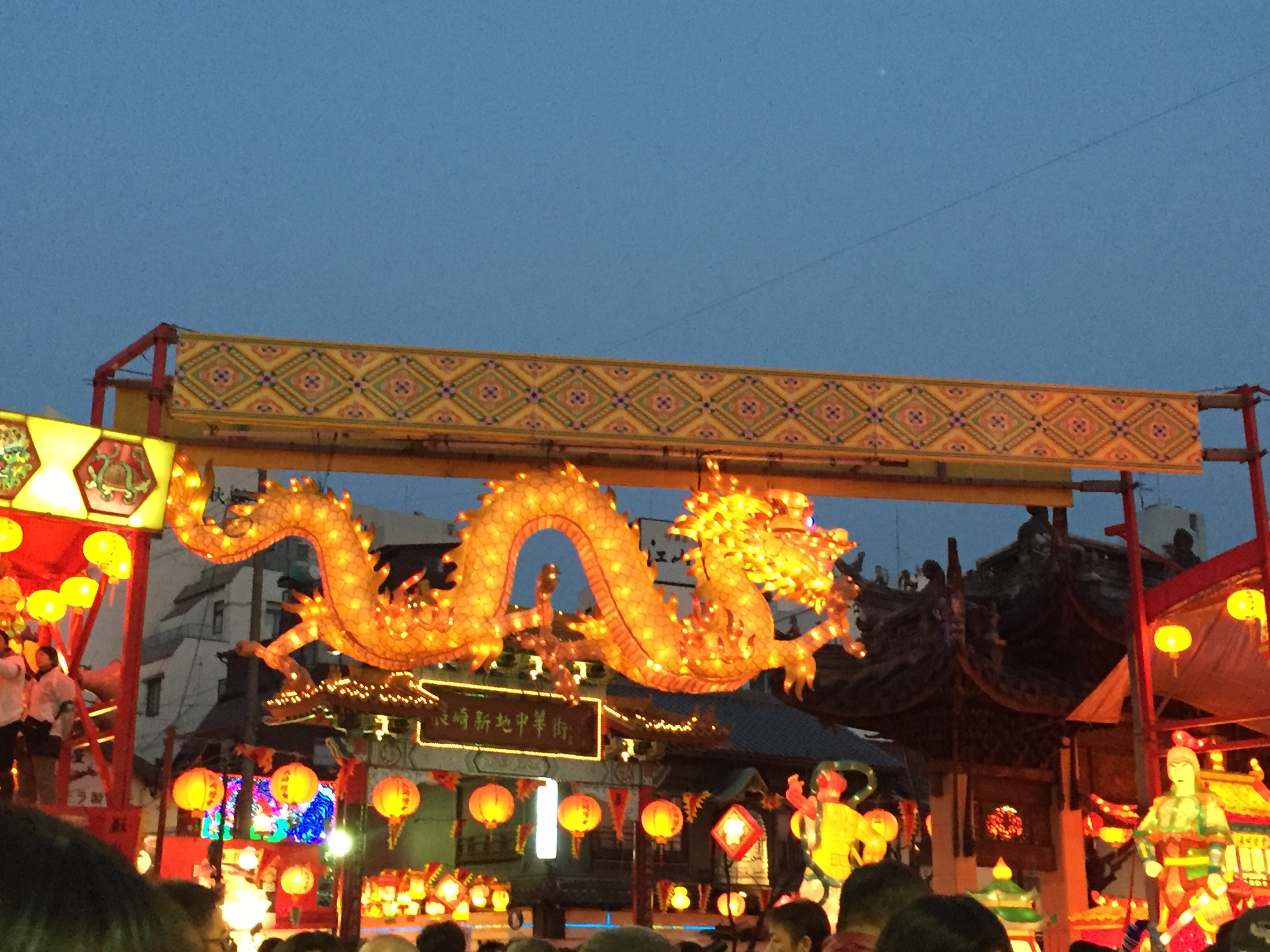
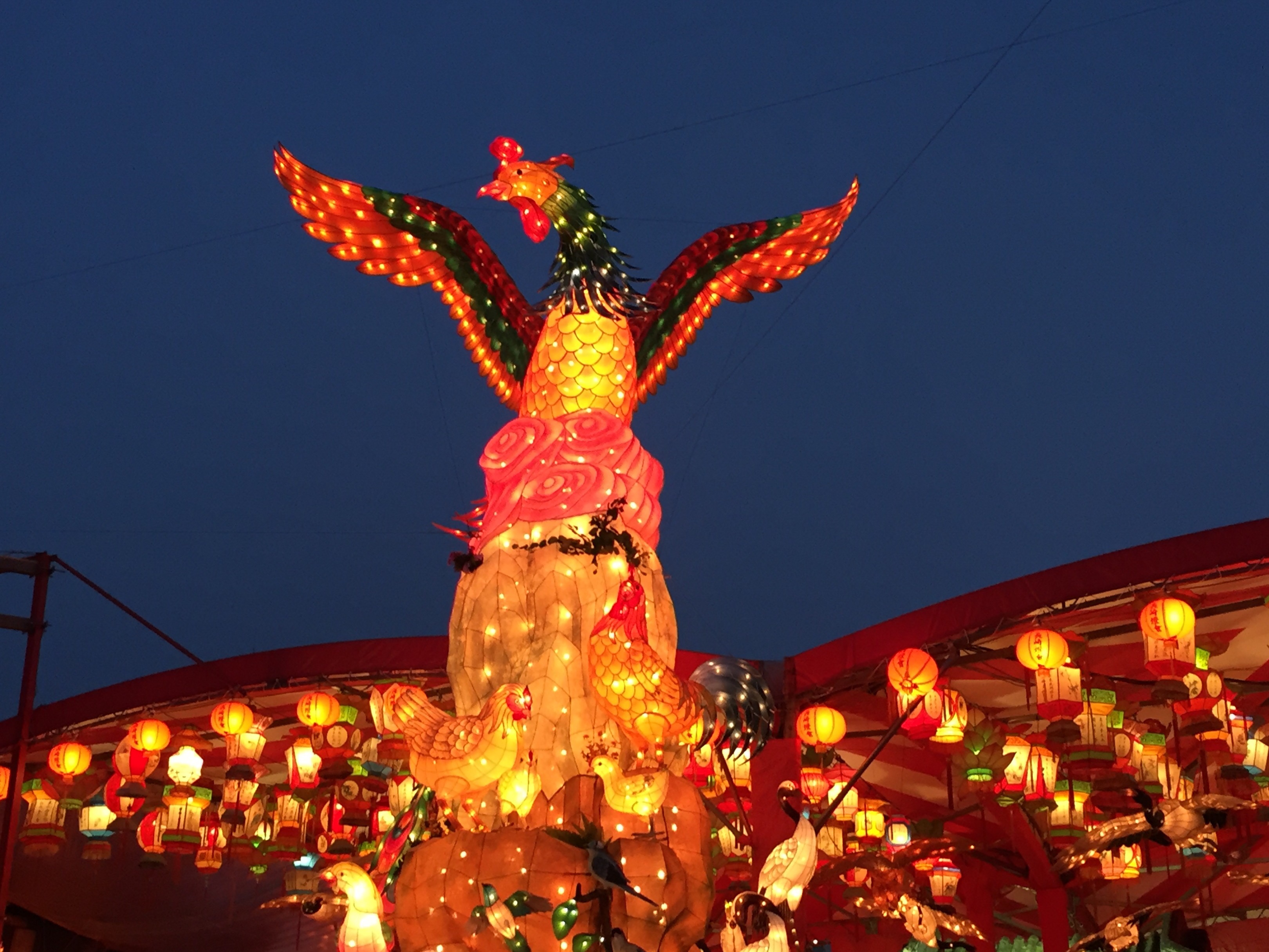
  • Nagasaki Chinese Lantern Festival

    Nagasaki Chinese Lantern Festival

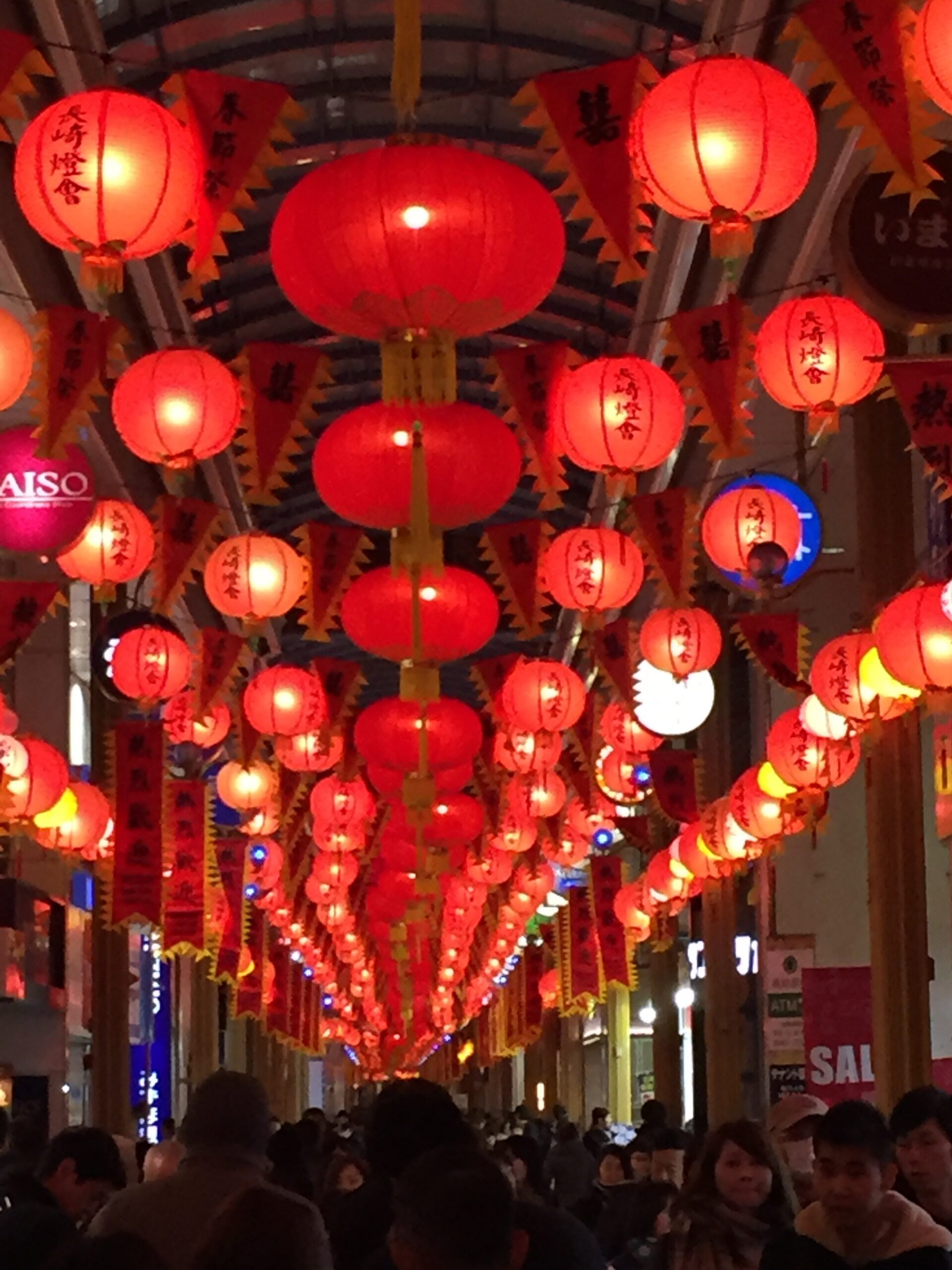
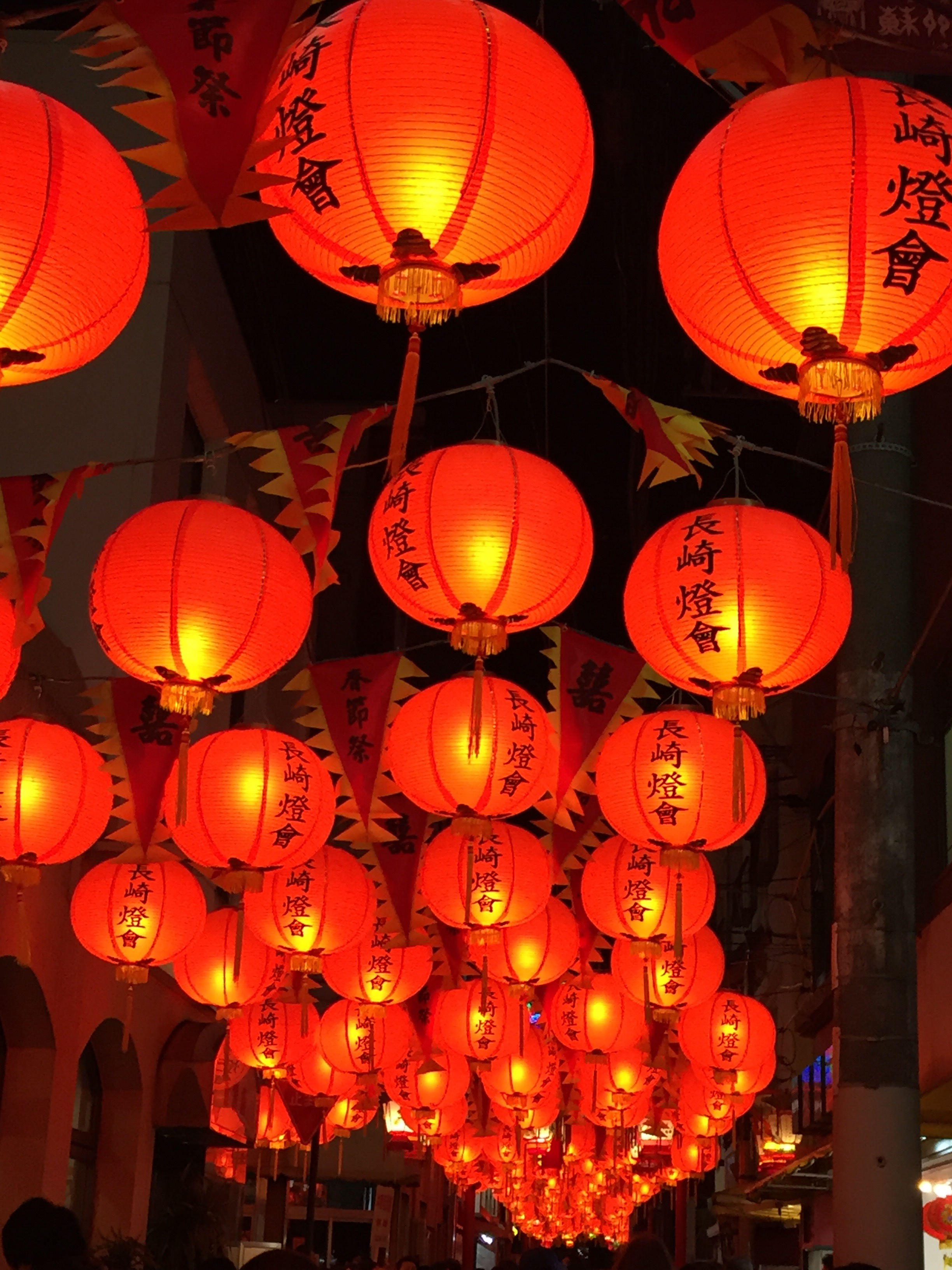
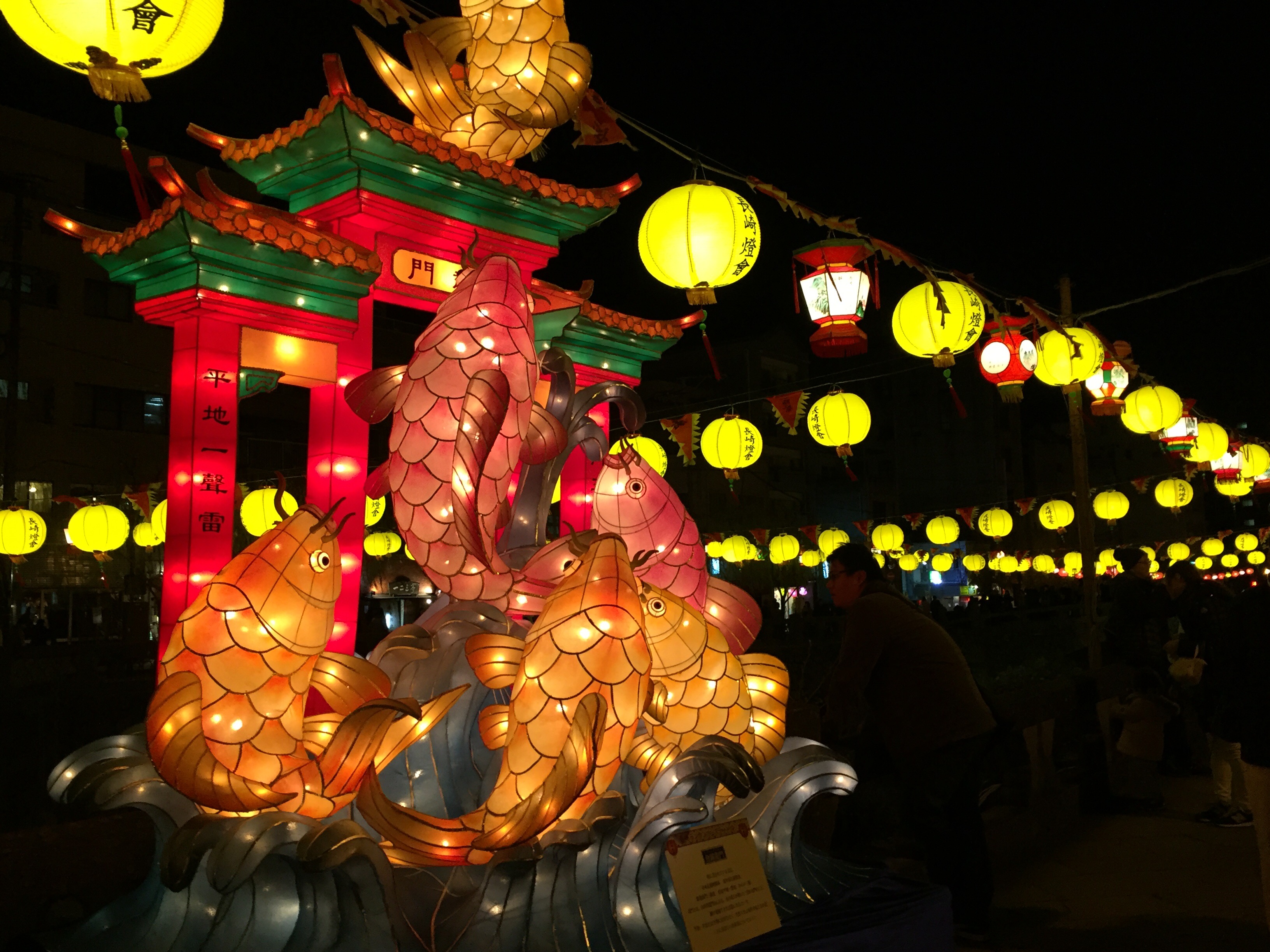
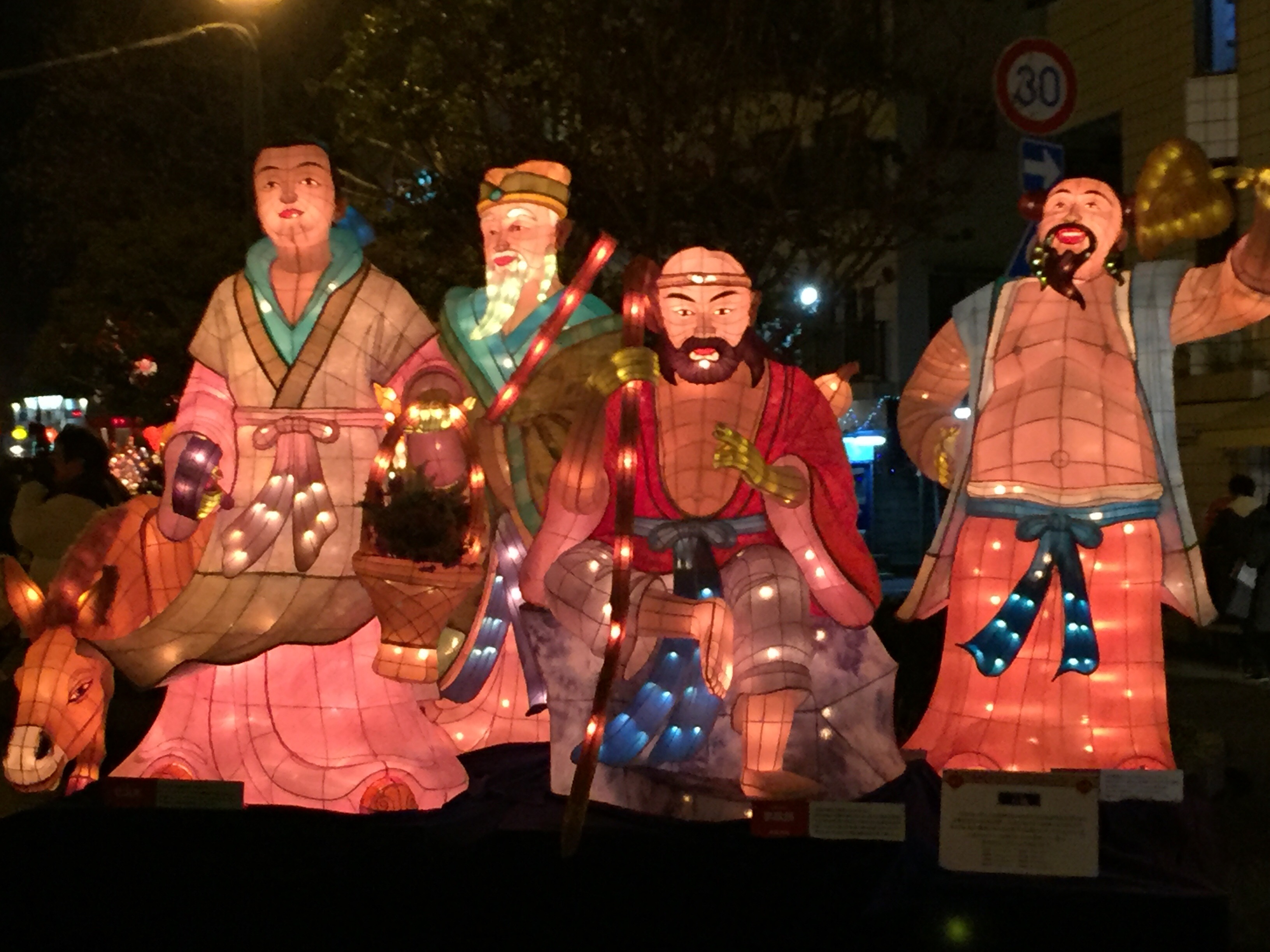
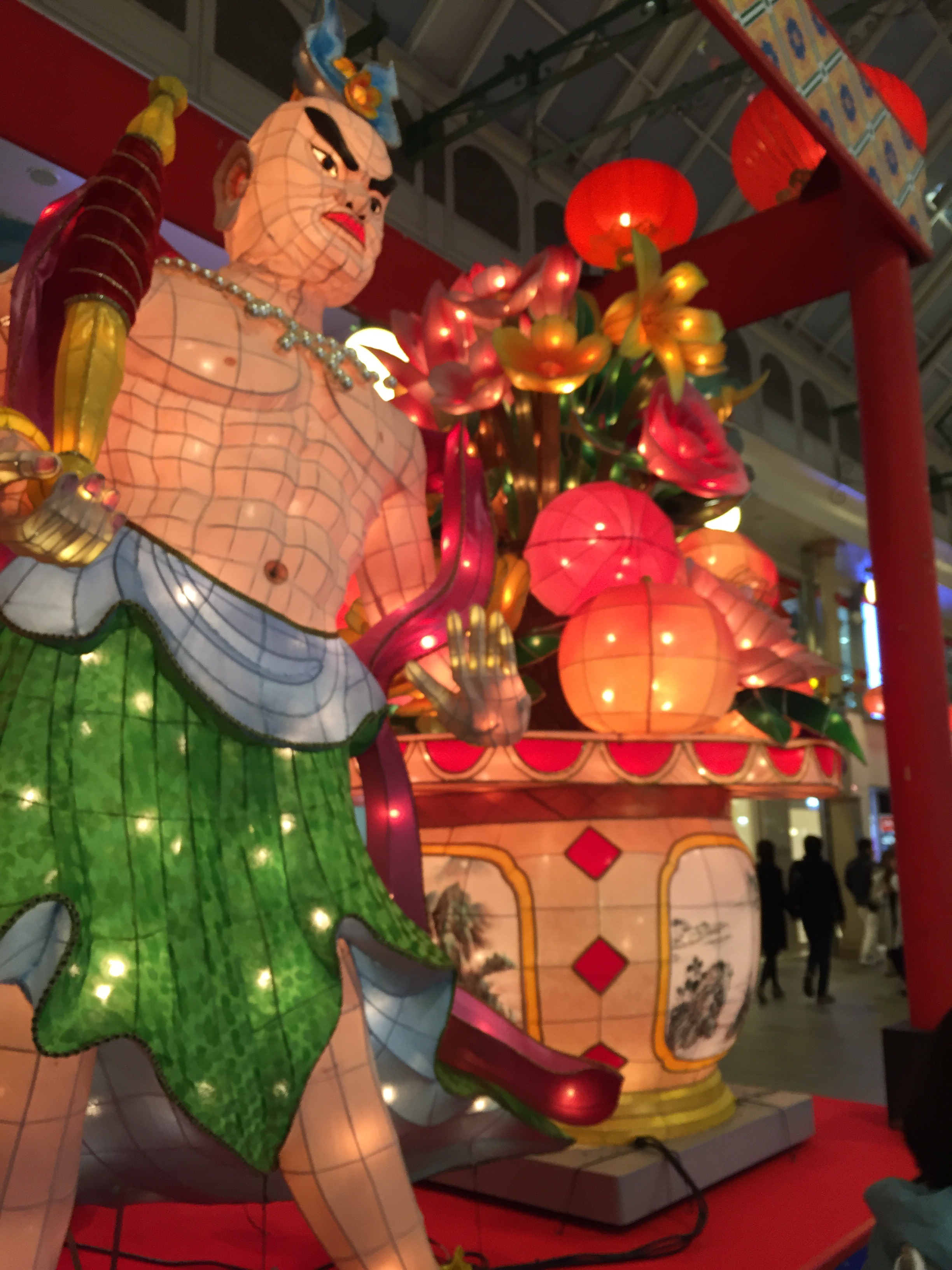
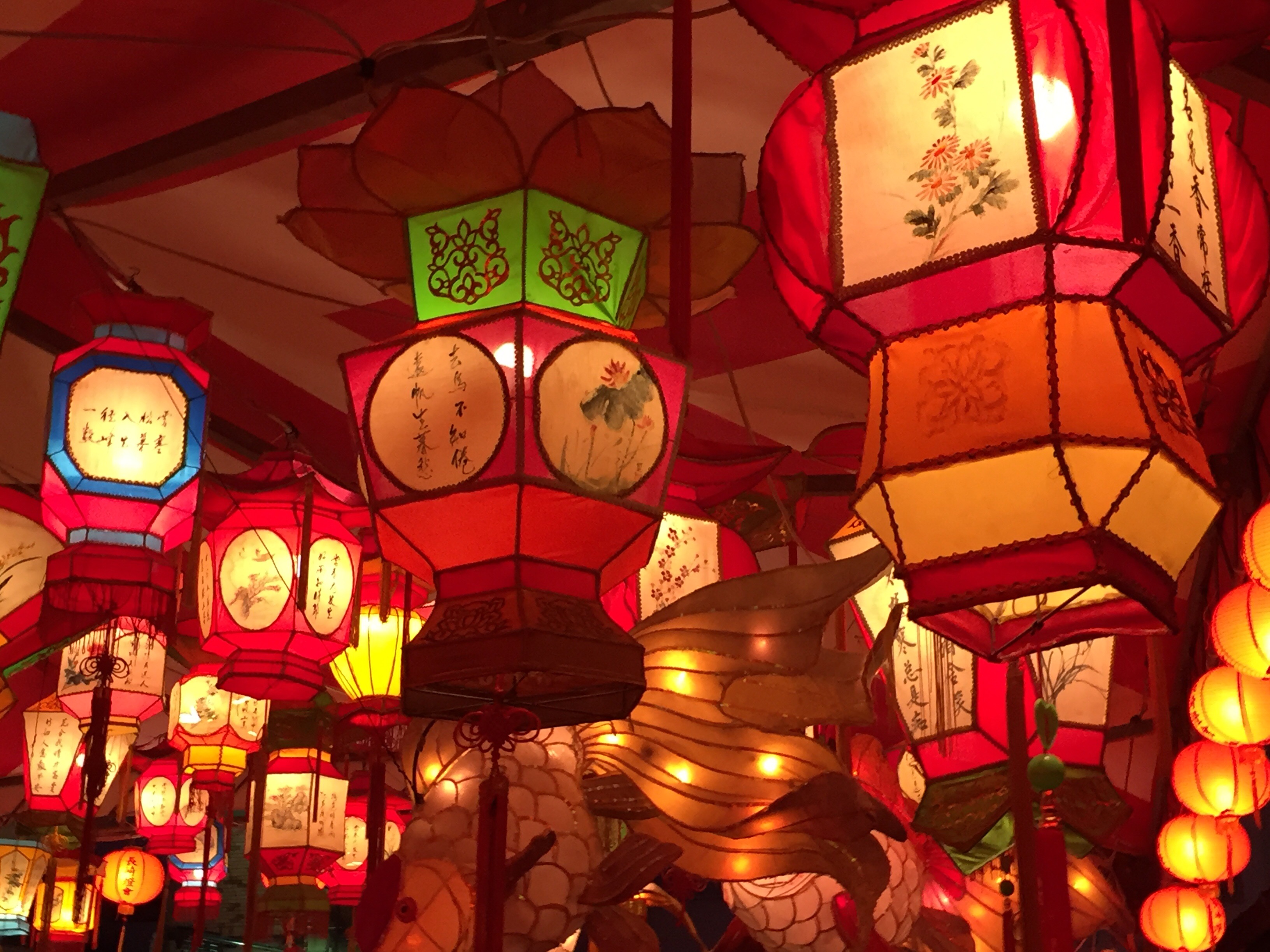
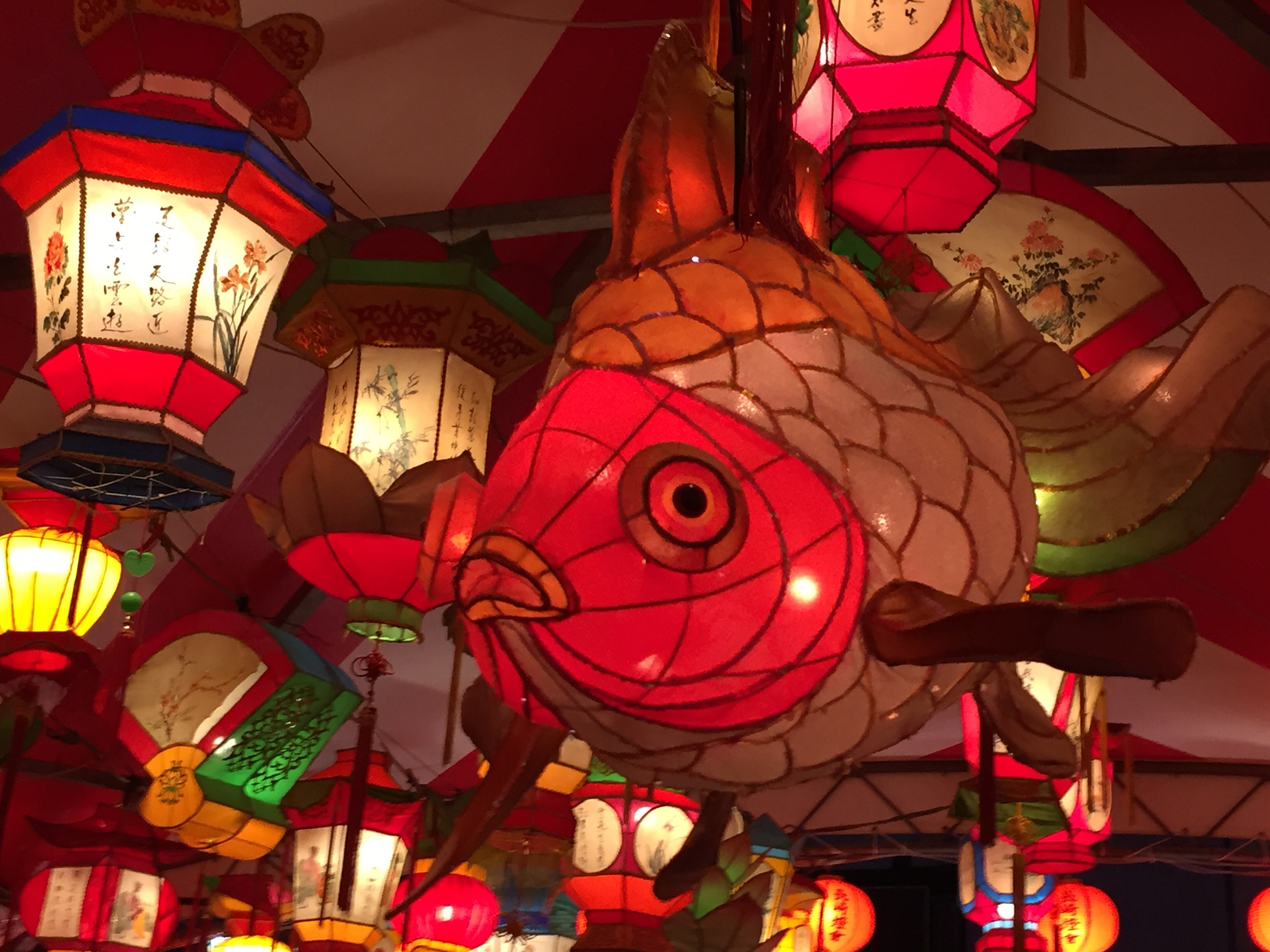
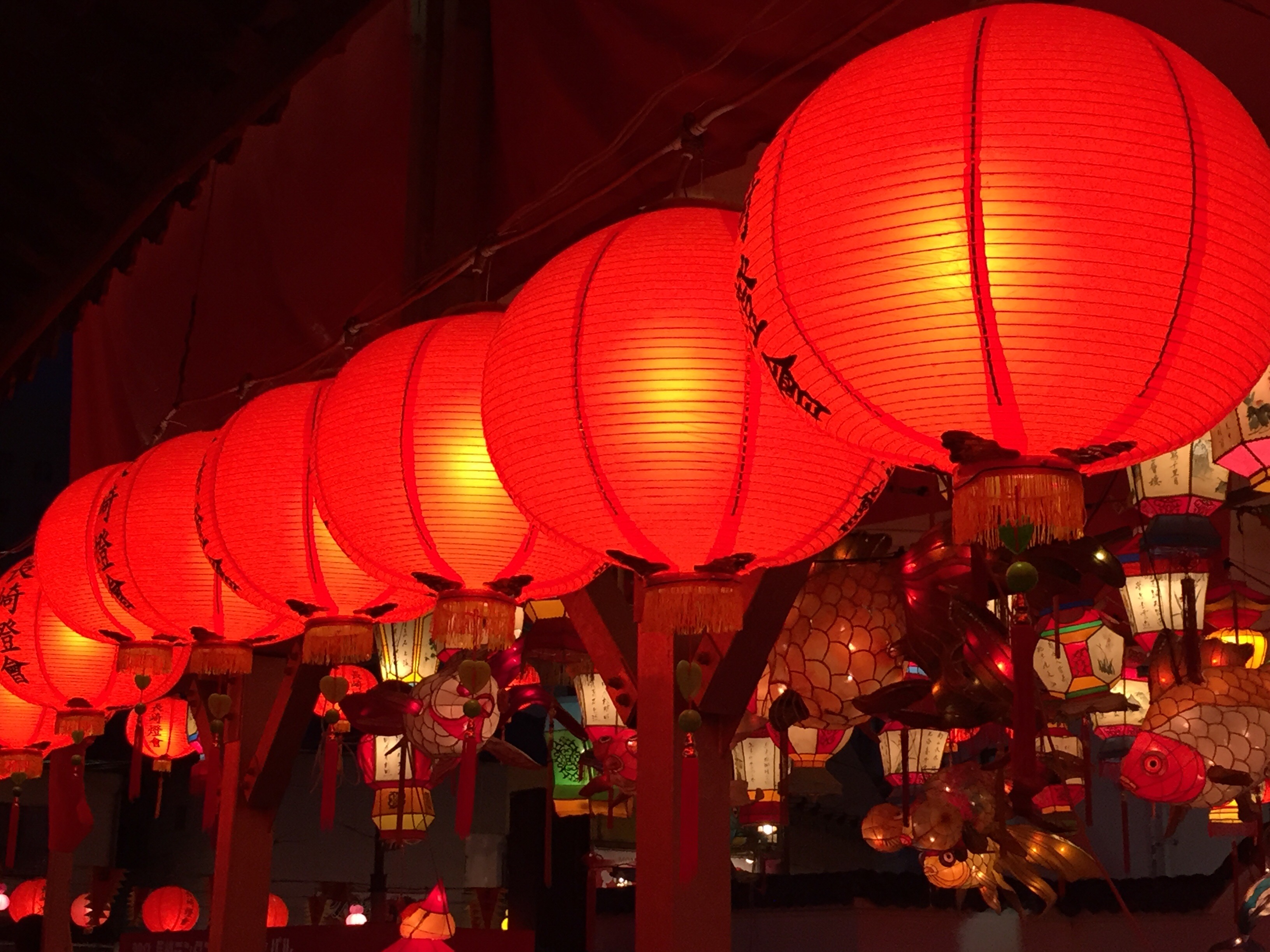
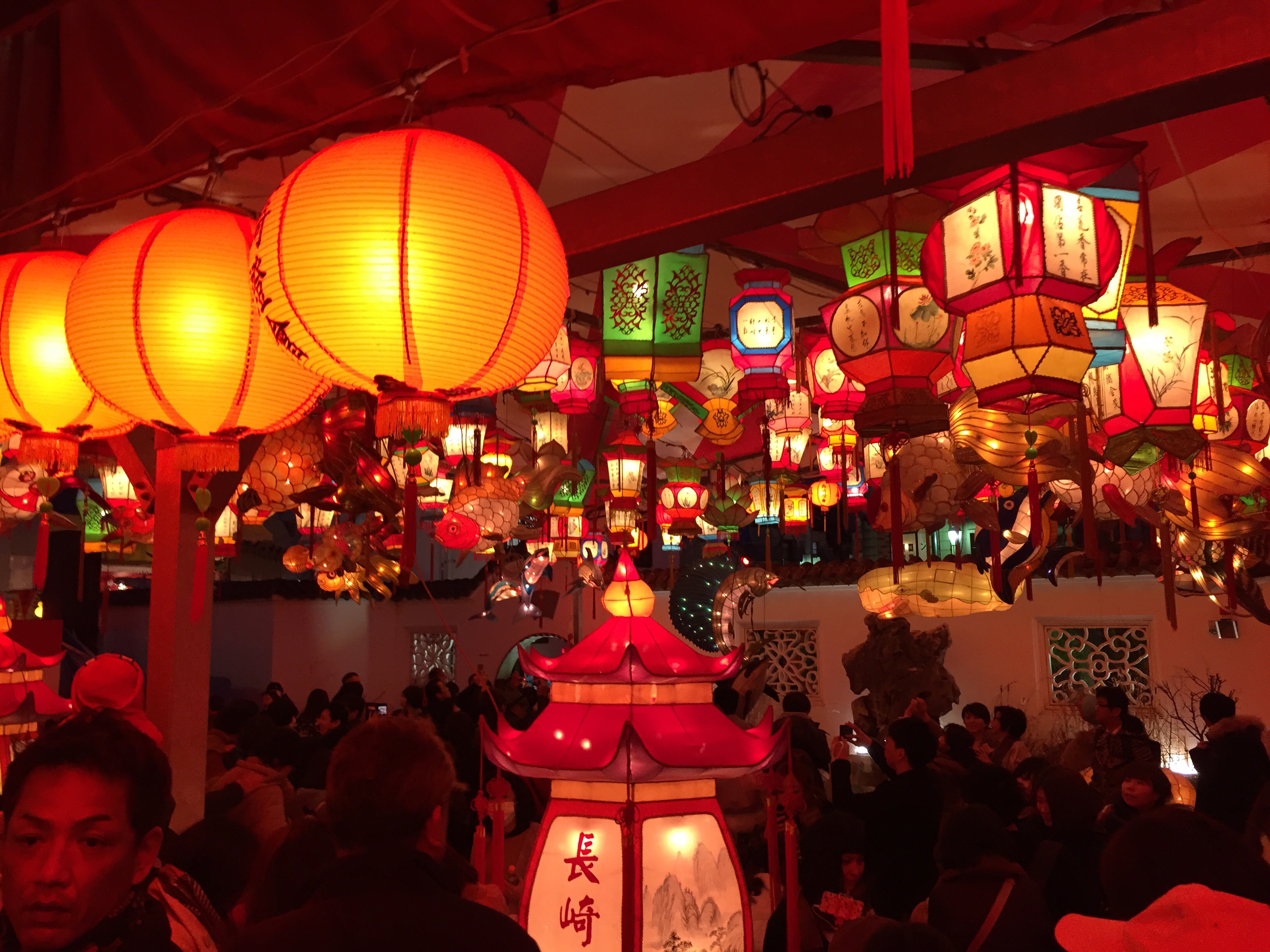
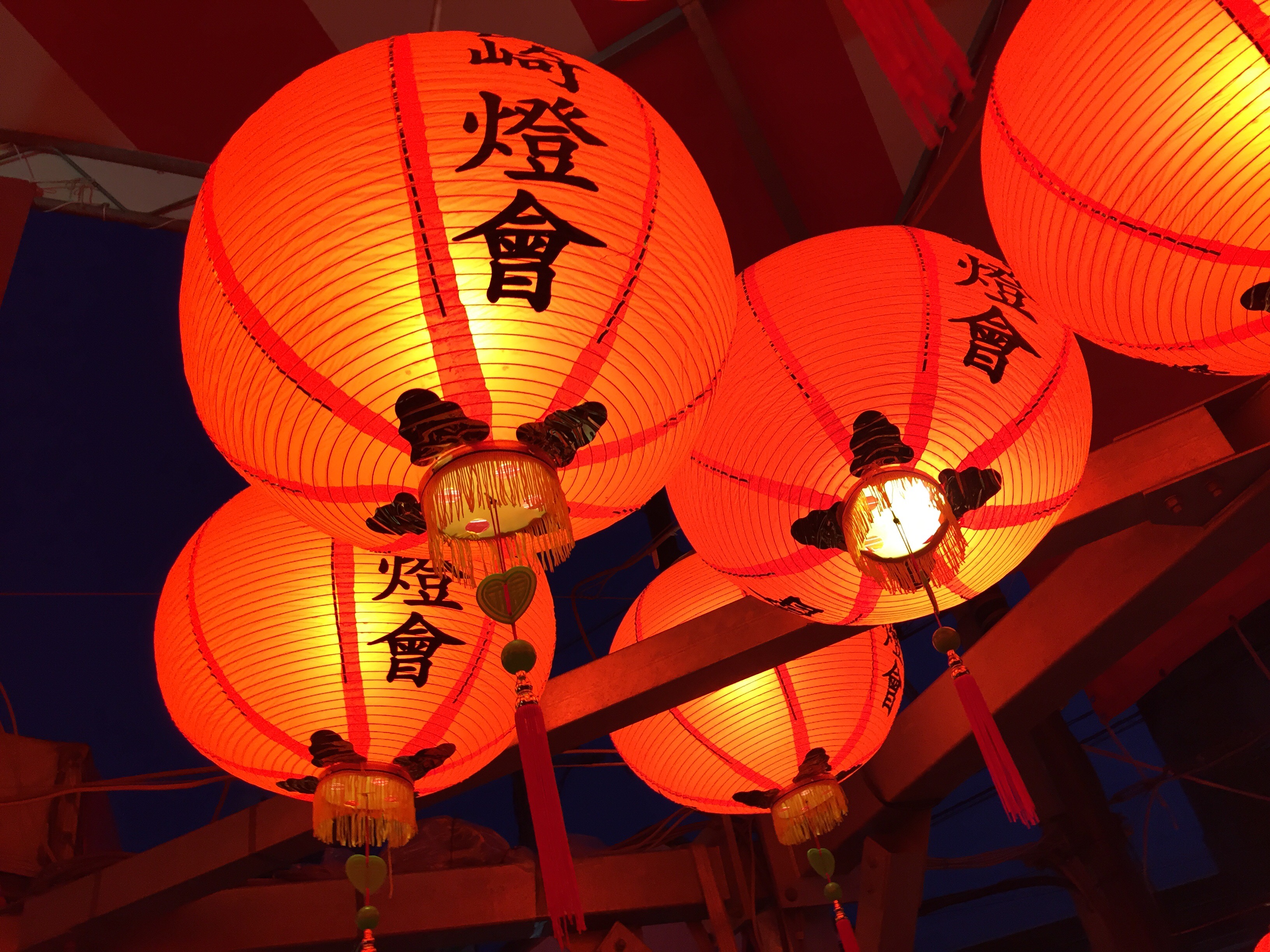
    Nagasaki City, in Kyushu Japan, celebrates The Lantern Festival every Chinese New Year.

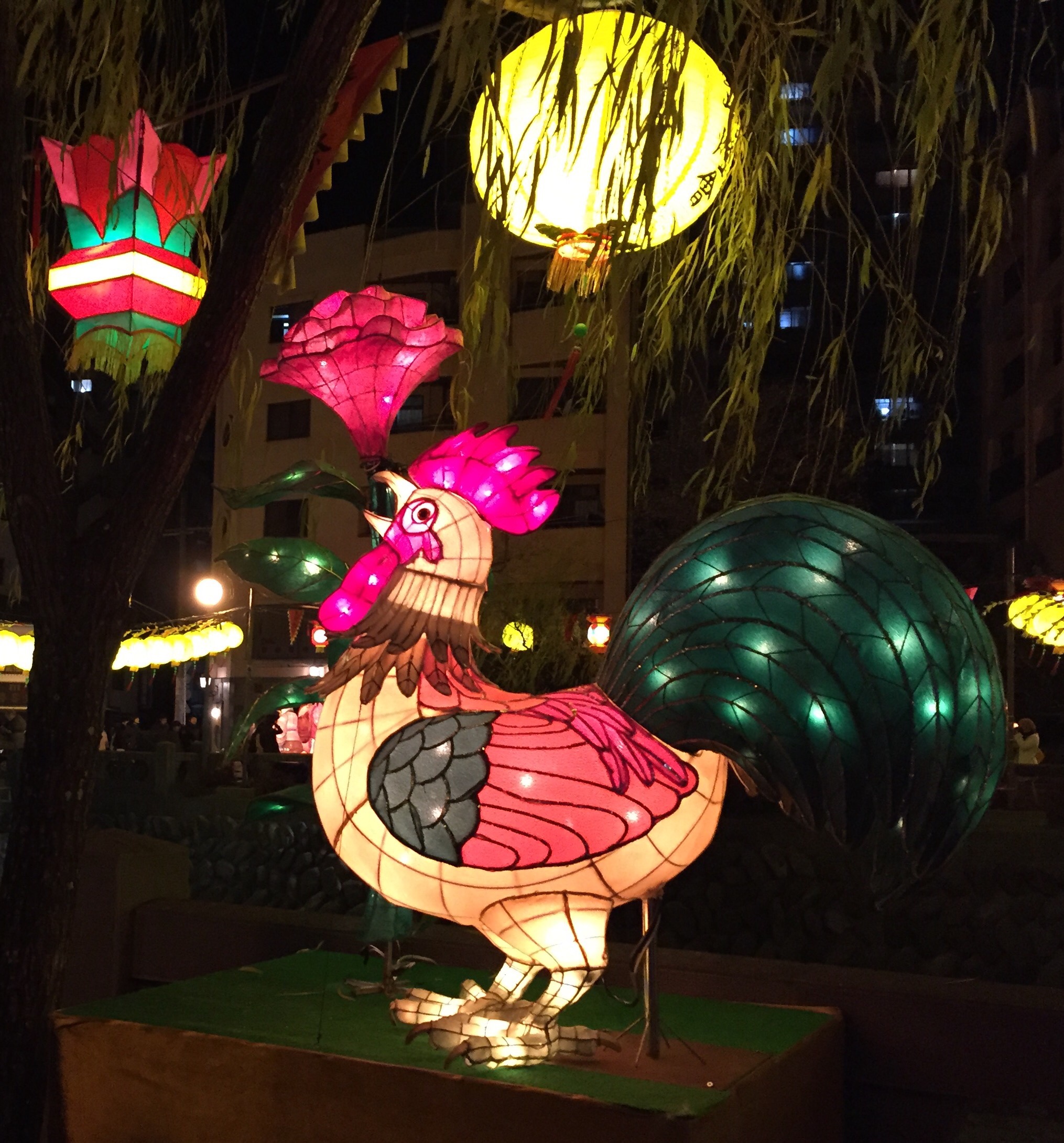
    This year, the Year of the Rooster, celebrated on January 28,2016, marks the opening of the two-week Chinese Lantern Festival in Nagasaki.

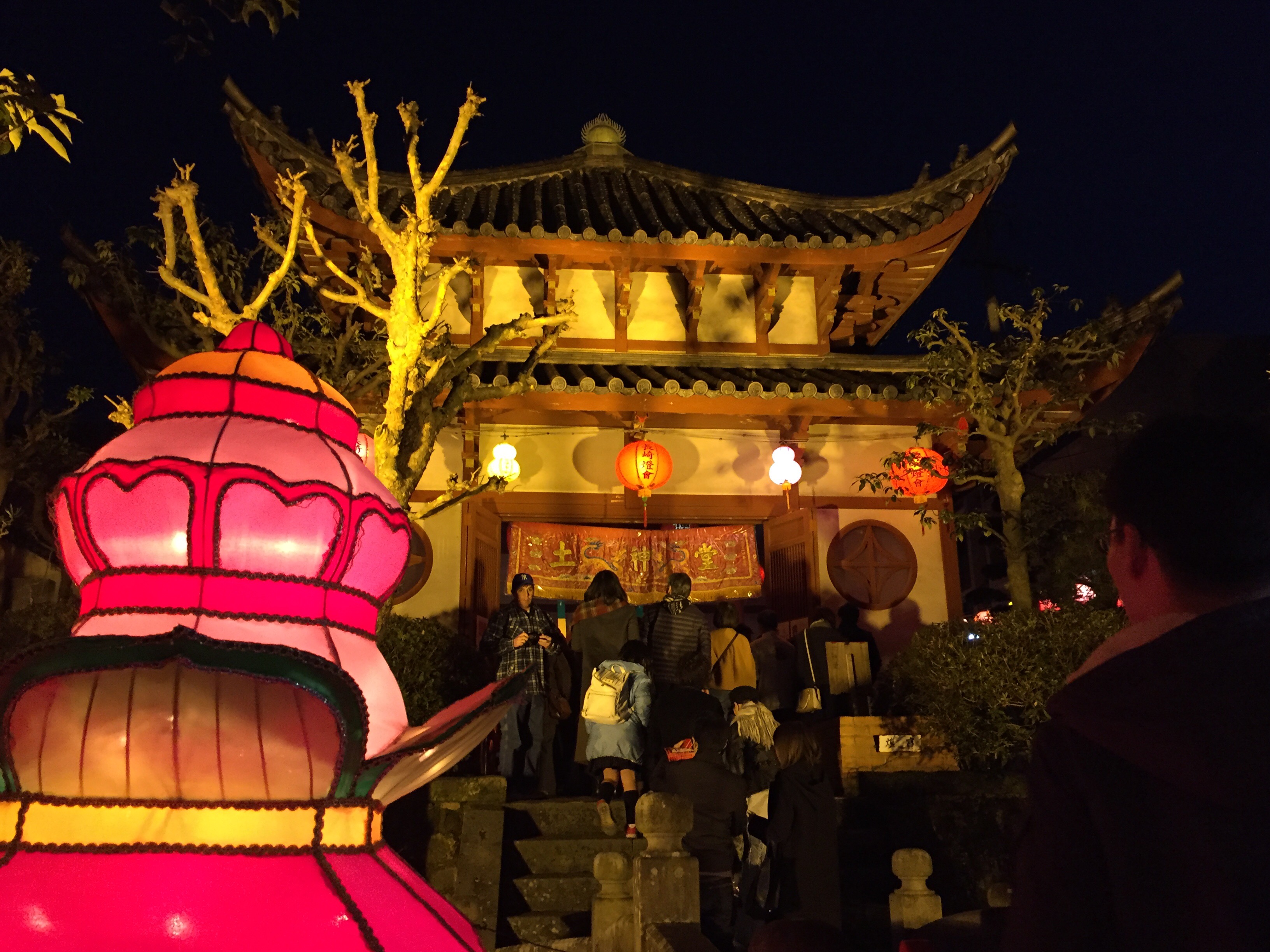
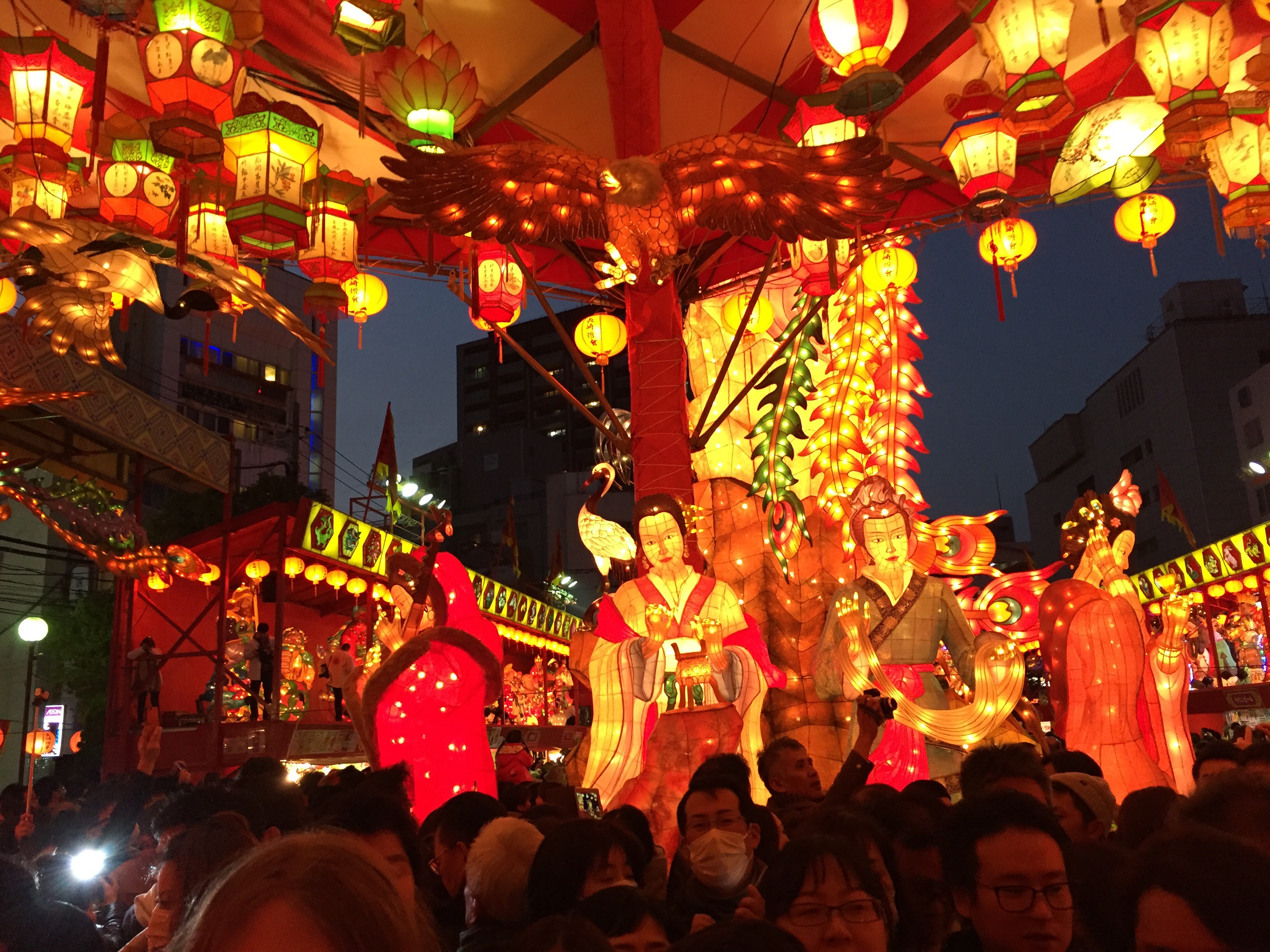
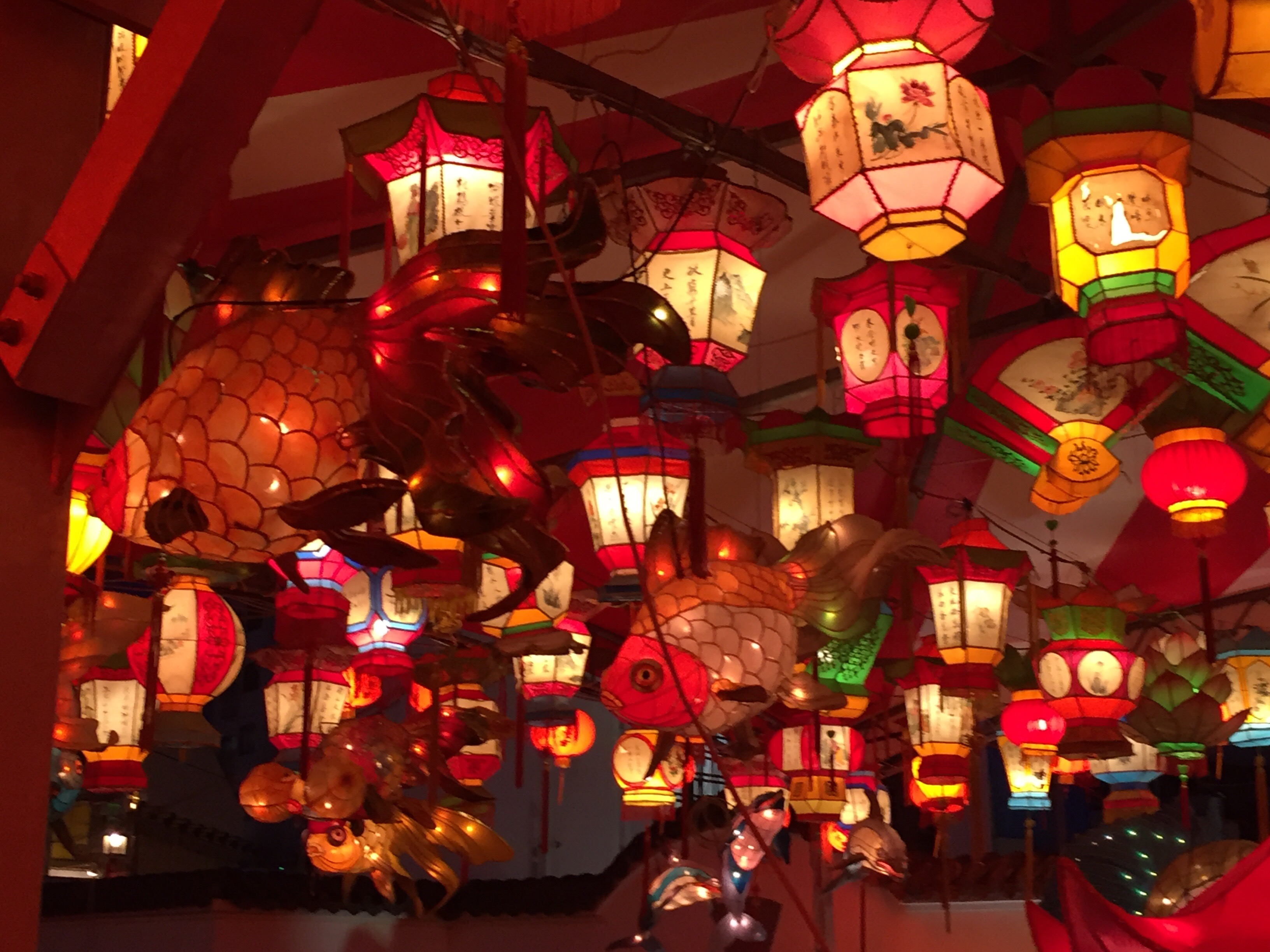
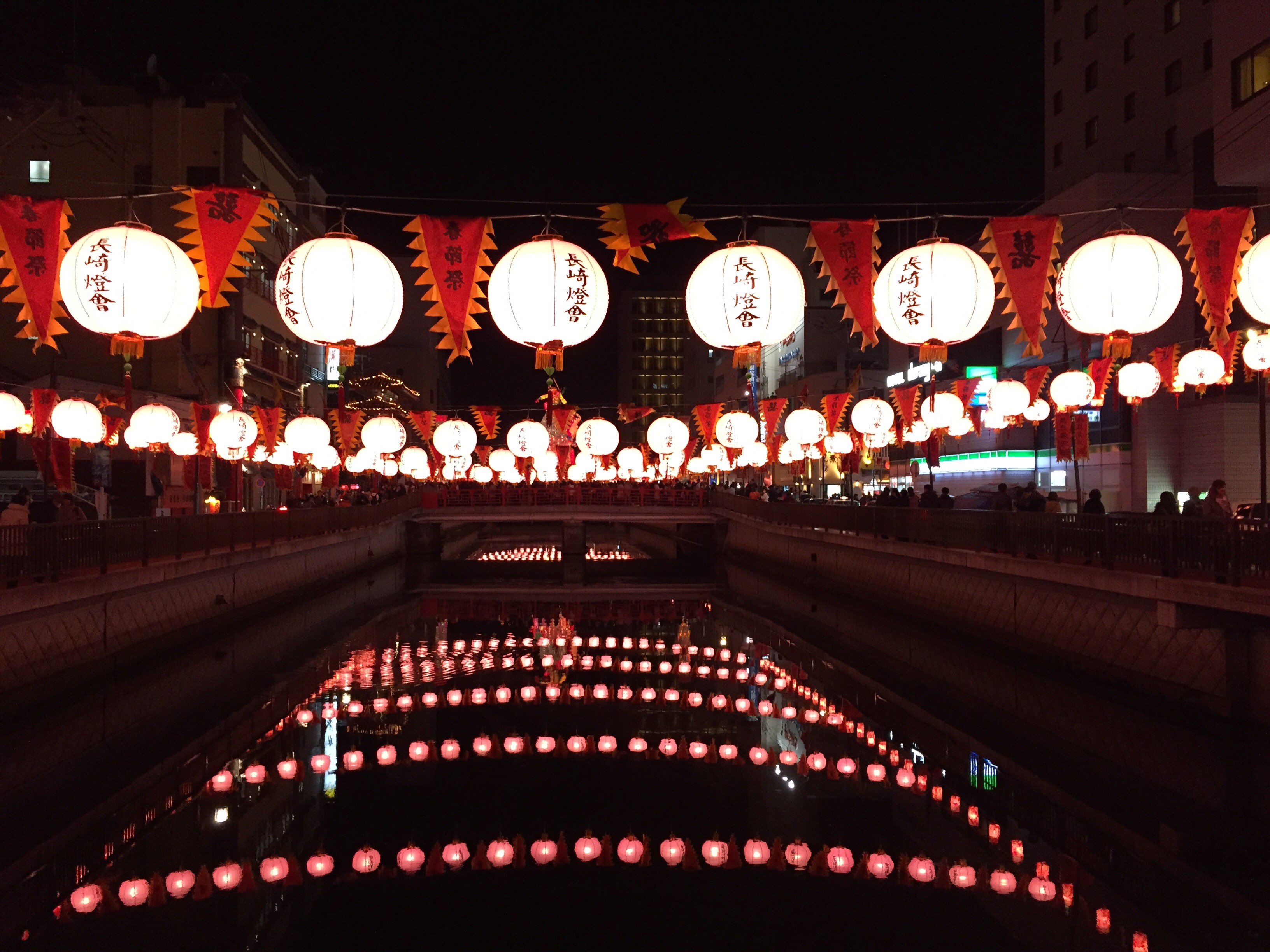
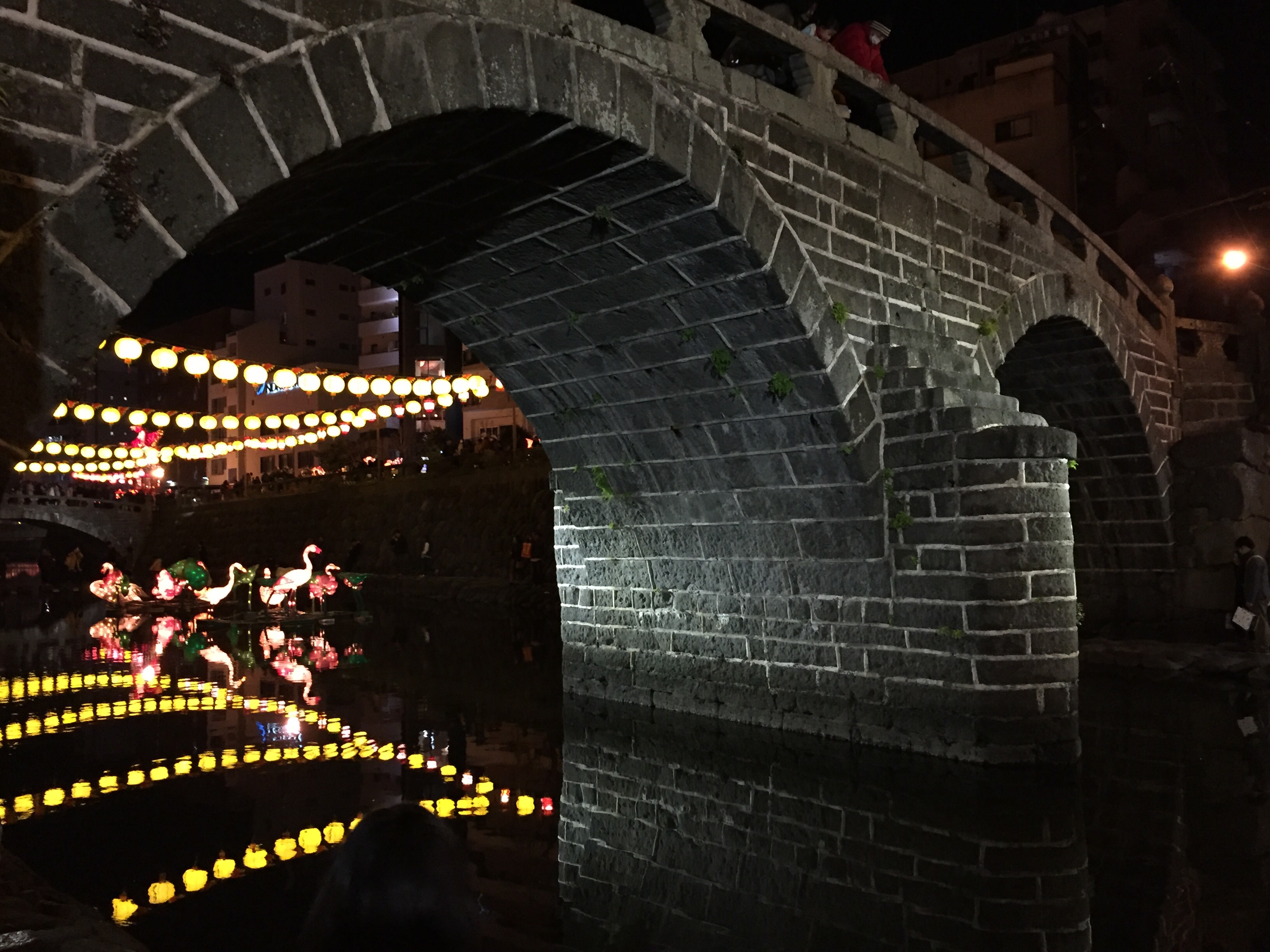
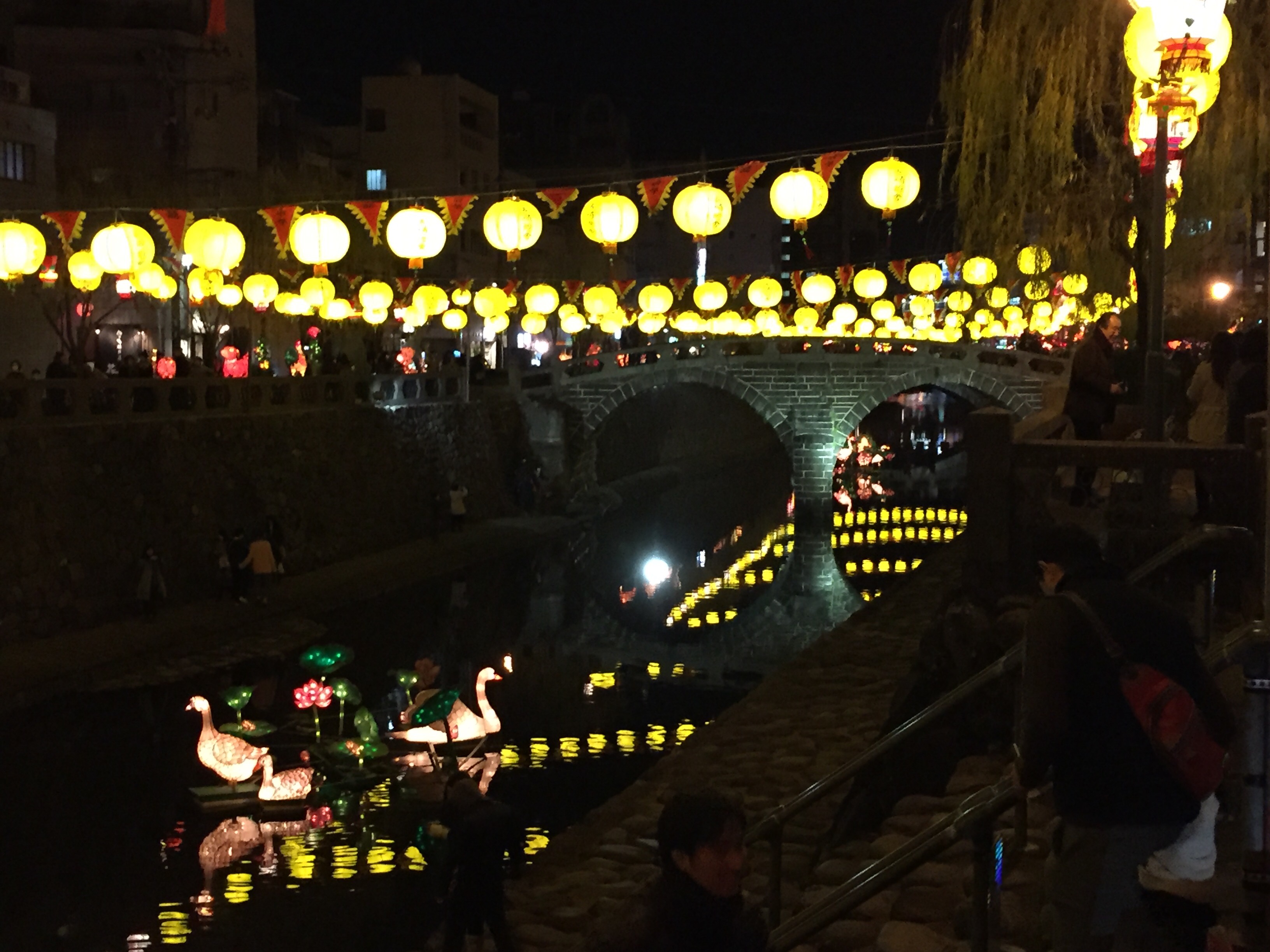
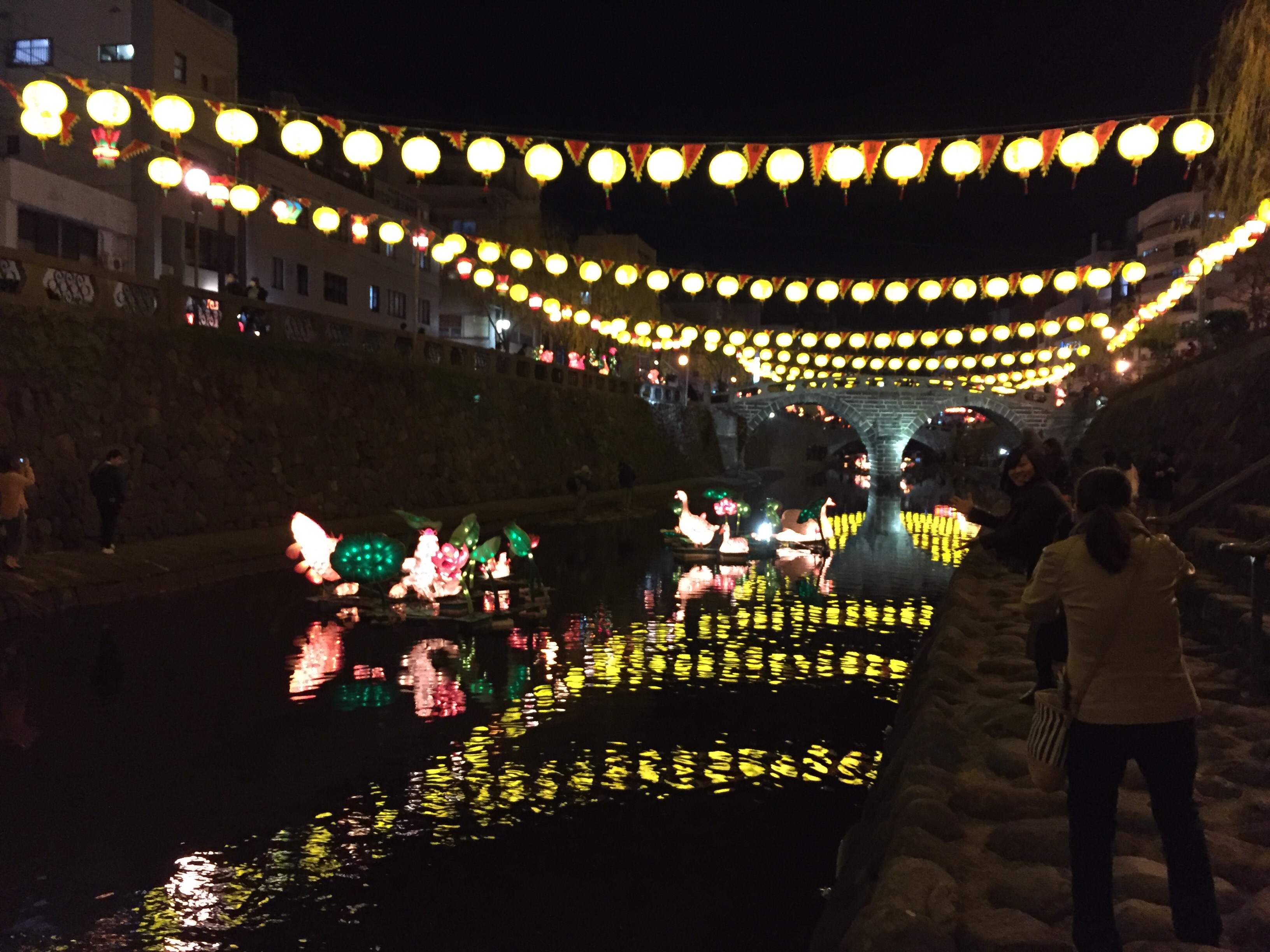
    Below are some of the photos I took. Yes, its only a few because I take a lot of photos like crazy. Blame it to the aspiring photographer in me. Or maybe I just love festivals.

    [wpvideo qHmq4fD8]

    [wpvideo 2LYmyBYa]
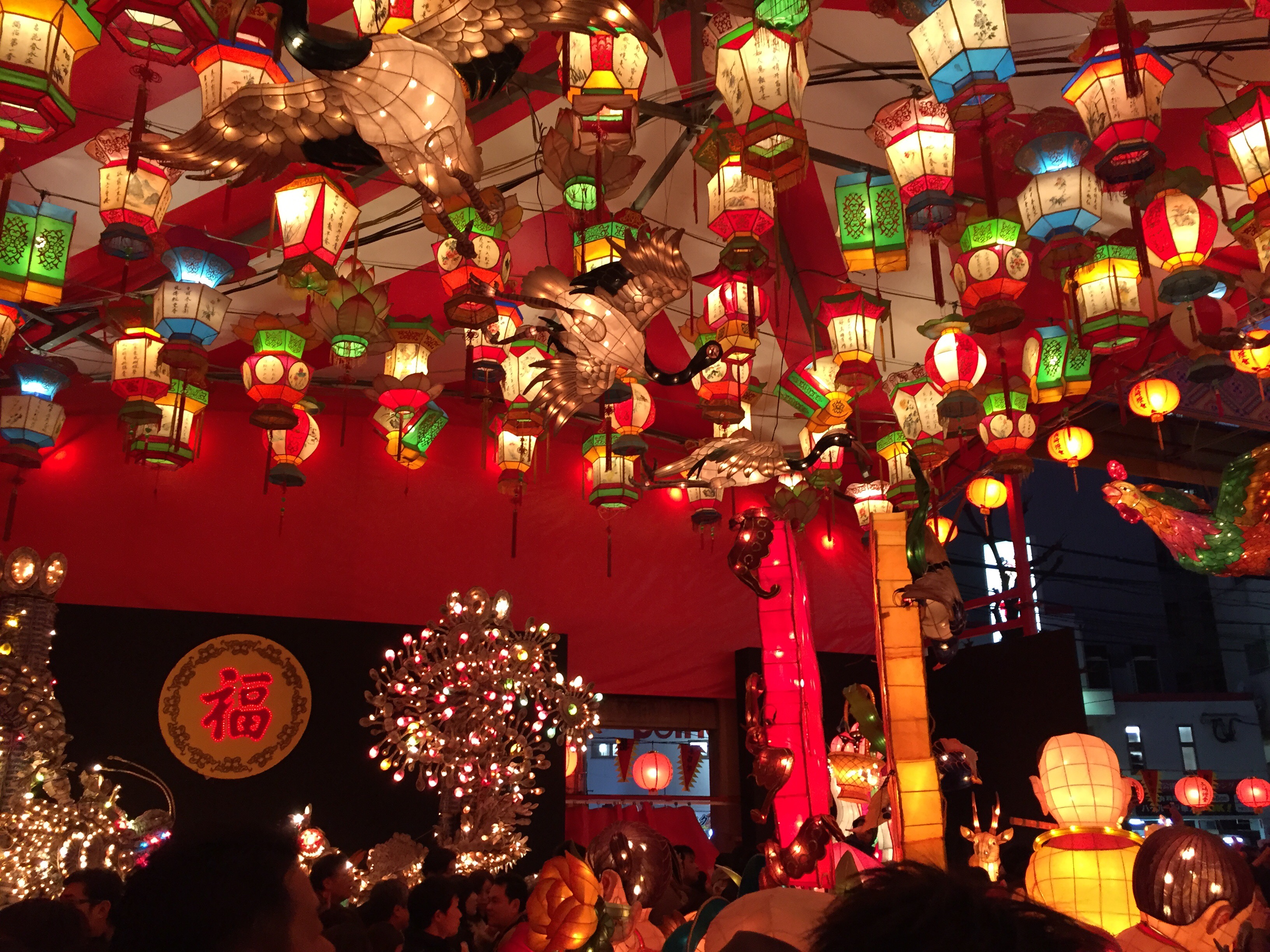
    The lanterns in Chinatown

    The place was filled with people. You can feel the festive mood.

    One of the giant lanterns that lit up the city.

    Another giant lantern.

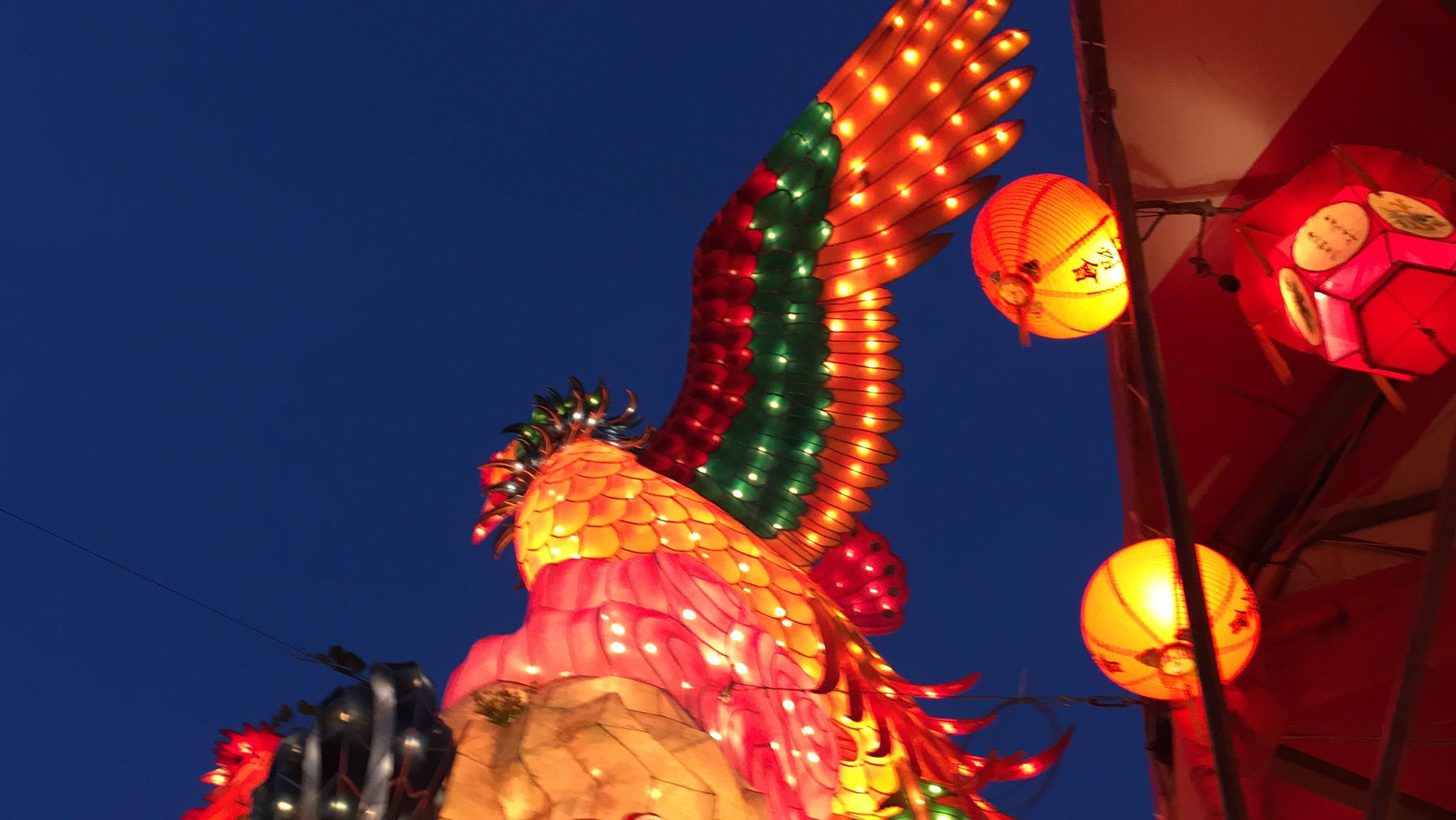
    This year’s animal.

    People climbing  up the stairs to the shrine to pray.

    Lanterns in close up.

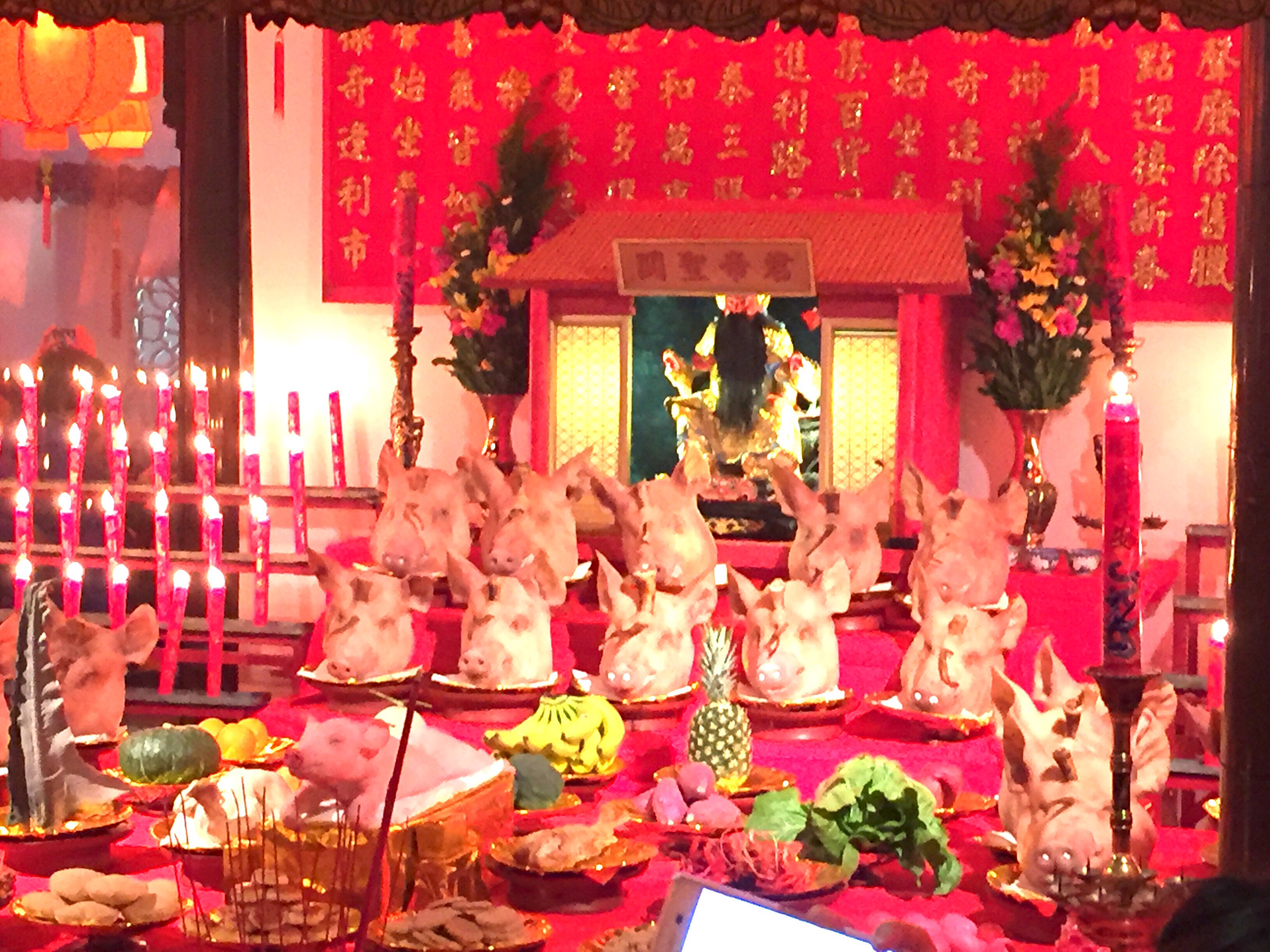
    The altar where a great crowd of people wanted to see (pray?).

    The dragon – symbol of Chinatown.

    The tallest lantern-the Rooster.

    The Megane Bashi. Megane is eyeglasses in Japanese. The bridge looks like an eyeglasses if seen from afar. The two arches with its reflection on the water look like eyeglasses.