How I learned Japanese in 3 months

When I came to visit for one month in 2011, I learned a few more words.
Words that are used in everyday life:
ohayou gozaimasu (good morning)
konichiwa (hello)
konbanwa (good evening)
oyasumi (good night)
itadakimasu (grace before meal)
gochisosamadeshita (grace after meal).
ittekimasu (I’m going – when leaving the house)
itterashai (take care – to someone leaving the house)
tadaima (I’m home)
okaeri (I’m happy your back in the house)
And words used by my sister raising her children (just by listening to her everyday)
oide (come here)
dame (No/not allowed)
yamete (stop)
abunai (dangerous)
hamigaki (brush your teeth)
shukudai (homework)
tabete (eat)
sugui (wow)
The following year when I came back as a government scholar, learning Japanese was the main objective for the first semester.
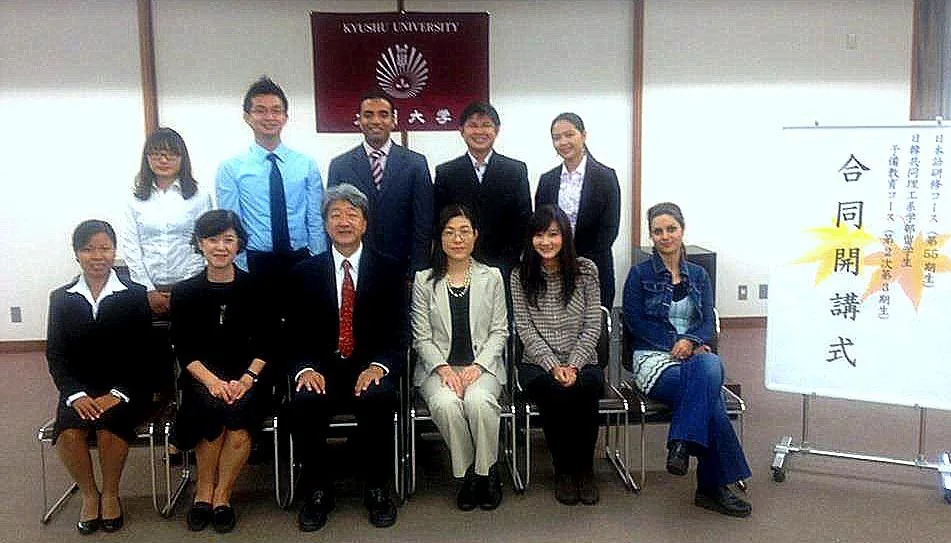
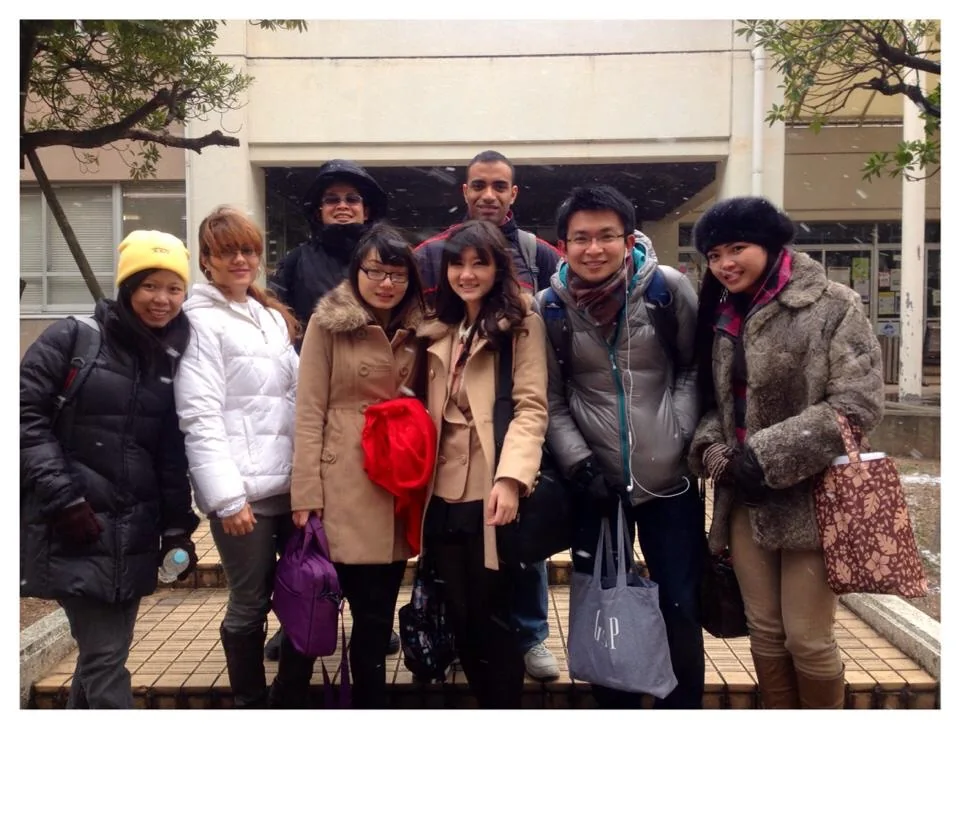
We were eight students in our class. One from each country: Philippines (me), Myanmar, Thailand, Iran, Laos, Egypt, Malaysia, and China.
So, how did I learn Japanese? Let me enumerate the methods below.
1. Memorize hiragana and katakana. These are the basics like the alphabet. Katakana are for foreign/loan words and hiragana are for Japanese words. My university asked me to memorize katakana and hiragana even before coming to Japan. I can’t remember exactly if it was both or just one of the two but I’m sure it was the first task as a student.
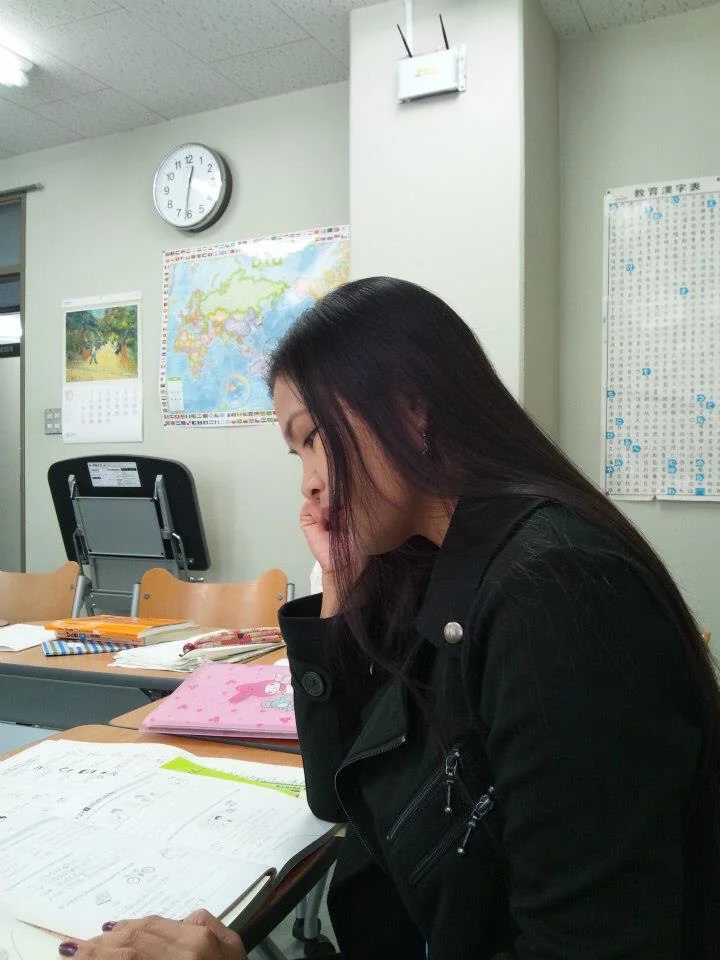
2. Increase vocabulary. By mastering hiragana and katakana, I learned to read words and thus increased my vocabulary. In my university, we were taught tons of new words everyday like twenty to thirty words depending on the lesson. We have to master those words because we were given a quiz everyday, five to ten words. And if we make a mistake, we had to write the words several times to fit on a whole sheet of paper. You don’t wanna do that, trust me.
Photo unavailable in the source archive.reading stories and learning the dreaded kanji.
3. Conversation practice. This is the most important part, putting the learned language into practice. In my class, we always have kaiwa no renshu (conversation practice). We were paired with our classmates to do specific conversations and sometimes converse with the teacher. There was a recorded kaiwa test where we had to talk to the teacher and answer her questions. We listened to the record for evaluation.
4. Make a (PowerPoint) presentation. Believe it or not, with very little vocabulary, we were told to make a presentation of our country almost every week. The purpose is to increase vocabulary, share our culture and gain confidence in speaking. We had Japanese tutors who helped us in our Japanese. I remember the first presentation was Watashi no Kuni no Asagohan (My Country’s Breakfast). We also presented about our countries houses, tourist spots and many more. And the final presentation- about our major.
5. Write a diary. Once a week, every Monday, we were asked to submit a diary. This was also very hard in the beginning because of not enough vocabulary and knowledge of the language. But this really helped us learn the language on our own, translating every word and sentences we wanted to say in Japanese. This was when google translate became handy. And the app imiwa? is also very helpful. I highly recommend it. After the teacher checked our composition, we were asked to read it in front of everybody. Oh, I still remember a few times I couldn’t read my own writing. Lol.
6. Watch movies and anime. This was my way to learn Japanese outside of class. Even before coming to Japan, I started watching Japanese movies and anime. A few of my favorites are Sen to Chihiro no Kamikakushi (Spirited Away), Hotaru no Hakka (Grave of the Fireflies), and Hachiko. I watched it in Japanese with English subtitles. I know it’s hard to learn a language this way but I kind of picked up some Japanese words and phrases. I was drowned in tears with the last two movies. My ultimate favorite anime is Chibi Maruko – which I still watch even up to now. I used to watch it everyday. I learned many things from Chibi Maruko- from daily Japanese family life to school life and events and Japanese culture and celebrations. The language used is fairly easy too because the main character is a third grade student.
7. Talk to locals. There’s no better way to learn a language than using it to talk to the natives. You will be surprised how much you will learn naturally by engaging in conversations with the Japanese. I learned a lot talking to my Japanese tutor and my Japanese friends words and phrases I never learned in class. I was advised to have more Japanese friends and spend more time with them than hanging out with fellow foreigners/kababayan where you tend to use English or Filipino/Bisaya.
Japanese Intensive Course
I started learning Japanese officially in late October 2012 and we finished in early February 2013. It was called the Japanese Intensive Course. I salute all my teachers. They were all really good.
During that rough three months, I learned to speak basic conversational Japanese and I was even able to give a (memorized) speech in full Japanese at the podium in front of everyone during the closing ceremony.
Never Enough
But, that was not enough. Japanese is a difficult language to master given that it uses many characters – hiragana, katakana, romaji and kanji, and it has many forms – basic, polite and honorific.
Lifelong Learning
Even after more than seven years I am still trying to learn more. I learn new words by dealing with everyday life – medical terms when I got sick and when I gave birth, construction and real estate terms, bank terms, neighborhood association terms and the list goes on.
It’s like filling a sack with grains everyday. But the sack will never get full but surely the grains will get plenty enough to survive.
Reader responses