It’s official — my first children’s book is now on Amazon!
I’m a Filipino mom raising my daughter, Mari, here in Japan. At home, our languages mix every day — English, Tagalog, Bisaya, and Japanese all live under one roof. I kept looking for a picture book that sounded like our family, one where Mari could see her own languages side by side on the same page. I couldn’t find it. So I made it.
About the book
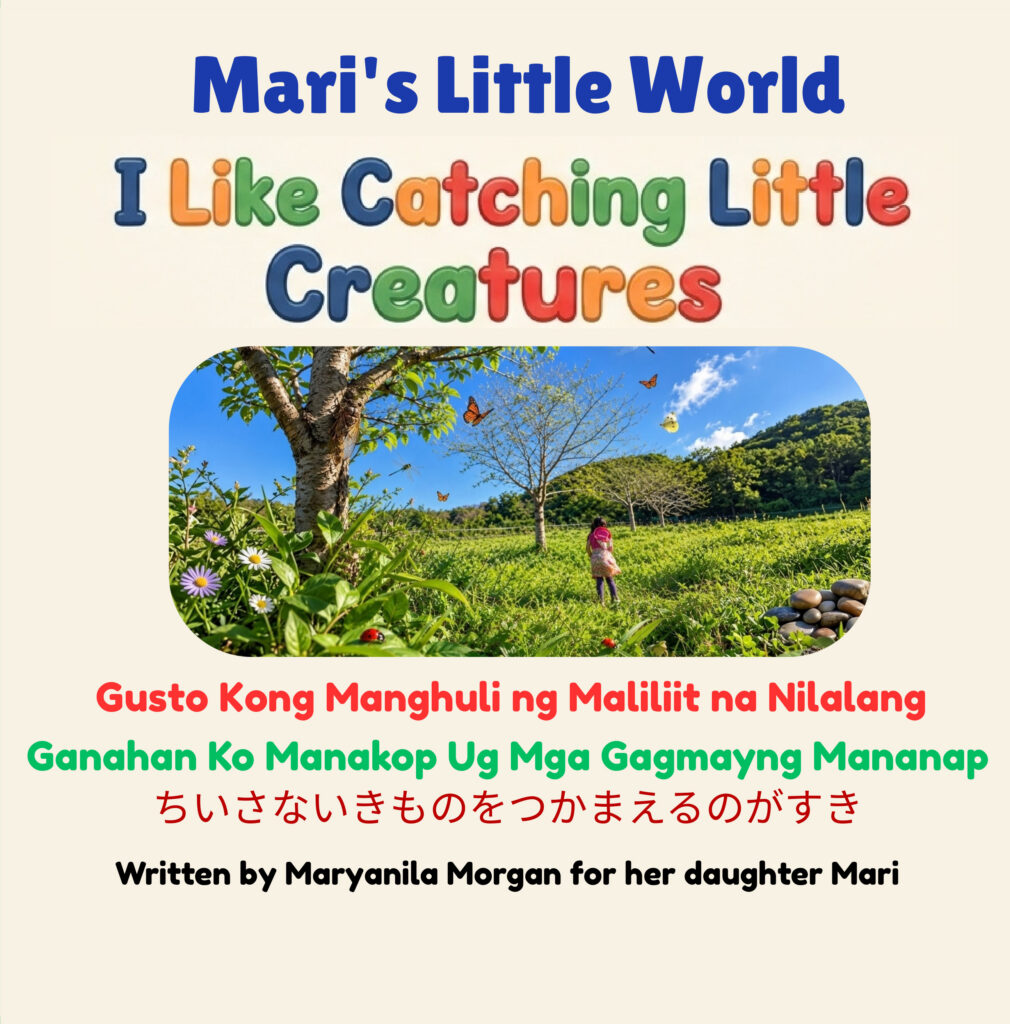
Mari’s Little World — I Like Catching Little Creatures is a picture book of real photos of Mari exploring the garden and catching the little creatures she loves: a dragonfly, a butterfly, a mantis, a grasshopper, a roly-poly, a cicada, a frog, and a ladybug.
Every creature’s name appears in four languages — English, Tagalog, Cebuano (Bisaya), and Japanese (with romaji, so anyone can read the Japanese aloud). Butterfly, for example, is Paru-paro in Tagalog, Alibangbang in Bisaya, and ちょうちょ (Chocho) in Japanese.
And because Mari loves hide-and-seek, the book is a game, too — 33 little creatures are hiding throughout the pages, waiting for young readers to find them all.
The honest part
I’m a teacher, not a publisher. I wrote this book, took the photos over the years as Mari grew, and then learned publishing as I went — mistakes, fixes, late nights and all. Seeing it finally live, with Mari’s name in the title, still feels a little unreal.
Book 2 is already growing in the garden, too — this time, it’s all about colors.
Where to find it
Mari’s Little World — I Like Catching Little Creatures is available on Amazon in paperback and Kindle:
- Paperback: https://www.amazon.co.jp/dp/B0HPJQ1PNV
- Kindle: https://www.amazon.co.jp/dp/B0HPBJHVY9
If you read it with your little one, I would be so happy to hear which creature they found first.
What languages does your family speak at home? I’d love to read your answers in the comments.
Reader responses