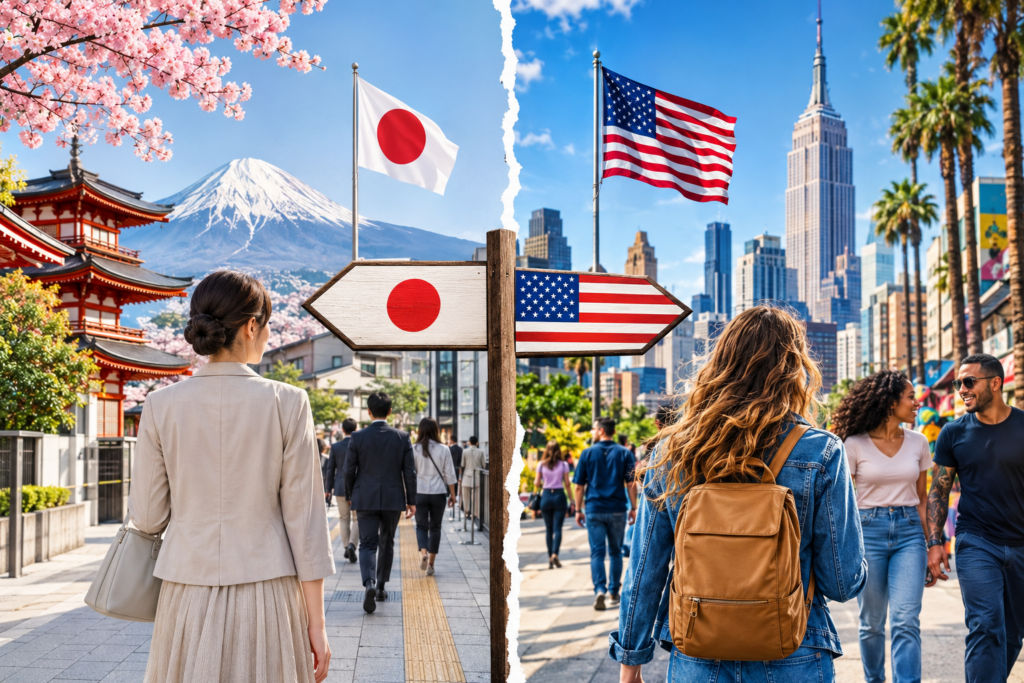
Having lived in Japan for more than a decade and being married to an American citizen, I have had the opportunity to experience and observe the stark contrast in language, expression, individuality, and uniformity as distinctive characteristics of both countries.
In Japan, people are taught to follow the rules without question, maintain 平和 (heiwa)—peace—through conformity, and show respect as the highest form of social relationship.
It is evident in the way they dress. Subtle colors are generally preferred over loud ones. Standing out from the crowd is not encouraged but rather avoided.
Blending in is the social norm. Uniformity is valued over individuality. No one wants to be the nail that sticks out because, as the saying goes, it will be struck.
You don’t want to 目立つ (medatsu)—to stand out.
You don’t want to cause 迷惑 (meiwaku)—trouble or inconvenience to others.
The rules are what shape society, and many of them are never written. They are the silent rules that people simply know and follow.
This is also evident in the Japanese language itself, where there are different levels of respect. The highest level uses honorific language. The longer the sentences and the more sophisticated the vocabulary, the greater the respect being expressed.
Customer service in Japan is among the finest in the world. Customers are often treated as if they are gods and are served with the utmost courtesy and honor.
In America, on the other hand, people are encouraged to speak their minds through discussion and open communication. Individuality is valued more than uniformity.
You can be different, and that is considered beautiful. You can express your opinions, and that is acceptable—expected, even.
This is also reflected in the way people dress. You can wear whatever is comfortable, whatever makes you happy, and whatever expresses who you are. Braided hair, tattoos, unusual clothes, slippers? Go ahead.
Communication is also plain and direct. Say what’s on your mind. Ask questions. Exchange ideas.
I was reminded of these contrasts again when we visited the USA this summer.
At the airport in Japan, a security officer silently motioned with his hand for incoming passengers to move to another line. Even though some passengers ignored him and stayed where they were, he didn’t say anything. He simply let them through.
At an airport in America, however, a security officer said bluntly, “There’s another line at the end, but I guess people are too lazy to walk over there. It’s the same thing. It’s the same line—you just have to walk.”
On a bus in the USA, the driver explained the route to the passengers before departing. At the end of her announcement, she added, “If you need to use the restroom, there’s one at the back of the bus. I really hope you don’t use that one and instead use the ones at the stopovers so I don’t have to clean it myself.”
In Japan, you would never hear a bus driver say something like that to passengers, who are, after all, customers. But here in the USA, nobody seemed to mind. The driver simply said what she meant, and it was perfectly acceptable.
If someone said that in Japan, the driver might even lose her job. More than that, it is simply unimaginable for a Japanese bus driver to speak to passengers in that way.
These little differences fascinate me.
It doesn’t mean one culture is better than the other. They are simply different. Each reflects its own values, and each has shaped its people in unique ways.
And as someone who has the privilege of living between these two worlds, I find those differences endlessly interesting.
Reader responses